
Pan
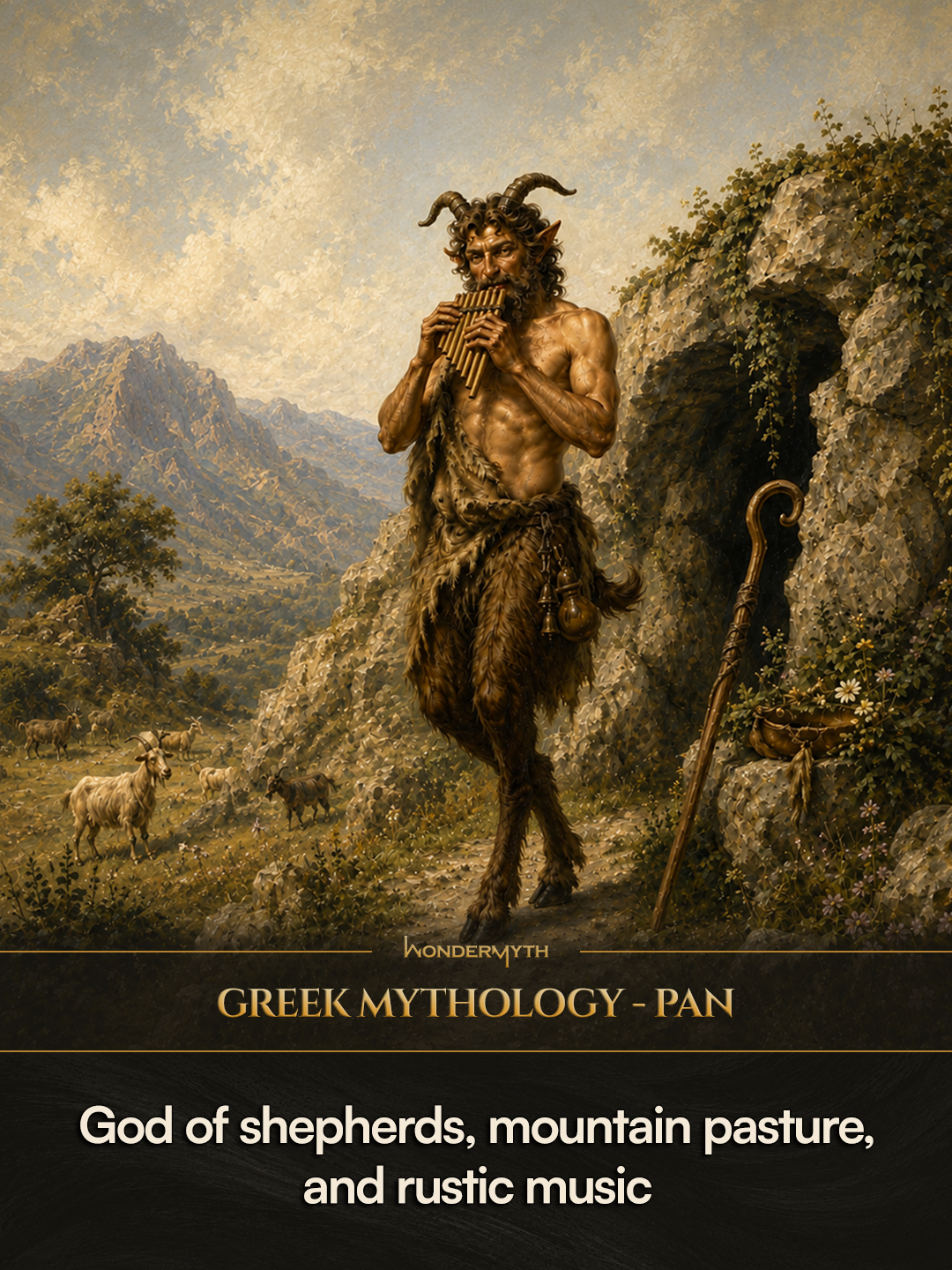
Pan is the Arcadian god of shepherds, mountain pasture, rustic music, and sudden fear. His goat-like body belongs to the borderland he inhabits, where human paths meet caves, flocks, nymphs, and wild country. His myths move between pleasure and alarm: music invites dance, but desire and unseen presence can turn the same landscape dangerous.
English pronunciation: PAN
Original name (Greek): Πάν
Transliteration: Pān
Who Was Pan?
Pan is an immortal Greek god whose oldest identity is rooted in Arcadia. Although the Homeric Hymn to Pan brings him before the gods on Olympus, he is not one of the Twelve Olympians.
Pan’s hybrid body places him at the boundary between settled pastoral life and uncultivated mountain country. He is divine but visibly animal, and his myths repeatedly bring together pastoral protection, rustic pleasure, sudden fear, and uncontrolled desire. This tension makes him distinct: he belongs to the world of shepherds while remaining part of the wild country beyond it.
Origins & Family
In the Homeric Hymn to Pan, Pan is the son of Hermes and an unnamed daughter of Dryops. The story places his birth within an Arcadian pastoral setting while Hermes tends sheep, tying the god’s family origin to the same landscape that defines his later identity. Hermes accepts the unusual child and presents him to the gods on Olympus.
Herodotus records a separate tradition in which Pan is the son of Hermes and Penelope.
Parents: Hermes and an unnamed daughter of Dryops.
Domains, Appearance & Symbols
Domains & Roles
Pan’s domains are specific rather than universal. His power belongs to shepherds, flocks, mountain pasture, caves, hunting, and paths beyond cultivated land. He sings, plays the syrinx, joins nymphs in dance, and sometimes enters musical rivalry. He can also break order through sudden fear. In local traditions, he gives oracles through a nymph and sends dreams that reveal a cure.
Appearance
Ancient artists identify Pan through horns, goat ears, a tail, facial hair, and the syrinx, but his degree of animality changes from image to image. A Classical Attic hydria gives him human feet alongside horns, animal ears, and a tail, while later sculpture often shows goat legs and a shaggy, bearded body. He may appear youthful or mature, so no single age or body type defines him.
Symbols
• Syrinx or reed pipes: Pan’s defining musical attribute, formed in Ovid’s Syrinx story from reeds into which the fleeing nymph is transformed.
• Goat horns, ears, legs, and tail: His clearest bodily markers, though ancient depictions do not always use all of them.
• Pastoral and hunting equipment: Ancient images may show Pan with crooks, throwing sticks, or skins, but no single item defines every depiction.
Key Myths
The Birth and Welcome of Pan
While tending sheep for a mortal man, Hermes fathers Pan with an unnamed daughter of Dryops. Pan is born with goat’s feet, horns, a beard, and a strange face, causing the woman tending him to flee. Hermes does not reject the child. He wraps Pan in hare skins and carries him to Olympus, where the gods delight in him, with Dionysus especially pleased. The myth joins Pan’s unusual body and pastoral origin with his full divine status.
Syrinx and the Reed Pipes
In Ovid’s account, Pan sees the Arcadian nymph Syrinx returning from Mount Lykaion and pursues her. She runs until a river blocks her escape, then calls on the river nymphs for help. As Pan reaches for her, Syrinx is transformed into marsh reeds. Wind passing through them makes a mournful sound, and Pan cuts reeds of unequal length and binds them with wax. The instrument keeps her name, joining Pan’s music to an unwanted pursuit and a bodily escape.
Pheidippides and the Athenian Cult of Pan
Before the Battle of Marathon, the Athenians send Pheidippides to Sparta. Near Mount Parthenion, Pan meets the runner and asks why Athens neglects him despite his friendship and earlier help. Pheidippides reports the encounter when he returns. After the Athenian victory, the city establishes a sanctuary for Pan below the Acropolis and honors him with annual sacrifices and a torch race. The episode carries an Arcadian mountain god into official Athenian civic worship.
Pan’s Musical Contest with Apollo
In Ovid’s account, Pan sets his reed pipes against Apollo’s lyre, and the mountain-god Tmolus judges the performance. Pan plays first, but Tmolus awards victory to Apollo. Midas alone rejects the verdict and insists that Pan’s music is better. Apollo punishes Midas by transforming his ears into those of an ass. Pan is not punished, but the story defines his rustic music by contrast with Apollo’s formal lyre and links him with Midas’s famous transformation.
Worship & Ancient Impact
Pan’s strongest cult roots lie in Arcadia. On Mount Lykaion, he had a sanctuary and grove connected with the older Lykaian games. Athens adopted him into civic worship after Pheidippides reported their meeting near Mount Parthenion. The city established a sanctuary below the Acropolis and honored Pan with annual sacrifices and a torch race.
Cave worship also became a major form of his wider Greek cult. The Corycian Cave on Mount Parnassus was dedicated jointly to Pan and the Corycian nymphs, preserving the rocky grotto as one of his characteristic sacred settings.
Modern Influence
Pan’s most direct modern legacy survives in the word “panic,” derived through Greek panikos, fear attributed to Pan. Arthur Machen’s 1894 horror work The Great God Pan turns his name into a sign of forbidden perception and collapsing boundaries. Claude Debussy’s 1913 solo-flute work Syrinx, originally written for Gabriel Mourey’s Psyché, renews the association between Pan, breath, and flute music. Maurice Ravel’s ballet Daphnis et Chloé also returns to Pan and Syrinx within a modern version of the ancient pastoral world.
Lore Moments
-
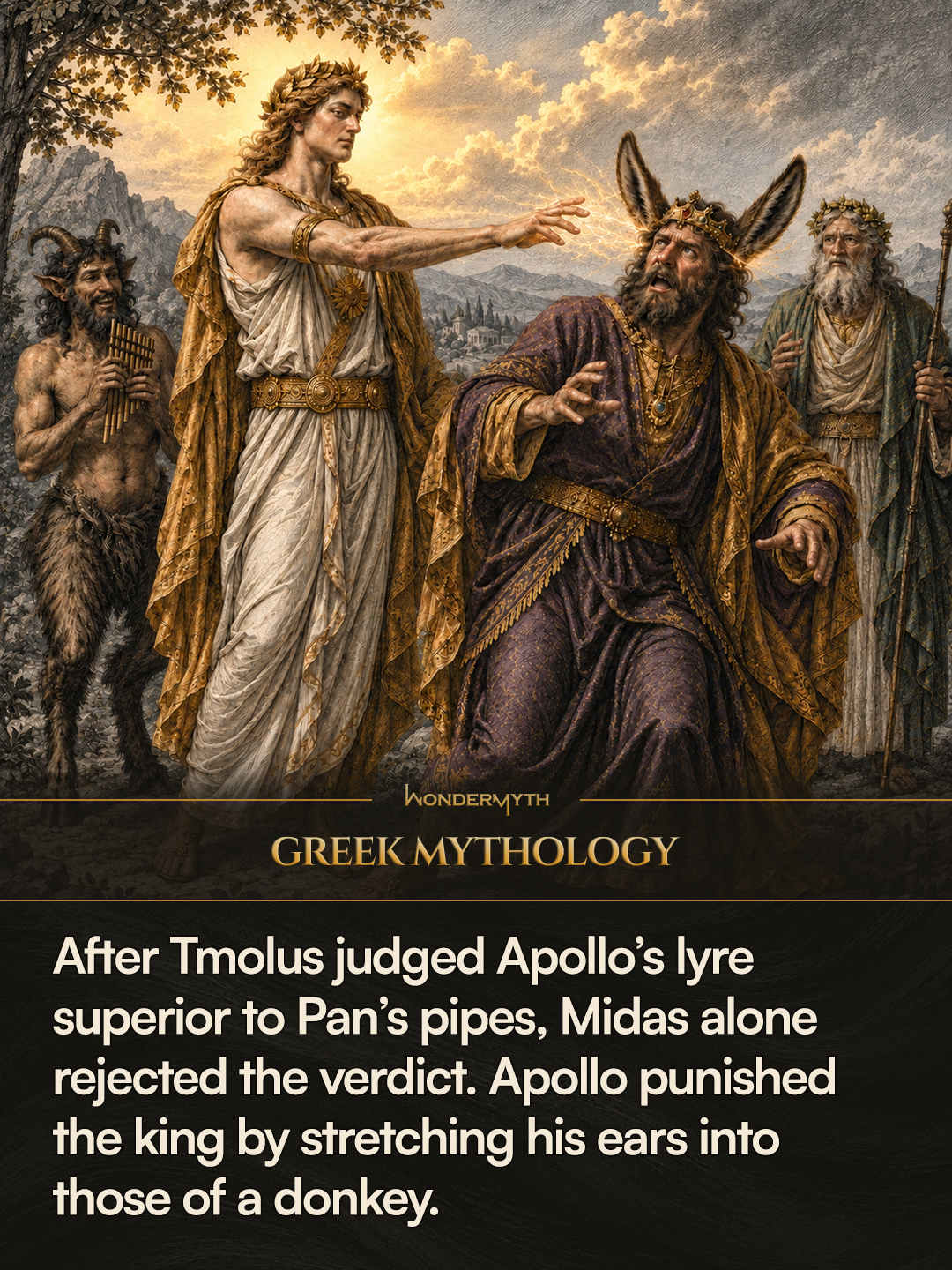
After Tmolus judged Apollo’s lyre superior to Pan’s pipes, Midas alone rejected the verdict. Apollo answered by stretching the king’s ears into those of a donkey. Midas hid them beneath a purple turban, but the servant who cut his hair discovered the punishment. Unable to speak openly, the servant dug a shallow hole, whispered what he knew into the earth, and covered it again.
About a year later, reeds grew from the spot. When the south wind stirred them, they repeated the buried words and revealed the secret Midas had tried to hide.
✦ Trying to bury a secret may not erase it. It may only give it another way to speak.