
King Midas
King Midas is a mortal Phrygian ruler remembered through two sharp reversals. He asks for everything he touches to become gold and finds he can no longer eat. Later, he rejects Apollo’s musical victory and receives ass’s ears. His myths turn royal wealth, judgment, and secrecy into traps, while the name behind them recalls a powerful kingdom in Phrygia.
English pronunciation: MY-dəs
Original name (Greek): Μίδας
Transliteration: Midas
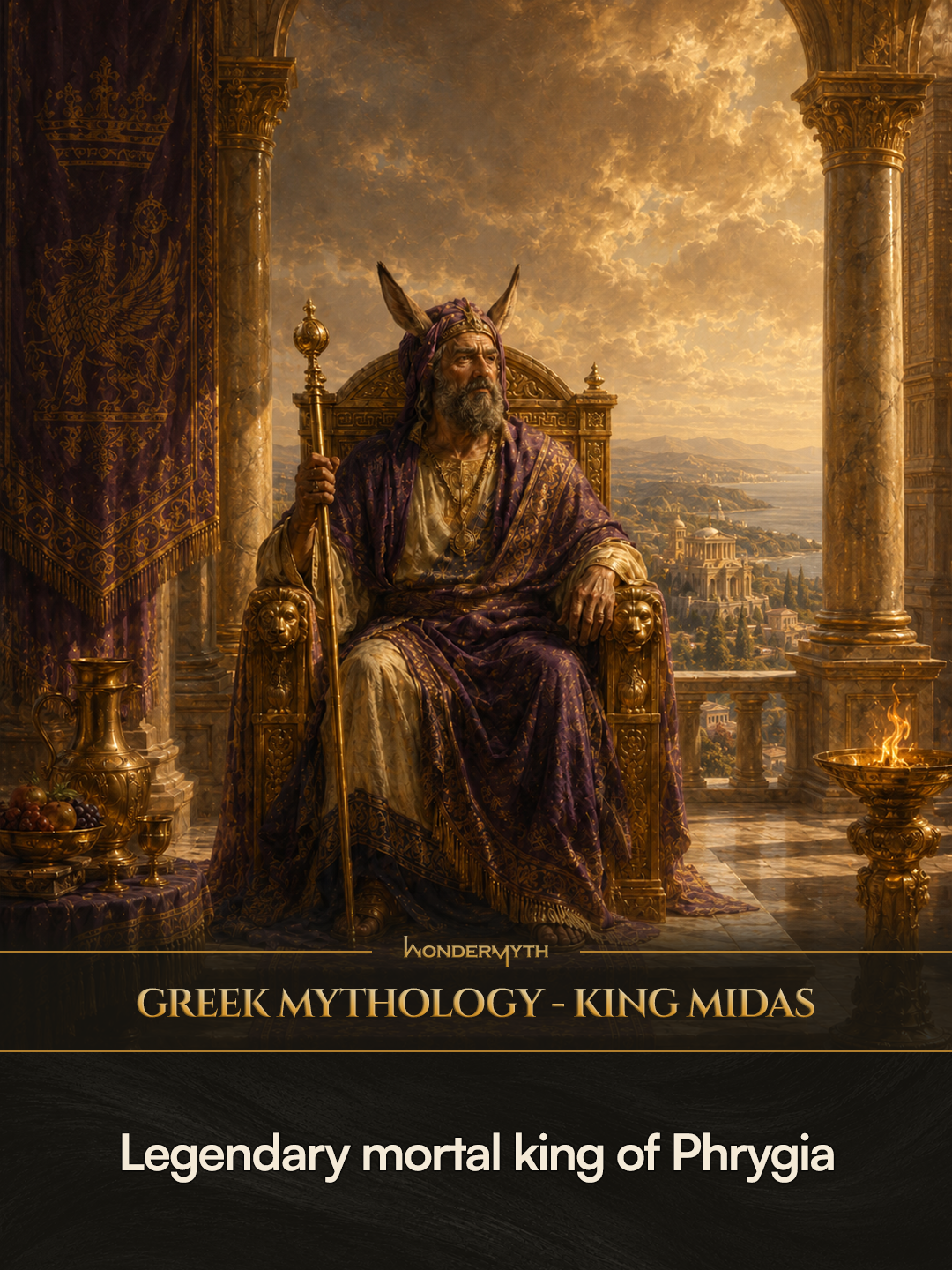
Who Was King Midas?
King Midas belongs to Greek mythology, but his legends are rooted in Phrygia. The mythological king draws on the memory of one or more rulers named Midas, especially the late-eighth-century king called Mita of Mushki in Assyrian records. The stories are not a reliable biography of that ruler. Greek and Roman traditions gathered supernatural tales, dynastic memories, local foundations, and warnings about wealth around the royal name.
Midas is not a god and has no divine powers of his own. His defining myths repeatedly reverse what appears desirable or defensible. Wealth becomes hunger, personal judgment becomes bodily humiliation, and concealment gives a secret another path into the world. A separate dynastic tradition remembers him more favorably as the wagon-borne king who ends Phrygian discord.
Origins & Family
In Arrian’s dynastic account, Midas is the son of Gordias, a poor Phrygian farmer, and an unnamed Telmissian woman skilled in interpreting divine signs. A later Roman tradition instead names Cybele as his mother. The Aristotelian tradition preserved by Heraclides names Midas’s wife Hermodike, while Pollux calls her Demodike of Cyme and identifies her as the daughter of Agamemnon, king of the Cymaeans. Separate traditions name Anchurus and Lityerses as Midas’s sons.
Parents: Gordias and an unnamed Telmissian woman (in Arrian); Cybele is named as his mother in a later Roman tradition.
Spouse: Hermodike, wife of Midas in the Aristotelian tradition preserved by Heraclides; Pollux calls her Demodike of Cyme and names her father as Agamemnon, king of the Cymaeans.
Children: Anchurus (in the pseudo-Plutarchan Parallela Minora) and Lityerses (in later Greek tradition).
Domains, Appearance & Symbols
Appearance
An Attic red-figure vase from about 440 BCE shows Midas seated with a sceptre and head covering while a bound Silenus is led before him. Long ass’s ears project from beneath the covering. Ovid later describes him as otherwise human, with grey-haired, movable ass’s ears hidden beneath a purple turban. No universal ancient portrait fixes his other features.
Symbols
• Gold and the golden touch: The emblem of Midas’s destructive wish, which turns abundance into hunger and thirst.
• Ass’s ears: Apollo’s bodily punishment after Midas rejects Tmolus’s musical verdict in Ovid’s version.
• Purple turban: The covering Midas uses to conceal his transformed ears.
• Earth and whispering reeds: The servant buries the secret in the ground, but reeds repeat it when the wind moves them.
• The Pactolus: The river that receives the golden power when Midas washes away his gift.
• Gordias’s wagon and knotted yoke: The objects linked to Midas’s dynastic accession and the later prophecy of rule over Asia.
Key Myths
The Golden Touch
In Ovid’s account, Midas welcomes the lost Silenus and returns him to Dionysus after a ten-day celebration. Offered a reward, he asks that everything he touches become gold. The wish transforms branches, stones, fruit, food, water, and wine, but it leaves him unable to eat or drink. Midas begs for release, and Dionysus sends him to wash in the Pactolus. The power passes into the river, whose golden sands preserve the result of his disastrous choice.
The Ass’s Ears and the Whispering Reeds
Pan challenges Apollo’s music, and the mountain god Tmolus judges Apollo’s lyre superior. Everyone accepts the verdict except Midas, who calls it unjust. Apollo stretches the king’s ears into those of an ass, and Midas hides them beneath a purple turban. His unnamed hair-cutter discovers the punishment, whispers the secret into a hole, and covers it. Reeds grow from the spot and repeat the buried words whenever the wind moves them, exposing what Midas tried to conceal.
The Wagon That Brought a King
In Arrian’s local dynastic account, civil conflict divides the Phrygians until an oracle announces that a wagon will bring the king who ends their discord. Midas arrives with his parents in their wagon, and the people appoint him king. After restoring order, he dedicates the wagon to Zeus the King. Its knotted fastening later becomes the center of a prophecy that whoever loosens it will rule Asia. Other traditions place greater emphasis on Gordias as the dynasty’s chosen founder.
Worship & Ancient Impact
No secure evidence shows that Midas received organized worship as a god or hero. The throne attributed to him at Delphi was an offering to Apollo, not evidence of a cult directed toward Midas. His ancient importance instead rests on Phrygian kingship, wealth, and contact between Anatolia and Greece. Assyrian records present Mita of Mushki as a major late-eighth-century ruler, while Greek tradition remembers Midas through exceptional riches, a royal marriage alliance, and a Delphic dedication. The historical ruler and legendary king remained closely associated, but the collected stories do not form a reliable biography of the late-eighth-century Midas.
Modern Influence
Nathaniel Hawthorne’s 1851 story “The Golden Touch” reshapes Midas for children by introducing his daughter Marygold and turning her into gold. That famous scene belongs to modern reception, not the ancient accounts. Walt Disney’s 1935 animated short The Golden Touch replaces Dionysus with a comic magical visitor and presents the myth as a warning about greed. The phrase “Midas touch,” recorded in English from 1813, now usually praises someone who makes money or succeeds in business, reversing the destructive meaning of the ancient wish.
Lore Moments
-
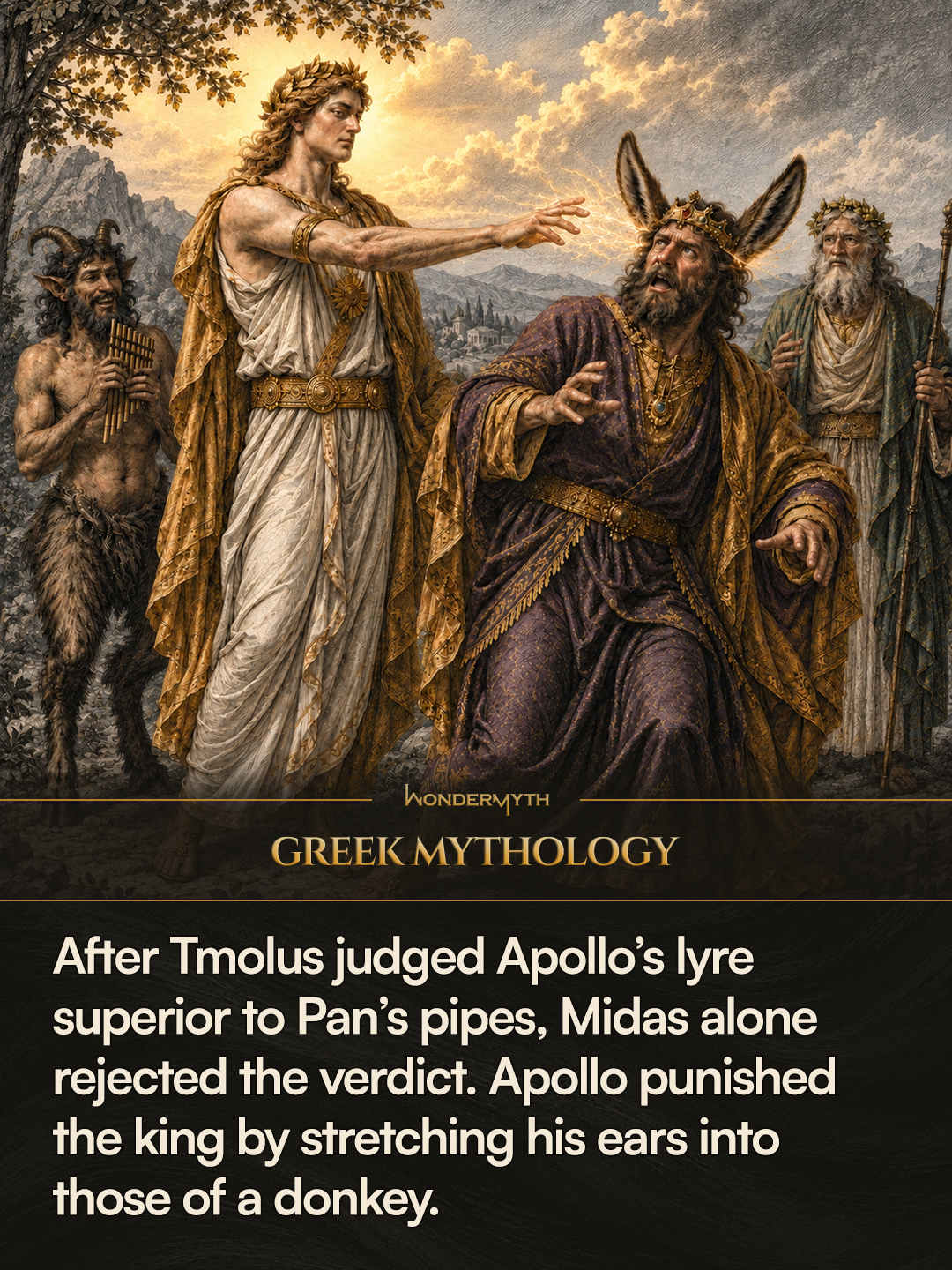
After Tmolus judged Apollo’s lyre superior to Pan’s pipes, Midas alone rejected the verdict. Apollo answered by stretching the king’s ears into those of a donkey. Midas hid them beneath a purple turban, but the servant who cut his hair discovered the punishment. Unable to speak openly, the servant dug a shallow hole, whispered what he knew into the earth, and covered it again.
About a year later, reeds grew from the spot. When the south wind stirred them, they repeated the buried words and revealed the secret Midas had tried to hide.
✦ Trying to bury a secret may not erase it. It may only give it another way to speak.