
Apollo
Apollo brings beauty and danger into the same divine sphere. His prophecy, music, and distant arrows express a power defined by precision, while his healing and purification stand close to disease and death. His myths repeatedly show ordered power turning severe when sacred honor, artistic rank, or divine boundaries are challenged.
English pronunciation: uh-POL-oh
Original name (Greek): Ἀπόλλων
Transliteration: Apollōn / Apollon
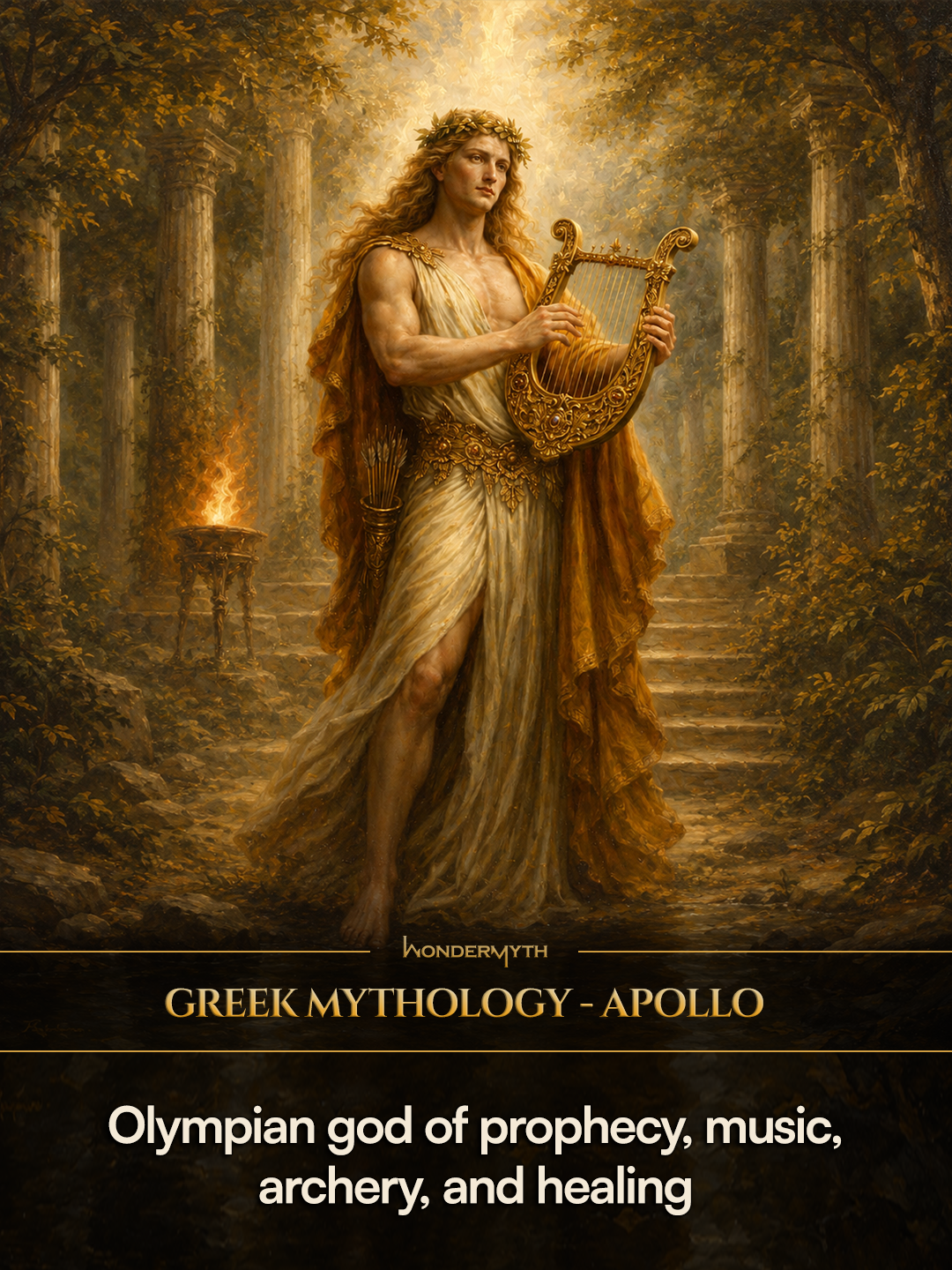
Who Was Apollo?
Apollo is a major Olympian god whose many powers are joined by a recurring pattern of precision, order, and controlled distance. His arrows strike without physical combat, his oracle reveals what others cannot see, and his music gives structure to sound.
Yet his order is not gentle by nature. Apollo protects priests, punishes rivals, pursues those who reject him, and answers wounded honor with plague, killing, or bodily torment. His myths combine beauty, discipline, and divine severity.
Origins & Family
Apollo’s birth on Delos establishes both his divine family and one of his most important sacred places. He is the son of Zeus and Leto, and his birth follows Hera’s obstruction of Eileithyia, whose absence delays Leto’s labor. Artemis is his close divine sibling and counterpart, sharing his parentage, archery, defense of Leto, and participation in several punishment myths, while his notable son Asclepius extends Apollo’s healing identity into a separate divine tradition.
Parents: Zeus and Leto.
Sibling: Artemis.
Children (Notable): Asclepius (with Coronis).
Domains, Appearance & Symbols
Domains & Roles
Apollo governs prophecy and oracles, music and poetic performance, archery, plague, healing, and ritual purification. At Delphi, he speaks through the Pythia and gives divine authority to the sanctuary and its oracle.
His myths also connect him with youth, artistic competition, sudden death, and the protection of priestly and sacred rank.
Appearance
Ancient Greek and Roman art usually presents Apollo as a youthful, beardless male figure. He may appear nude, lightly draped, or fully clothed, often with long or carefully arranged hair. The lyre or kithara, bow and quiver, and laurel are his clearest visual identifiers. No fixed ancient tradition establishes his colors, facial features, build, or permanent expression.
Symbols
• Lyre or kithara: Apollo’s principal musical symbol.
• Bow and arrows: His principal attributes as an archer.
• Laurel: Apollo’s sacred plant.
• Delphic tripod and omphalos: Symbols of his oracle and sacred authority at Delphi.
• Palm: Belongs especially to his Delian birth tradition.
• Dolphin: Appears in the story of the Cretan sailors he guides to Delphi.
• Ravens and swans: Limited poetic and visual associations rather than universal defining symbols.
Key Myths
The Birth on Delos
Leto searches for a place willing to receive Apollo’s birth, but Delos fears that the powerful child will abandon the poor island. Leto promises that Apollo will establish a sacred precinct there. After Hera delays the birth by withholding Eileithyia, the other goddesses summon her in secret. Apollo is born beside the palm and immediately claims the lyre, the curved bow, and the interpretation of Zeus’s will.
Apollo Claims Delphi
Apollo travels in search of a place for his oracle and chooses Pytho beneath Mount Parnassus. He kills the great dragoness of the region with his arrows and establishes his sanctuary. Later, he takes the form of a dolphin, guides Cretan sailors to the coast, reveals his divinity, and assigns them priestly service. Apollo establishes his oracle, brings the Cretan sailors into priestly service, and secures his divine authority at the Pythian sanctuary.
The Plague in the Achaean Camp
When Agamemnon humiliates Chryses and refuses to return his daughter, the priest prays to Apollo for justice. Apollo descends in anger and sends plague through his arrows, first killing animals and then soldiers as funeral fires burn across the camp. The offense against his priest must be corrected before the plague ends. Apollo’s intervention begins the dispute between Agamemnon and Achilles that drives the Iliad.
Coronis and Asclepius
Coronis carries Apollo’s child but forms a union with the mortal Ischys. In Pindar’s version, Artemis kills her, and her body is placed on a funeral pyre. Apollo refuses to let his unborn child die with her, removes Asclepius before the flames consume him, and entrusts him to Chiron. Asclepius becomes a healer of extraordinary power. In the wider tradition, Zeus kills him with a thunderbolt after his healing crosses the boundary of death, and Apollo retaliates by killing the Cyclopes.
Apollo and Marsyas
Marsyas challenges Apollo in a musical contest between the pipes and Apollo’s stringed instrument. Apollo wins, binds Marsyas, and flays him alive. Marsyas’s challenge ends with Apollo enforcing his divine musical superiority through extreme bodily punishment.
Daphne and the Laurel
In Ovid’s account, Cupid drives Apollo toward desire while making Daphne reject it. Apollo pursues her as she flees and refuses his advances. When he is about to overtake her, Daphne seeks escape through transformation and becomes a laurel tree. Apollo then claims the laurel as his sacred plant, joining one of his most enduring symbols to a pursuit that ends without consent or union.
Worship & Ancient Impact
Delphi was Apollo’s principal pan-Hellenic oracle sanctuary. Individuals, cities, and rulers consulted the Pythia, while dedications from across the Greek world filled the sacred site. The Pythian Games honored Apollo through athletic and musical competition, and the omphalos marked Delphi as the world’s sacred center.
Delos was revered as his birthplace and became another major sanctuary. Worshippers gathered there for sacrifice, song, dance, and athletic performance. Across the Greek world, Apollo received hymns, offerings, processions, purification rites, and appeals concerning disease, healing, civic decisions, youth, and local protection.
Modern Influence
NASA’s Apollo spaceflight program is the clearest named modern example. NASA credits Abe Silverstein with proposing the name because the image of Apollo driving his chariot across the Sun matched the planned program’s grand scale. The choice draws on Apollo’s later solar identification, not his earliest Greek profile, in which Helios remains the distinct physical Sun.
Modern adaptations continue to select different parts of Apollo’s identity, sometimes emphasizing youthful beauty, music, prophecy, laurel, archery, or solar imagery more strongly than the varied ancient traditions do.
Lore Moments
-
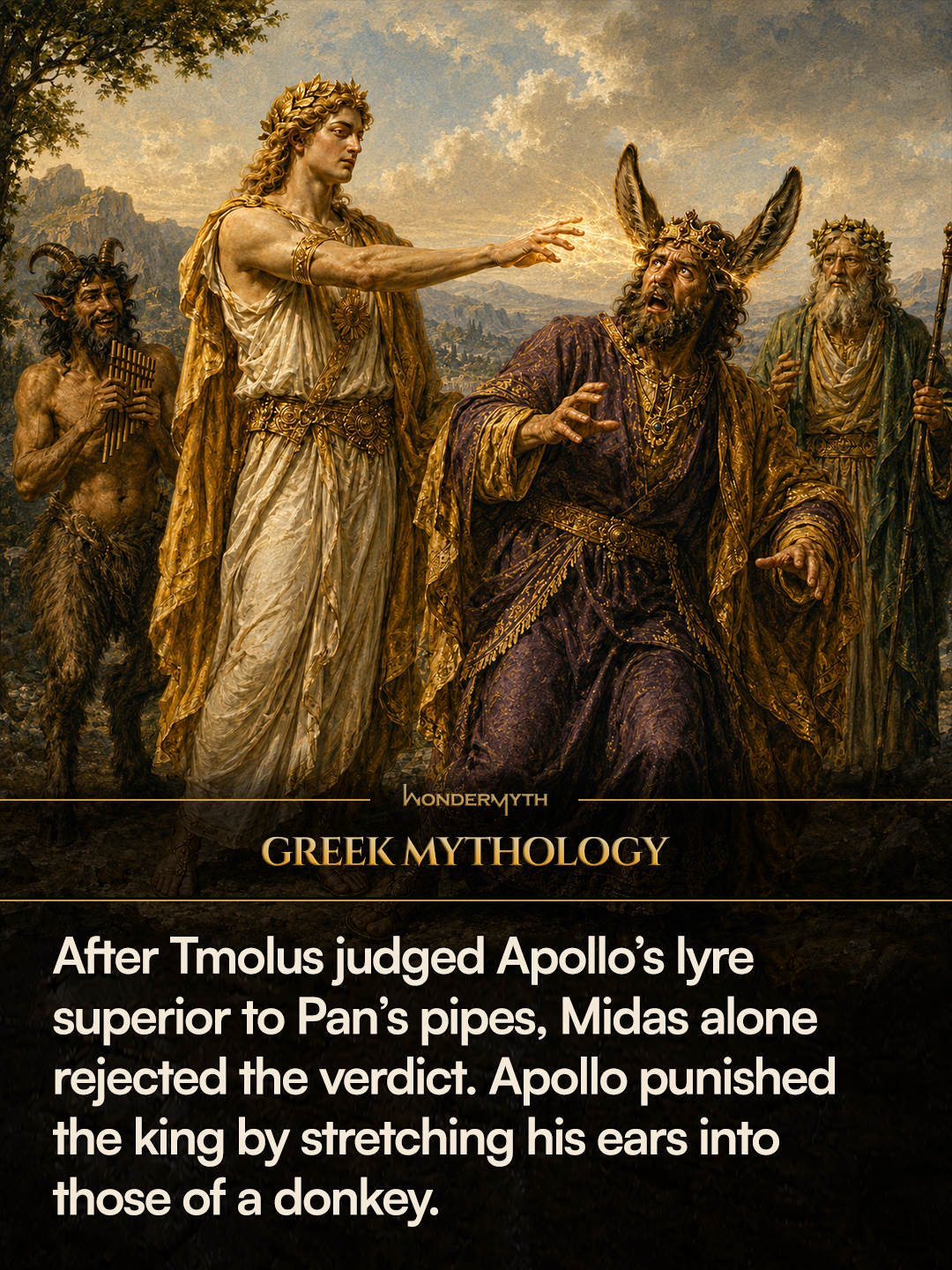
After Tmolus judged Apollo’s lyre superior to Pan’s pipes, Midas alone rejected the verdict. Apollo answered by stretching the king’s ears into those of a donkey. Midas hid them beneath a purple turban, but the servant who cut his hair discovered the punishment. Unable to speak openly, the servant dug a shallow hole, whispered what he knew into the earth, and covered it again.
About a year later, reeds grew from the spot. When the south wind stirred them, they repeated the buried words and revealed the secret Midas had tried to hide.
✦ Trying to bury a secret may not erase it. It may only give it another way to speak.