
Tmolus
Tmolus is the divine personification of a Lydian mountain overlooking Sardis. In his best-known myth, the wooded landscape becomes an attentive judge as he listens to Pan and Apollo compete in music. His authority comes from the mountain itself: its slopes become his seat, its trees move at his command, and his verdict decides the contest.
English pronunciation: MOH-lus
Original name (Greek): Τμῶλος
Transliteration: Tmōlos
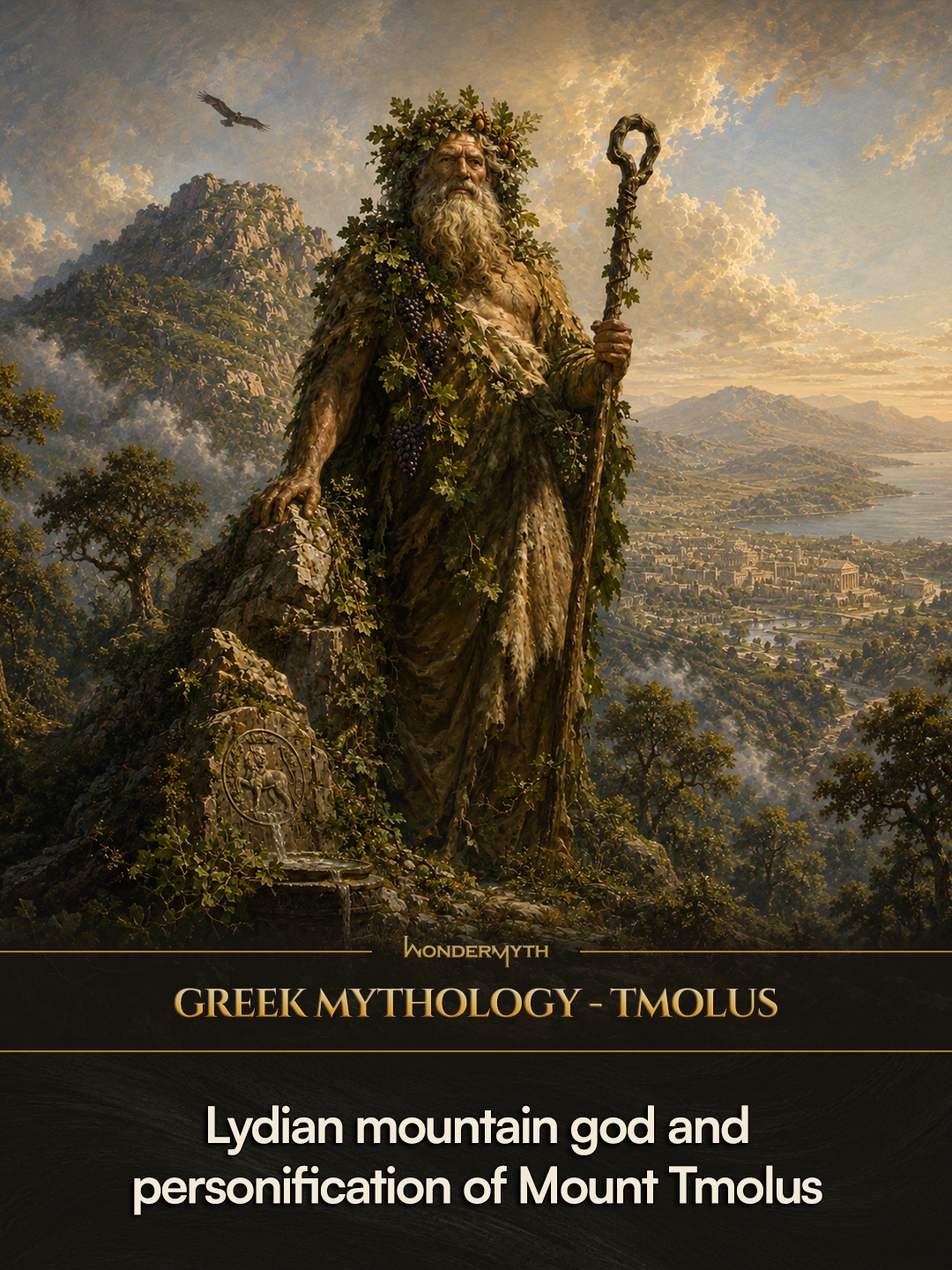
Who Was Tmolus?
Tmolus is the male divine personification of Mount Tmolus in Lydia. He is not simply a god who inhabits the mountain. Its slopes, rocks, and trees form part of his divine identity, allowing the landscape itself to listen, speak, and act.
His importance lies in this fusion of deity and place. Greek and Roman traditions turn a regional landmark into an active divine presence whose authority remains inseparable from the Lydian landscape.
Origins & Family
Snowy Tmolus appears in early Greek poetry as part of the Lydian landscape, although the mountain is not yet described as an anthropomorphic deity. Ovid later presents it as an acting mountain god who listens, speaks, and judges.
Other traditions preserve mortal or royal figures named Tmolus, including Omphale’s deceased husband and a king whose death is said to give the mountain its name. These source-specific figures cannot be securely combined with the personified mountain into one continuous biography or family tree.
Domains, Appearance & Symbols
Domains & Roles
Tmolus embodies Mount Tmolus and the wooded Lydian landscape overlooking Sardis. His defining narrative role is to judge the musical contest between Pan and Apollo, exercising an authority rooted in the mountain itself.
Regional traditions also connect Mount Tmolus with vines, Dionysus, and the Pactolus area. These associations reflect the mountain’s fertile and sacred setting, but they do not make Tmolus a general god of wine, music, or judgment.
Appearance
Ovid describes Tmolus as an aged mountain god seated upon his own slopes, with hair resembling the mountain’s vegetation, an oak wreath, and acorns beside his temples. In later Roman Lydian coinage, he appears as a mature, bearded figure identified through varying combinations of vines or grapes, a staff or fawnskin, and rocky mountain support. These later regional images do not establish one universal appearance for every period.
Symbols
• Oak wreath and acorns: Attributes from Ovid’s description of the wooded mountain god.
• Trees: Tmolus moves them away from his ears before judging the musicians.
• Vines and grapes: Roman regional attributes linking him with the fertile and Dionysian landscape.
• Rocky support: Identifies reclining images of Tmolus as the embodied mountain.
• Staff and fawnskin: Local Roman-period attributes with pastoral and Dionysian associations.
• Infant Dionysus: Appears in some Tmolian coin types as a regional association, not as part of the musical contest.
Key Myths
The Judgment Between Pan and Apollo
Pan boasts that his rustic pipes surpass Apollo’s music and brings the contest before Tmolus. The mountain god seats himself upon his slopes and moves the trees away from his ears before listening to both performers. After Pan plays, Apollo answers with his lyre, and Tmolus declares Apollo the winner. Everyone accepts the verdict except Midas, whose protest leads Apollo to transform his ears into those of an ass.
The Death of King Tmolus and the Naming of the Mountain
In a late tradition, Tmolus is a Lydian king rather than an embodied mountain. He pursues and rapes Arrhippe inside a sanctuary of Artemis. After recounting the assault, she hangs herself, and Artemis sends a maddened bull that kills Tmolus upon the mountain. His son Theoclymenus buries him there and names the mountain after him. This late account concerns a royal Tmolus and remains separate from Ovid’s personified mountain god.
Worship & Ancient Impact
No secure evidence attests a temple, priesthood, festival, oracle, or regular sacrificial practice dedicated solely to Tmolus. Roman coinage from Sardis and Tmolus-Aureliopolis nevertheless places the personified mountain within local civic and religious imagery, often beside vines, grapes, fawnskin, Silenus, or Dionysus. An inscribed column drum from Sardis names the phyle Tmolis above a relief of the child Dionysus reclining on Mount Tmolus. It records the mountain’s civic and Dionysian associations but does not depict Tmolus himself. These objects show public regional importance, but they do not prove an independent organized cult.
Modern Influence
Mary Shelley’s drama Midas presents Tmolus as the god of a hill who presides over the musical contest from a throne of turf. Percy Bysshe Shelley’s accompanying songs for Apollo and Pan also preserve the mountain as the silent listener. Later retellings and artworks often shift attention toward Midas’s foolish objection and punishment, reducing Tmolus to a secondary judge or omitting him. Modern depictions therefore have no single stable design.
Lore Moments
-
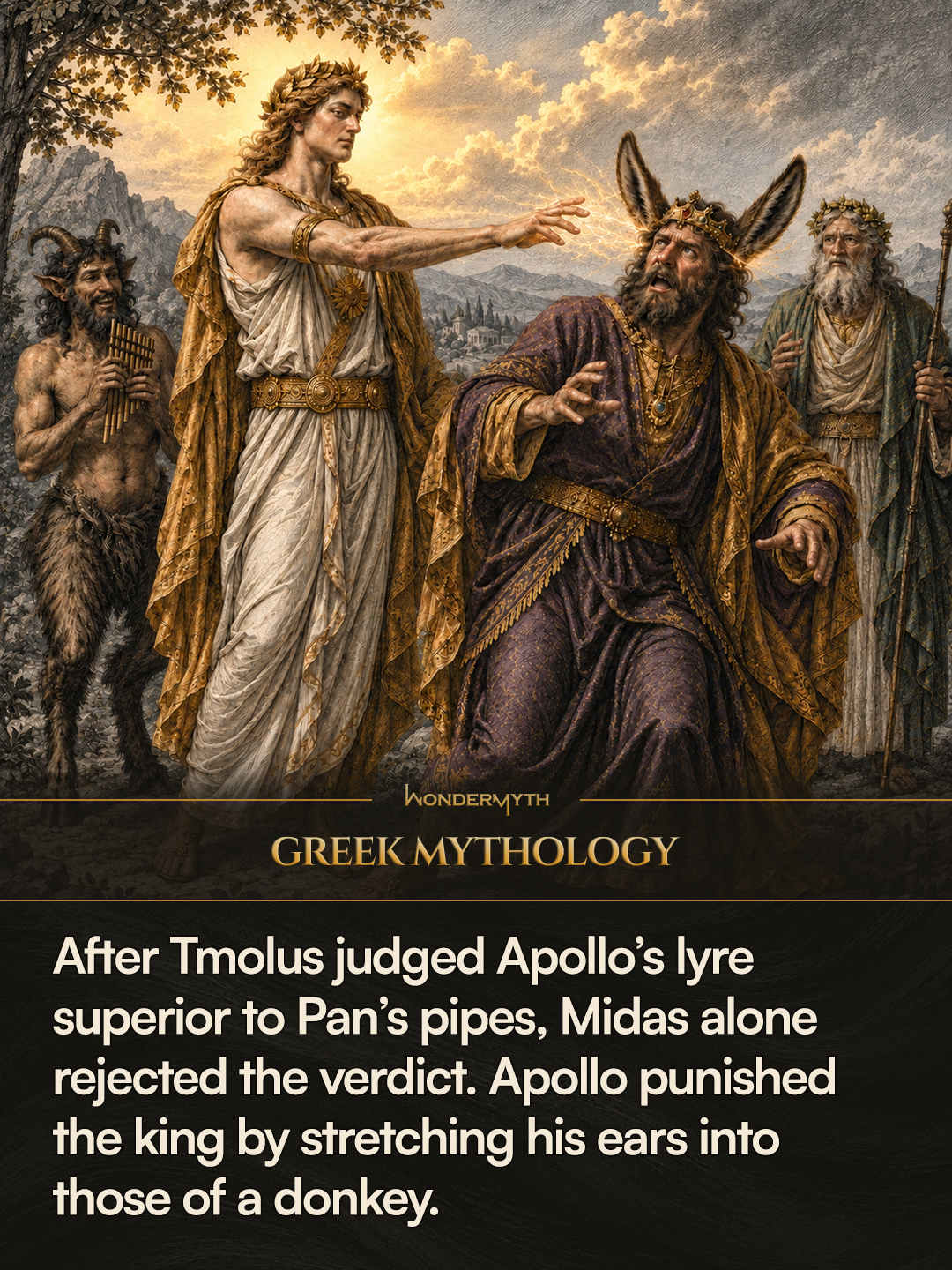
After Tmolus judged Apollo’s lyre superior to Pan’s pipes, Midas alone rejected the verdict. Apollo answered by stretching the king’s ears into those of a donkey. Midas hid them beneath a purple turban, but the servant who cut his hair discovered the punishment. Unable to speak openly, the servant dug a shallow hole, whispered what he knew into the earth, and covered it again.
About a year later, reeds grew from the spot. When the south wind stirred them, they repeated the buried words and revealed the secret Midas had tried to hide.
✦ Trying to bury a secret may not erase it. It may only give it another way to speak.