
Zeus
Zeus rules the Olympian gods through more than thunder. He wins power by surviving Cronus, freeing imprisoned allies, defeating rival powers, and distributing honors among gods. His myths join sky and kingship with oaths, hospitality, justice, punishment, and the difficult work of holding a divine order together.
English pronunciation: ZOOS
Original name (Greek): Ζεύς
Transliteration: Zeús
Name meaning: The name continues an Indo-European sky-god name associated with the bright or daylight sky.
Who Was Zeus?
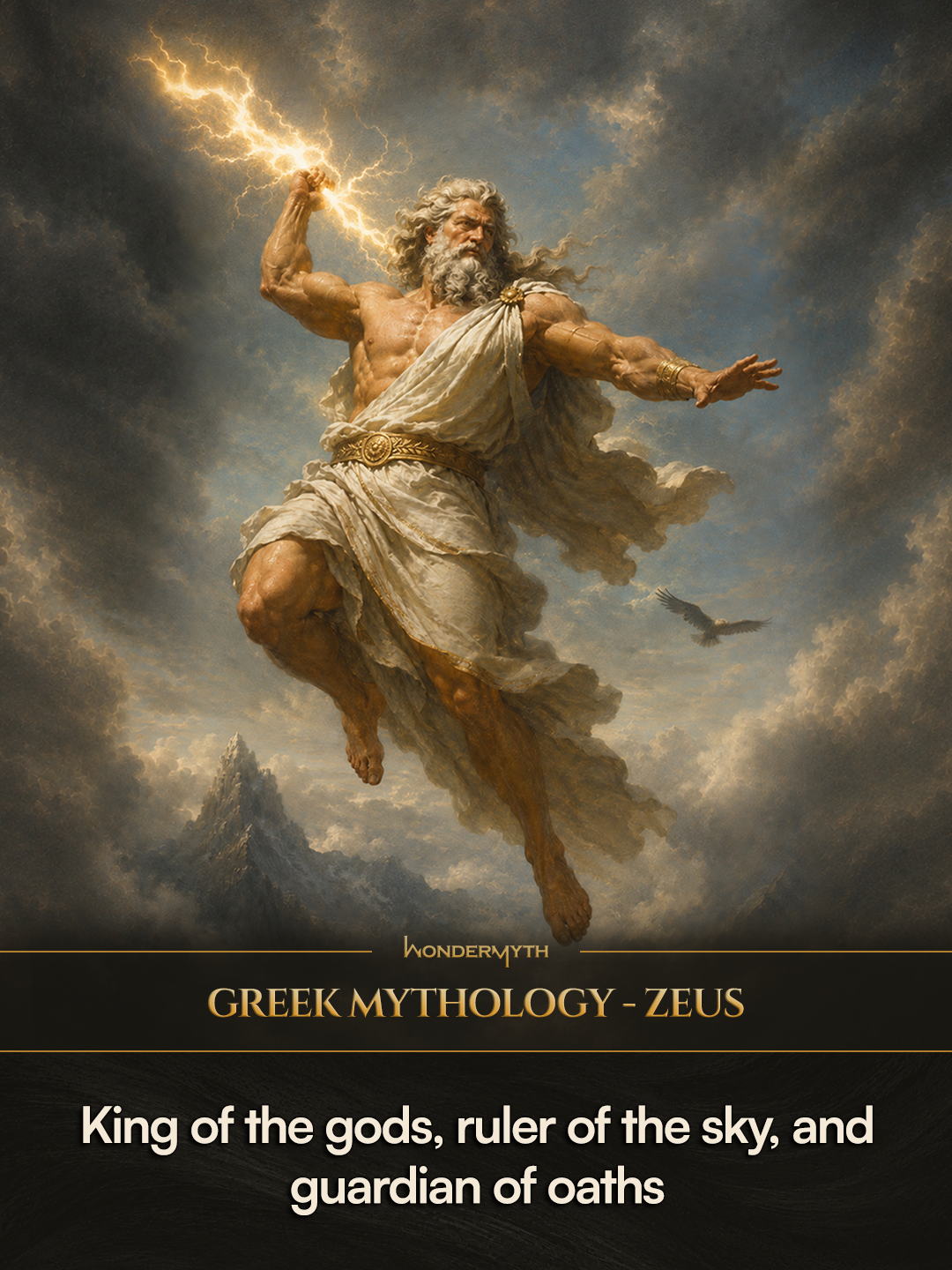
Zeus is a male Olympian god, king of the gods, and ruler of Olympus. He commands the sky, thunder, lightning, clouds, rain, and weather, but his importance extends far beyond storms. He guards oaths, hospitality, suppliants, households, cities, lawful judgment, and the distribution of honors among gods and mortals.
His authority is broad but not absolute in every ancient source. Greek poetry can show him negotiating with other gods, responding to prophecy, and respecting established divine shares. Zeus remains the central divine authority, but other gods retain meaningful agency, prophecy can shape his decisions, and established divine honors and allotted shares still matter within his rule.
Origins & Family
Zeus is the youngest son of the Titans Cronus and Rhea. In Hesiod’s succession account, Cronus swallows Zeus’s siblings, but Rhea secretly bears Zeus in Crete and Gaia conceals him, allowing him to survive and later recover them. One Arcadian tradition instead places his birth near Mount Lykaion. Zeus’s family connects Olympian rule with many major gods and heroic dynasties.
Parents: Cronus and Rhea.
Siblings: Hestia, Demeter, Hera, Hades, and Poseidon.
Spouse: Hera.
Consorts (Notable): Metis, Themis, Eurynome, Demeter, Mnemosyne, Leto, Maia, Semele, and Dione.
Children (Notable): Athena (with Metis); the Horae and Moirai (with Themis); the Charites (with Eurynome); Persephone (with Demeter); the Muses (with Mnemosyne); Apollo and Artemis (with Leto); Hermes (with Maia); Dionysus (with Semele); Aphrodite (with Dione, in Homeric tradition); Hebe, Ares, and Eileithyia (with Hera); Perseus (with Danae); Heracles (with Alcmene); Minos, Rhadamanthus, and Sarpedon (with Europa).
Domains, Appearance & Symbols
Domains & Roles
Zeus governs the upper sky and its visible forces, especially thunder, lightning, clouds, rain, and weather. As divine king, he protects the Olympian order, assigns honors, and defends sworn agreements and lawful judgment. Under titles such as Xenios, Horkios, Herkeios, and Polieus, his authority also reaches guests and hosts, oaths, household enclosures, and civic life.
Appearance
Ancient art commonly presents Zeus as a mature, bearded god with a powerful build. In one major visual type, he stands or strides with an arm raised to cast the thunderbolt. In another, he sits enthroned with a scepter, thunderbolt, or eagle, stressing sovereign rule. Ancient works vary in clothing and detail, so no single costume or color scheme defines him.
Symbols
• Thunderbolt: Zeus’s defining weapon and most reliable identifying attribute.
• Eagle: An attendant and emblem of Zeus, and also a transformed form in selected myths.
• Scepter and throne: Signs of divine kingship, judgment, and sovereign authority.
• Oak: Sacred to Zeus, especially in the oracular tradition of Dodona.
• Aegis: A divine attribute shared especially with Athena, not an object exclusive to Zeus.
Key Myths
The Hidden Birth of Zeus
Cronus swallows each child born to Rhea because he fears that a son will overthrow him. Rhea gives him a stone wrapped like an infant and secretly bears Zeus in Crete, where Gaia conceals him. When Zeus grows strong, Cronus disgorges the children he swallowed. Zeus then frees the Cyclopes, who give him thunder, lightning, and the thunderbolt that will support his rise.
The Titanomachy and Zeus’s Kingship
Zeus and the gods allied with him fight Cronus and the Titans for divine supremacy. Zeus releases the Hundred-Handers, restores them with nectar and ambrosia, and promises to honor their rightful place. They overwhelm the Titans with stones while Zeus attacks with the thunderbolt. After the Titans are confined in Tartarus, the gods urge Zeus to reign, and he distributes honors within the new Olympian order.
Prometheus, Fire, and Pandora
Prometheus deceives Zeus during the division of a sacrificial animal, beginning a struggle over the boundary between gods and mortals. Zeus withholds fire, but Prometheus steals it in a fennel stalk. Zeus then orders the gods to create Pandora and send her to Epimetheus. When her jar is opened, suffering enters human life while Hope remains inside. Humanity keeps fire, but it comes with toil, sickness, and pain.
Zeus and Typhoeus
After the Titans fall, Gaia produces Typhoeus, a monstrous threat to Zeus’s new rule. Zeus meets him with thunder, lightning, and the blazing thunderbolt as the conflict shakes earth, sky, sea, the underworld, and Tartarus. He burns Typhoeus’s heads with the thunderbolt, overcomes him, and casts him into Tartarus. The victory ends the succession struggle by securing Zeus’s rule against its last great challenger.
Metis and the Birth of Athena
Metis is destined to bear a daughter equal to Zeus in strength and wisdom, followed by a son who could replace him as king. Warned by Gaia and Uranus, Zeus deceives and swallows Metis while she is pregnant. Athena later emerges from his head, while Metis remains within him as a source of counsel. Athena enters the Olympian order, while the prophesied son who could overthrow Zeus is never born.
Worship & Ancient Impact
Olympia was the foremost sanctuary of Zeus and the setting of the Olympic Games, which joined Panhellenic athletic competition to his cult. Athletes and trainers swore oaths before Zeus Horkios, and offenders could be required to fund bronze statues of Zeus that recorded their violations. At Dodona, worshippers submitted practical questions on lead tablets to Zeus, often with Dione, while the sacred oak stood at the center of the oracle. Zeus was also honored in households and cities under titles tied to hospitality, oaths, civic order, and protection.
Modern Influence
Zeus remains a model of divine kingship and thunder-bearing authority in modern art and storytelling. Ingres’s 1811 painting Jupiter and Thetis reshapes his enthroned sovereign image through Neoclassical art, with the scepter, throne, mantle, and eagle reinforcing his command. The revival of the Olympic Games in 1896 continued the prestige of ancient Olympia without restoring Zeus’s ancient cult. In Rick Riordan’s The Lightning Thief, the theft of Zeus’s master bolt drives the central conflict, adapting his thunderbolt, kingship, and rivalry with Poseidon to a modern fantasy world.
Lore Moments
-
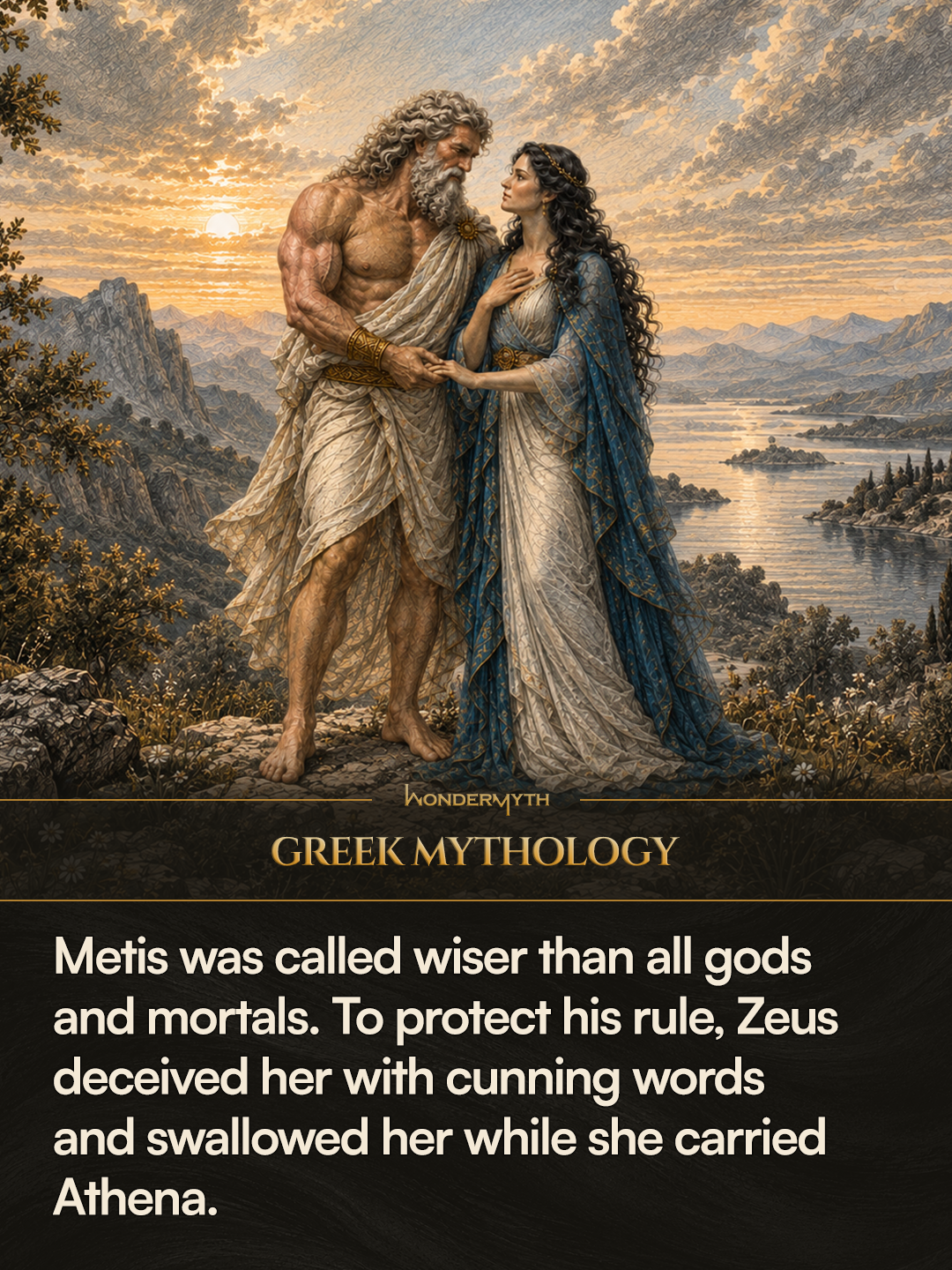
Metis was the first wife of Zeus and was said to be wiser than gods and mortals. Earth and Heaven warned Zeus that she was destined to bear remarkable children: first Athena, who would equal her father in strength and wisdom, and later a son who would become king of gods and men. To prevent that future ruler from taking his place, Zeus deceived Metis with cunning words and swallowed her while she was carrying Athena.
Swallowing Metis did not prevent Athena’s arrival. Later, Athena emerged from Zeus’s head. Metis remained within him, devising both good and evil for Zeus.
✦ Even the wise can be deceived when the picture they are asked to judge has already been distorted.