
Athena
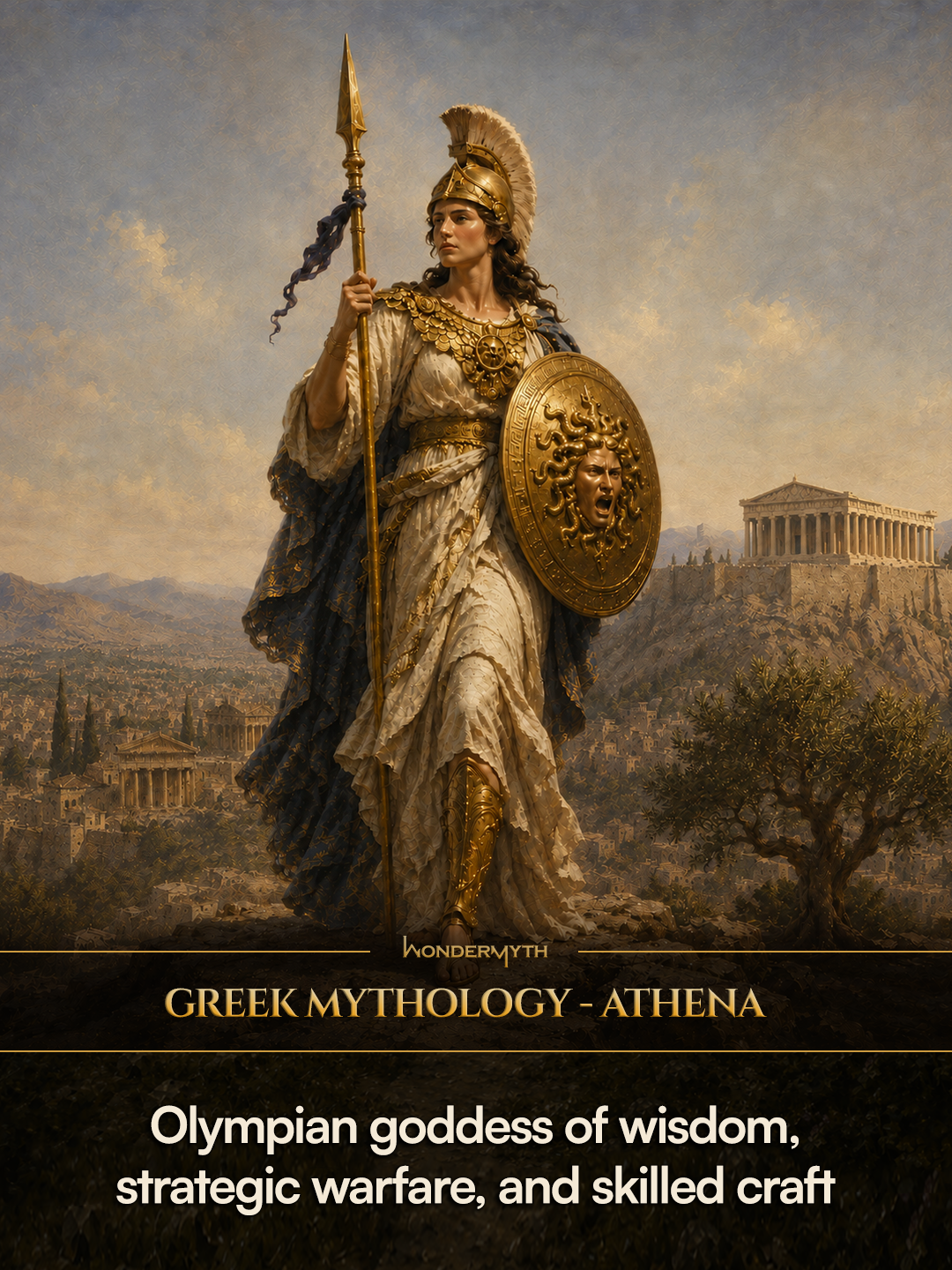
Athena is a major Olympian goddess of Greek mythology associated with wisdom, strategic war, civic defense, heroic guidance, and skilled craft. She is one of the most important divine figures in Greek myth and ancient Athenian religion.
English pronunciation: uh-THEE-nuh
Original name (Linear B): 𐀀𐀲𐀙𐀡𐀴𐀛𐀊
Transliteration: a-ta-na-po-ti-ni-ja
Who Was Athena?
Athena is the Greek goddess of wise counsel, disciplined warfare, city protection, and skilled work. She guides heroes through danger, protects civic order, and stands apart from Ares by representing strategy, restraint, and intelligent force rather than raw battle fury.
Her identity reaches back to Bronze Age religious evidence, but the fully developed Athena of myth is the Olympian daughter of Zeus and Metis. In Athens, she became the city’s divine protectress, tied to the Acropolis, the sacred olive, and the idea of reasoned power.
Origins & Family
Athena is born from Zeus’s head after Zeus swallows Metis, whose wisdom becomes part of his own rule. Many later versions make Athena emerge fully armed, while some add a helper who opens Zeus’s head. Athena is a virgin goddess, and Erichthonius is raised or guarded by her, not born from her.
Parents: Zeus and Metis
Half-Siblings (Notable): Ares, Apollo, Artemis, Hermes, Dionysus, Persephone, Heracles, Hebe, Eileithyia, and others
Consorts: None
Children: No consistent early tradition records children for Athena.
Domains, Appearance & Symbols
Domains & Roles
Athena governs wisdom, good counsel, strategic war, city defense, heroic support, weaving, pottery, and skilled craft. Her myths often show her turning intelligence into action, whether guiding Odysseus, aiding Perseus, or standing with Greek heroes in war.
Appearance
Ancient art usually shows Athena as a dignified armed woman in a long robe or peplos. She often wears a helmet and aegis, carries spear and shield, and bears the Gorgoneion. Owls, serpents, and Nike can appear near her in civic or victory imagery.
Symbols
- Aegis
- Gorgoneion
- Owl
- Olive tree
- Spear and shield
- Helmet
- Serpent
- Loom or weaving tools
Key Myths
The Birth of Athena
Zeus learns that Metis may bear a child who could threaten his rule, so he swallows her while she is pregnant. Later, Athena is born from Zeus’s head, already marked by warlike power and divine intelligence. The myth joins Athena’s wisdom to Metis and her authority to Zeus.
The Contest for Athens
Athena and Poseidon compete for patronage of Attica. Poseidon strikes the ground and produces a sea or salt-water sign, while Athena gives the olive tree. Athena wins the city’s favor, and the olive becomes a lasting sign of her bond with Athens, civic life, and cultivated prosperity.
Erichthonius and the Basket
After Hephaestus attempts to assault Athena, his seed falls to the earth and Erichthonius is born from Attic soil. Athena hides the child in a basket and gives it to the daughters of Cecrops, ordering them not to look inside. Their disobedience links the myth to Athenian ancestry and sacred Acropolis tradition.
Athena in the Gigantomachy
Athena fights beside the gods in the war against the Giants. Different traditions connect her with the defeat of powerful enemies such as Enceladus or Pallas, and she also supports Heracles in the gods’ victory. The myth presents Athena as an armed defender of divine order.
Perseus and Medusa
Athena helps Perseus in his quest against Medusa, guiding him toward a monster whose gaze can turn living beings to stone. After Medusa is slain, the Gorgon head becomes linked with Athena’s aegis. This early mythic pattern presents Athena as a guide in heroic danger, not as the source of Medusa’s original form.
The Judgment of Paris and the Trojan War
Athena competes with Hera and Aphrodite for the golden apple, but Paris chooses Aphrodite. During the Trojan War that follows, Athena supports the Greeks and aids heroes such as Diomedes, Odysseus, and Achilles. She also punishes impiety when Ajax the Lesser violates Cassandra at her Trojan shrine.
Athena and Odysseus
In the Odyssey, Athena becomes Odysseus’s chief divine helper. She protects Telemachus, guides Odysseus through danger, and helps shape his return to Ithaca. Her role shows her power as a strategist who works through disguise, timing, counsel, and careful planning.
Arachne and the Loom
In a later Roman-era story, Arachne challenges Athena in weaving and refuses to yield to the goddess’s skill. Their contest ends with Arachne transformed into a spider. The myth turns Athena’s craft domain into a warning about rivalry between mortal skill and divine authority.
Worship & Ancient Impact
Athena’s most important cult center was Athens, especially the Acropolis. Her older civic cult as Athena Polias stood beside famous forms such as Athena Parthenos, Athena Nike, and Athena Ergane. The Panathenaia honored her with procession and a peplos presentation, while other rites cared for her ancient image. Major cults also existed at Tegea, Lindos, Sparta, and other Greek cities.
Modern Influence
Athena lived on through the Roman Minerva and later became a lasting emblem of wisdom, learning, craft, law, and disciplined power. Renaissance and neoclassical art often used her as an allegory of reason and statecraft. Modern retellings, games, schools, courts, libraries, and civic symbols still use Athena as a figure of intelligence, protection, and strategic strength.
Explore More
Athena’s myth network connects her to Zeus and Metis through her birth, Poseidon through the contest for Athens, and Hephaestus through Erichthonius. Her heroic links include Odysseus, Perseus, Heracles, and Diomedes. Ares offers a useful contrast, showing the difference between battle fury and disciplined war.
References
Lore Moments
-
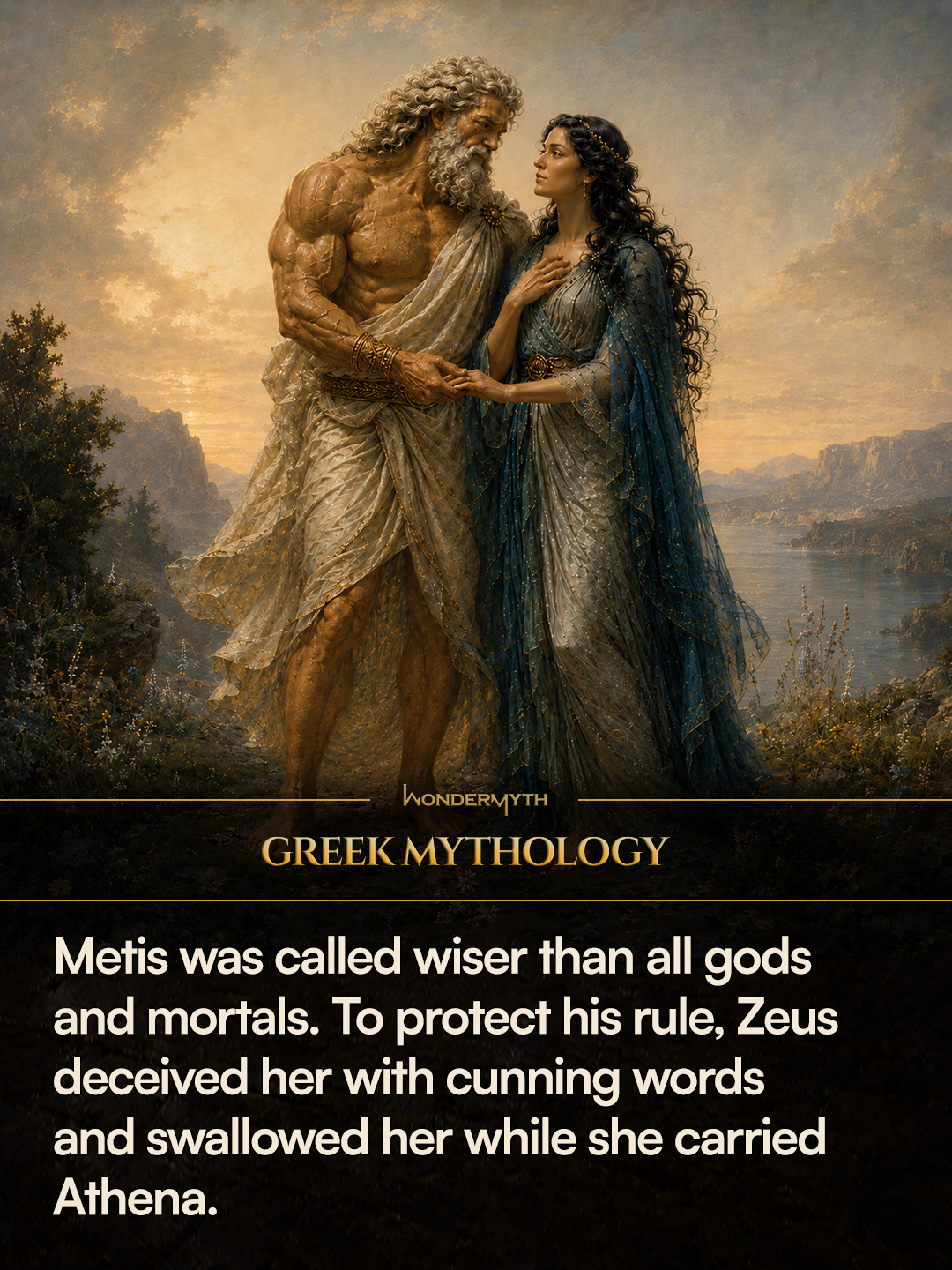
Metis was the first wife of Zeus and was said to be wiser than gods and mortals. Earth and Heaven warned Zeus that she was destined to bear remarkable children: first Athena, who would equal her father in strength and wisdom, and later a son who would become king of gods and men. To prevent that future ruler from taking his place, Zeus deceived Metis with cunning words and swallowed her while she was carrying Athena.
Swallowing Metis did not prevent Athena’s arrival. Later, Athena emerged from Zeus’s head. Metis remained within him, devising both good and evil for Zeus.
✦ Even the wise can be deceived when the picture they are asked to judge has already been distorted.