
Útgarða-Loki
Útgarða-Loki meets Thor’s overwhelming strength with deception rather than force. He controls what his guests see, disguising impossible opponents as ordinary rivals before revealing what Thor truly achieved: he lowered the sea enough to create the ebb, raised one paw of the cat concealing Jörmungandr, and withstood Old Age longer than expected. His victory depends on controlling perception and interpretation.
English pronunciation: OOT-gard-LOH-kee
Original name (Old Norse): Útgarða-Loki
Transliteration: Utgarda-Loki
Name meaning: “Loki of the Outyards” or “Loki of the outer enclosures.”
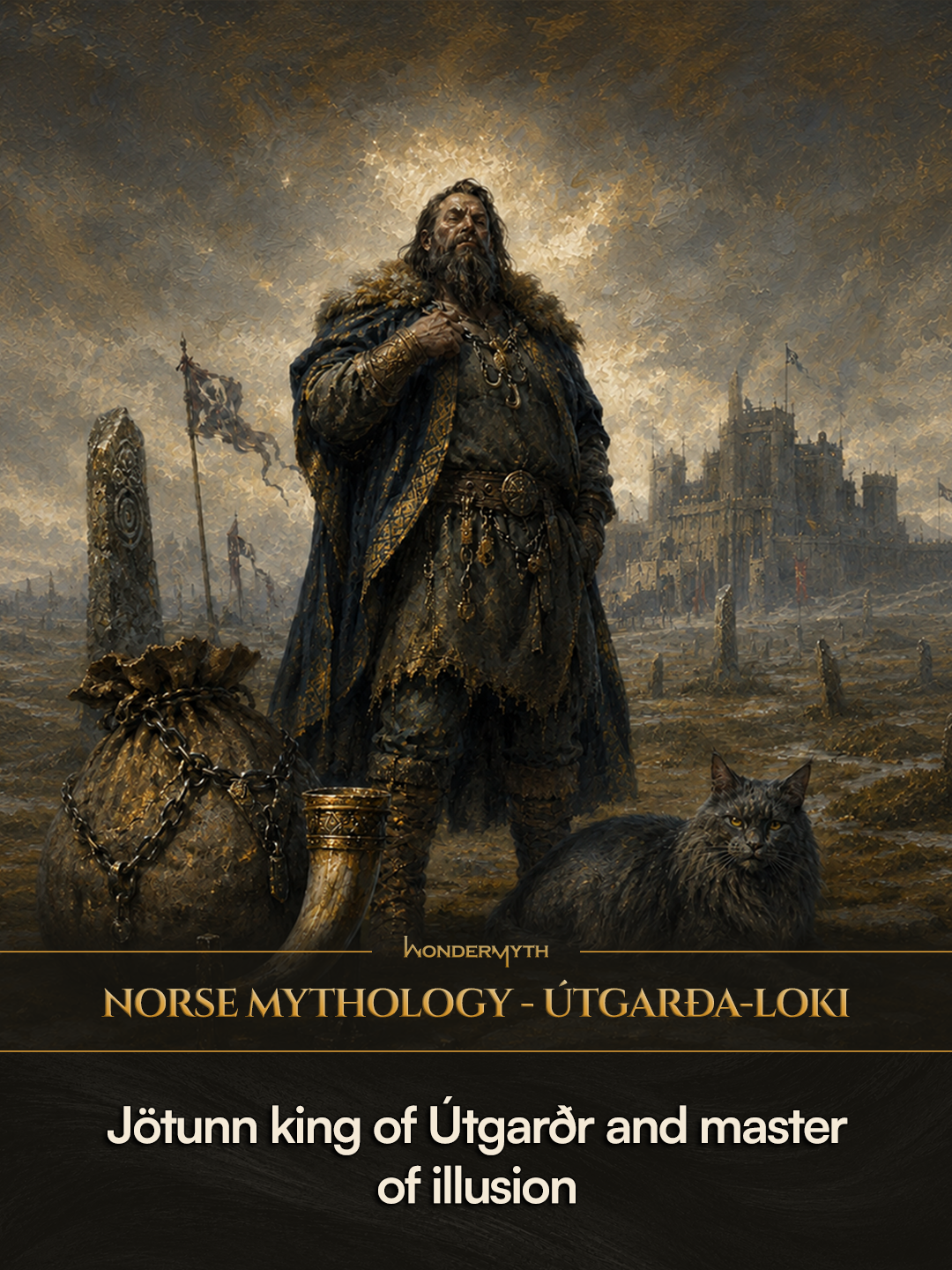
Who Was Útgarða-Loki?
Útgarða-Loki is a jötunn and king of the giant stronghold Útgarðr. He receives Thor, Loki, Þjálfi, and Röskva as a hostile host, demanding displays of exceptional skill before accepting them at his court. He is not an Æsir god, a formal god of illusion, or a securely attested form of Loki.
His story turns on controlled perception. He later identifies himself as the figure encountered as Skrýmir and says that he used visual illusions, including diverting Thor’s hammer blows into a mountain. At Útgarðr, he establishes the terms of every contest, makes impossible forces appear as ordinary opponents, and interprets the visitors’ apparent failures through explanations only he can provide.
Domains, Appearance & Symbols
Appearance
In Snorri’s account, Thor encounters the immense figure Skrýmir, whom Útgarða-Loki later identifies as himself while explaining that he used visual illusions. Skrýmir is so immense that his glove is mistaken for a building and his snoring seems to shake the ground. Snorri’s Gylfaginning does not describe Útgarða-Loki’s face, hair, clothing, armor, weapons, or age in the hall. Later artists supply detailed features rather than preserving a consistent source-grounded portrait.
Key Myths
The Trials at Útgarðr
Thor travels with Loki, Þjálfi, and Röskva to Útgarðr, where Útgarða-Loki demands contests of skill. Loki loses an eating match to wildfire, Þjálfi races against thought, and Thor cannot empty a horn joined to the sea, raises only one paw of a gray cat concealing Jörmungandr, and is forced onto one knee while wrestling Old Age. The next morning, Útgarða-Loki reveals every deception and admits that Thor’s achievements terrified him and the inhabitants of the stronghold: Thor drank enough to lower the sea and create the ebb, raised one paw of the cat concealing Jörmungandr, and withstood Old Age longer than expected. Thor then raises Mjölnir, but Útgarða-Loki and the stronghold vanish, leaving only an open plain.
Modern Influence
Útgarða-Loki’s story appeared in illustrated mythology books during the late nineteenth and early twentieth centuries. Arthur Rackham illustrated Thor and Skrýmir. C. E. Brock illustrated the Skrýmir encounter and Thor wrestling Old Age. Louis Moe depicted Útgarðaloki awaiting Ragnarök rather than the journey’s contests.
Peter Madsen’s 1986 animated film Valhalla built its story around Thor and Loki’s visit to the giants, giving Þjálfi and Röskva larger roles. Marvel’s Immortal Thor later recast Utgard-Loki as an Elder God, a modern classification with no basis in the surviving Norse account.
Lore Moments
-
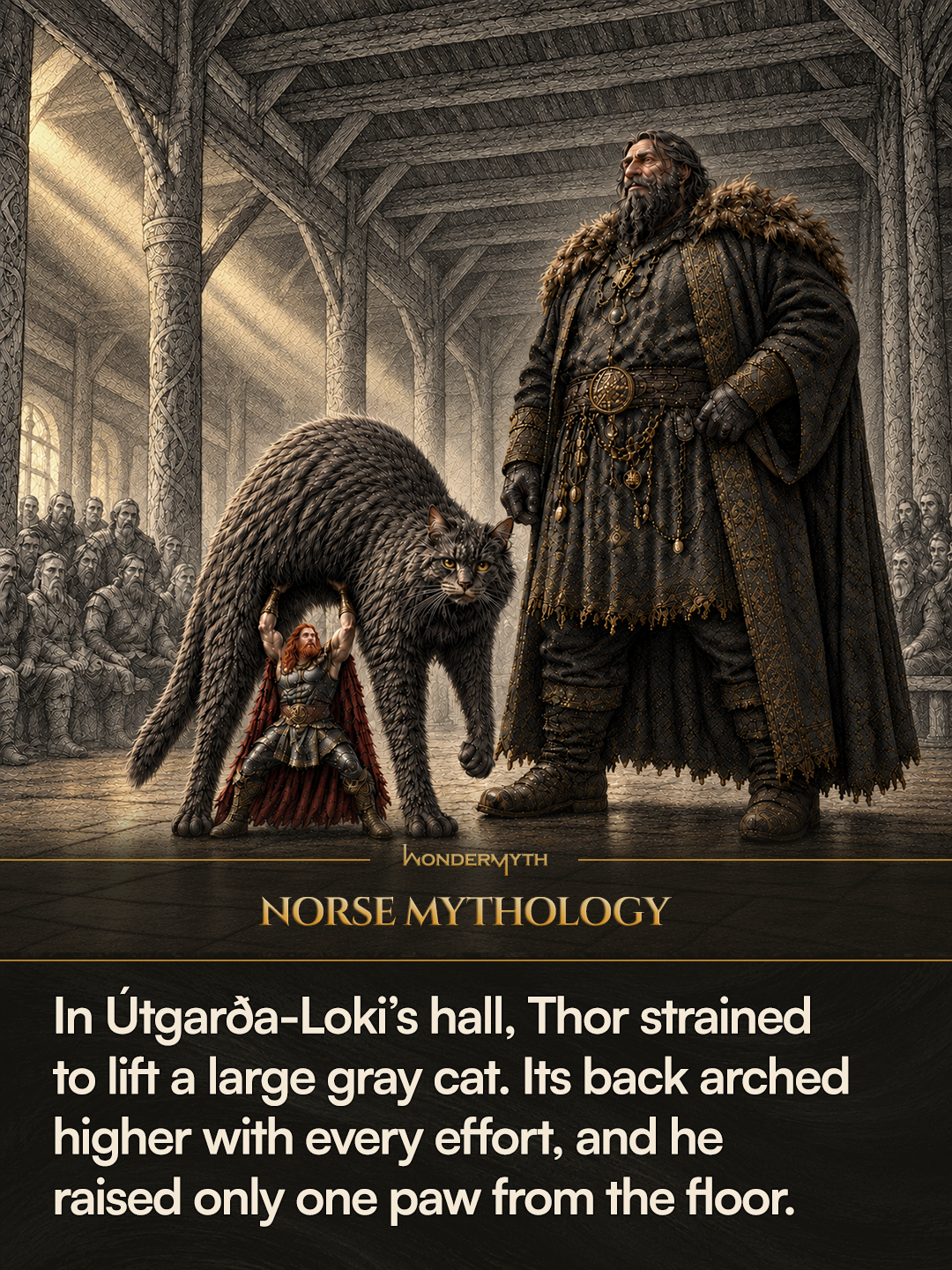
In Útgarða-Loki’s hall, Thor was offered what sounded like a trivial test: lifting the host’s large gray cat from the floor. He placed a hand beneath its body and strained upward, but the cat arched its back with every movement. Even at his full reach, Thor raised only one paw before giving up the attempt.
The next morning, Útgarða-Loki revealed that the contest had been an illusion. The cat was the Midgard Serpent, Jörmungandr, whose body encircled all lands. Thor had lifted against the immense serpent until his outstretched hand reached nearly to heaven. What appeared to be failure had terrified those who witnessed it, because lifting even one paw was an extraordinary feat.
✦ What looks like failure may actually be an extraordinary accomplishment once the true test is known.