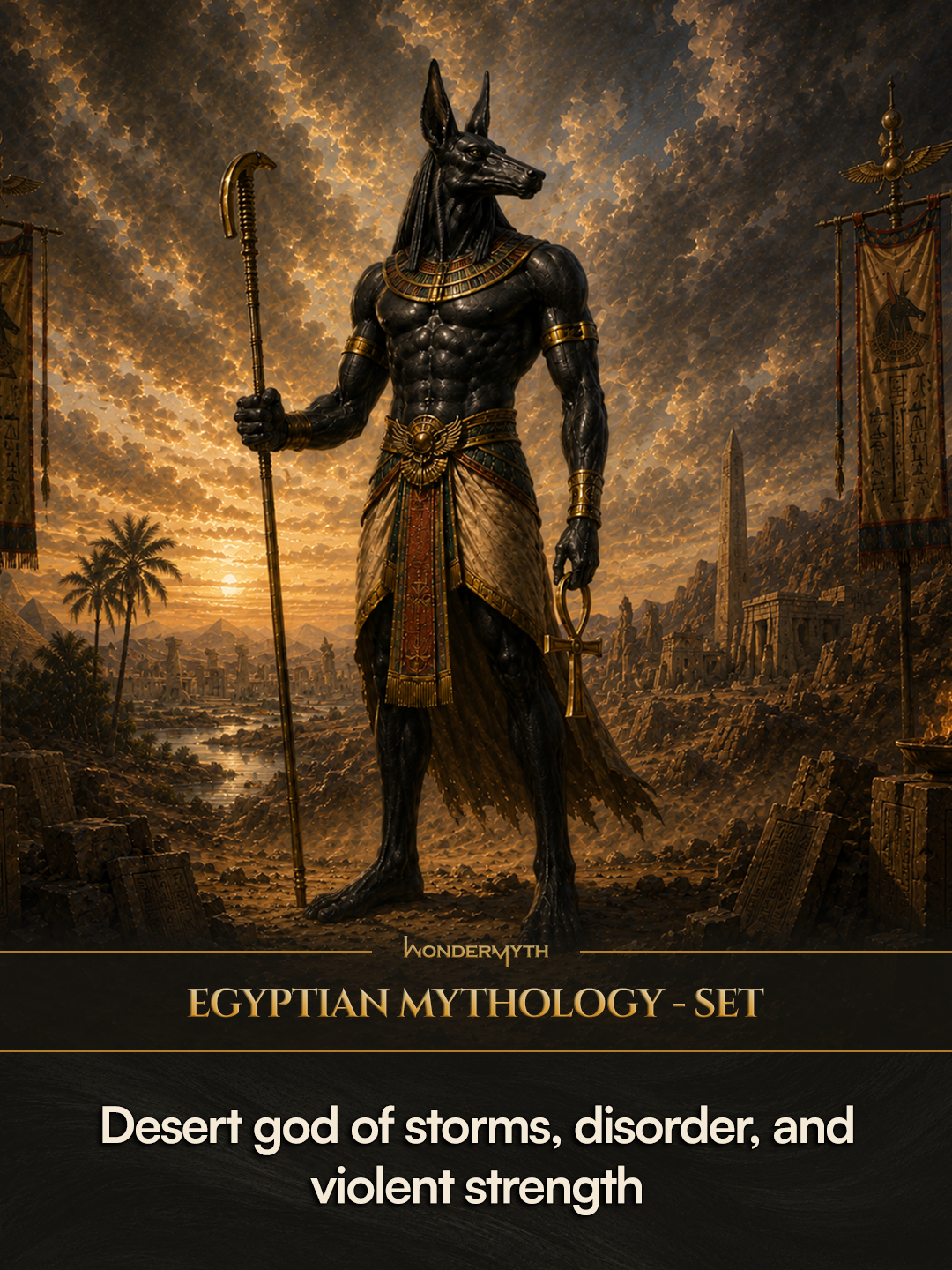
Set
Set is one of ancient Egypt’s most dangerous and necessary gods. He murders Osiris, battles Horus for kingship, commands the violent force of desert, storm, and foreign lands, yet also stands beside Ra against Apophis. His myths do not divide neatly between good and evil. They show destructive power threatening order, defending it, and being forced back into it.
English pronunciation: SET
Egyptian name, transliterated: Stẖ
Who Was Set?
Set is a male Egyptian god and a member of the Heliopolitan Ennead. He kills Osiris, contests Horus’s claim to kingship, and becomes the object of divine judgment, yet he remains part of the divine world rather than becoming an Egyptian devil or a simple god of evil.
His importance lies in the way Egyptian tradition treats dangerous power. Set’s strength becomes destructive when directed against kinship and rightful succession, but the same force can protect the divine order when turned against a greater threat such as Apophis.
Origins & Family
Set is one of the children of Geb, the earth god, and Nut, the sky goddess. His closest family relationships place him at the center of the Osirian succession crisis, where brother fights brother and the next generation struggles over inheritance.
Later and localized Egyptian traditions pair Set with his sister Nephthys. This pairing is not established as the general motive for Osiris’s murder.
Parents: Geb and Nut.
Siblings: Osiris, Isis, and Nephthys.
Spouse: Nephthys in later and localized traditions.
Domains, Appearance & Symbols
Domains & Roles
Set is associated with deserts and arid lands, storms and disruptive weather, foreign regions, borderlands, physical strength, violence, conflict, royal military power, and rivalry for kingship. In solar tradition, he uses his aggression to defend Ra against Apophis.
Set also appears in royal theology as a power opposed to Horus but capable of being brought together with him within legitimate kingship. His roles vary across texts, regions, and historical periods rather than forming one fixed universal portfolio.
Appearance
Set most commonly appears as the full Set animal or as a human-shaped male deity with the Set animal’s head. The creature has an elongated or curved snout, large upright ears, a slender body, and an erect tail, but its species remains unidentified. Other regional forms exist, including the falcon-headed, winged oasis protector found in Late Period and Roman contexts. Ancient art does not preserve one universal skin color, body type, costume, age, or expression for the god.
Symbols
- The Set animal: His principal identifying creature and hieroglyphic sign.
- Spear: Especially important in protective scenes where he attacks Apophis.
- Double Crown: Attested in Ramesside and later oasis images connected with kingship.
- Was staff: A sign of dominion strongly associated with Set, though not exclusive to him.
Key Myths
Set Kills Osiris
Set kills his brother Osiris and breaks the existing order of divine kingship. Egyptian traditions describe the murder and treatment of the body in different ways, including striking, drowning, injury, dismemberment, and attacks upon the corpse. Isis, Nephthys, Anubis, and other gods mourn, protect, and restore Osiris, who becomes ruler of the dead. Horus then claims his father’s office, turning the murder into a struggle over inheritance, vengeance, and legitimate rule.
The Contendings of Horus and Set
Horus claims the throne of his dead father, while Set argues that his greater strength makes him the better ruler. Their dispute stretches through hearings, deception, animal transformation, violence, races, and magical contests. Set attempts to dominate Horus sexually, but Isis and Horus reverse the intended humiliation through a counterplot involving lettuce, after which the rivals’ semen is magically called forth as evidence. Osiris finally pressures the tribunal to act. Horus receives the throne, while Set remains a powerful god rather than being destroyed.
Set Defends Ra Against Apophis
In solar traditions, Set turns his destructive force against Apophis, the serpent enemy who threatens the sun god’s repeated journey and the renewal of cosmic order. He attacks, restrains, or repels the serpent so the solar cycle can continue. Later oasis imagery shows him spearing and trampling Apophis as “Great of Strength.” The episode reveals the other side of his violence: the same force that endangers succession can become necessary for the survival of the cosmos.
Worship & Ancient Impact
Set received organized temple worship, priestly service, offerings, libations, amulets, and royal patronage. Major cult associations included Nubt or Ombos near Naqada, Avaris in the eastern Nile Delta, and the temple at Mut el-Kharab in Dakhleh Oasis. Ramesside rulers used Set-related names and connected him with military strength, frontier power, and the Levantine storm god Baal.
Hostility toward Set grew in some later periods, and his names or images were erased on certain monuments. This change was neither immediate nor universal. Oasis communities continued to worship him as a protective god and temple lord into the Roman period.
Modern Influence
The Greek and Roman identification of Set with Typhon strengthened his destructive image in later European retellings. Plutarch’s connected story of the chest made for Osiris and the division of his body into fourteen pieces became especially influential, even though it is a later Greco-Roman version rather than the complete timeless Egyptian account.
Modern fiction often presents Set as a straightforward villain, demon, death god, or apocalyptic enemy. Rick Riordan’s The Red Pyramid and Marvel’s Seth continue that adversarial image. Modern Egyptology presents a broader historical account that includes his royal patronage, solar defense, regional cults, and long history of changing roles.
Lore Moments
-
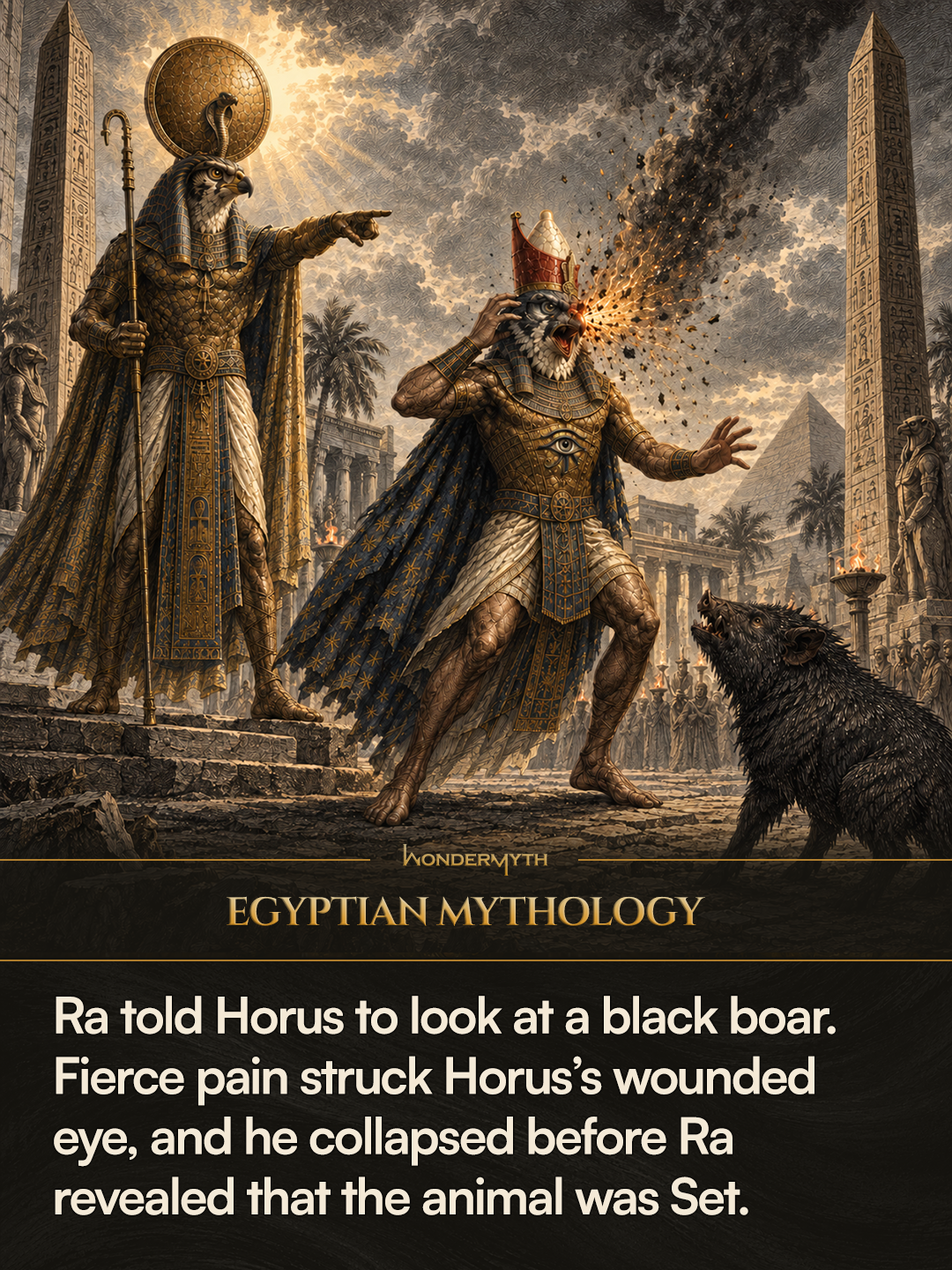
Ra examined Horus’s injured eye and told him to look at a black pig. When Horus obeyed, the eye erupted in severe pain, and he compared the agony to the blow Set had dealt it. Ra ordered the gods to place Horus on his bed until he recovered. The black pig was Set in animal form, the attacker who had wounded Horus’s eye.
The episode connected Set’s animal disguise with Horus’s wounded eye and explained why the pig became abhorrent to Horus and his divine following.