Loki
Loki moves through Norse mythology as the clever, unstable companion within the gods’ own circle. He causes disasters, escapes impossible bargains, changes shape and sex, and repeatedly becomes the figure who repairs the damage. That place among the Æsir eventually collapses, turning their most dangerous problem-solver into a bound enemy who fights against them at Ragnarök.
English pronunciation: LOH-kee
Original name (Old Norse): Loki
Transliteration: Loki
Who Was Loki?
Loki is an Æsir-associated mythic figure of jötunn ancestry whose place among the gods remains unstable. He travels with them, advises them, deceives them, rescues them, and repeatedly exposes weaknesses within their society. Modern descriptions often call him a trickster, but that label captures only part of his role.
His stories move between companionship, dependence, broken trust, and eventual hostility. The gods repeatedly rely on the same figure who endangers them, until Loki’s place within their circle collapses and he joins their enemies at Ragnarök. Loki should not be called a Norse god of fire. Logi, the embodiment of wildfire in the eating contest at Útgarða-Loki’s hall, is a separate figure.
Origins & Family
Loki is the son of Fárbauti, identified as a giant, and Laufey, who is also called Nál. His family connects him to both the society of the Æsir and the powers that destroy it: his children include Odin’s horse Sleipnir as well as Fenrir, Jörmungandr, and Hel. Sigyn remains beside him during his binding, while the names of the sons involved in that punishment vary across the surviving records. These relationships place Loki at the centre of several major Norse myth cycles.
Parents: Fárbauti and Laufey (also called Nál).
Siblings: Býleistr and Helblindi.
Spouse: Sigyn.
Consorts: Angrboða.
Children (Notable): Fenrir, Jörmungandr, and Hel (with Angrboða); Nari, also called Narfi, and Váli (with Sigyn, in Snorri’s binding account); Sleipnir (with Svaðilfari, born from Loki as a mare).
Domains, Appearance & Symbols
Domains & Roles
Loki has no stable divine domain. His recurring mythic functions include deceptive counsel, shapeshifting, provocation, negotiation, and solving crises that he often helped create.
He crosses boundaries between gods and jötnar, human and animal forms, and male and female bodies. He also obtains or recovers important treasures, attacks the gods through speech, assists them in dangerous journeys, and ultimately fights against them at Ragnarök.
Appearance
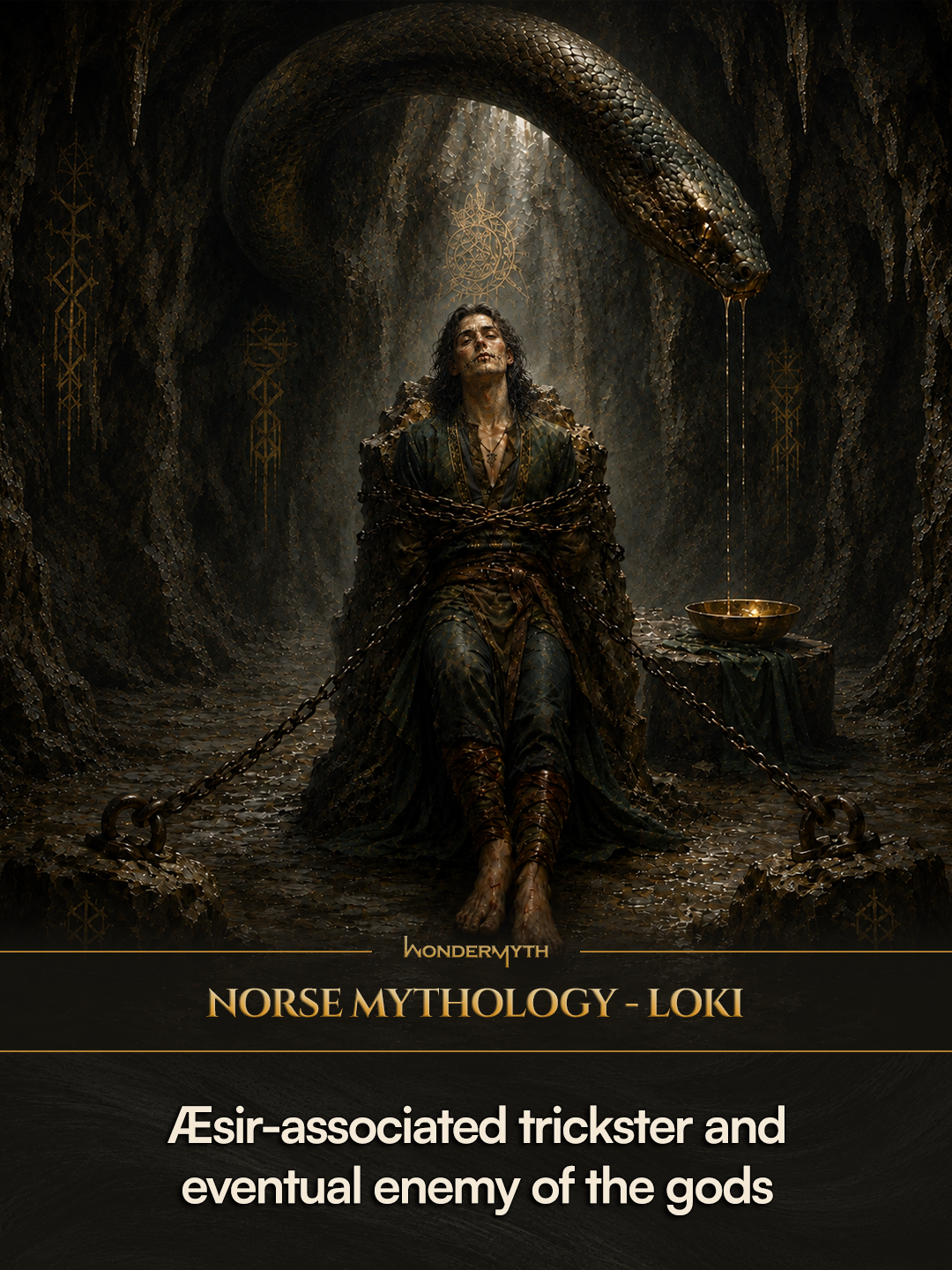
Snorri describes Loki as outwardly beautiful, but surviving sources give no fixed hair colour, clothing, age, or bodily type. The Snaptun stone is generally identified as Loki because its face has marked or sewn lips. On the Anglo-Scandinavian Gosforth Cross, a bound figure identified as Loki appears beneath a serpent while Sigyn holds a bowl beside him.
Symbols
Loki’s strongest attributes belong to particular stories rather than one universal emblem.
- Sewn lips: Belong to his wager with the dwarfs.
- Net and salmon: Belong to his attempted escape from the gods.
- Bonds, serpent, venom, and Sigyn’s basin: Belong to his punishment.
- Mistletoe: Appears in Snorri’s Baldr account.
- Borrowed feather plumage: Appears in Loki’s travel and rescue episodes.
- Sleipnir: Belongs to Loki’s transformation into a mare and the birth episode.
Key Myths
The Abduction and Rescue of Iðunn
While travelling with Odin and Hœnir, Loki strikes an eagle that is actually the jötunn Þjazi. The eagle drags him over rocks and trees until he promises to lure Iðunn and her apples from Ásgarðr. After Þjazi abducts her, the gods begin to age and force Loki to repair the disaster. Wearing Freyja’s hawk plumage, he transforms Iðunn into a nut and carries her home, restoring the gods’ youth.
Sif’s Hair and the Treasures of the Gods
Loki cuts off Sif’s hair, and Thor threatens to break every bone in him unless he replaces it. Loki commissions golden hair from the sons of Ívaldi, then wagers his head that Brokkr’s brother cannot match their work. Disguised as a fly, he tries to sabotage the rival forge, but the dwarfs still produce Mjölnir and other treasures. Loki escapes losing his head through wordplay, so Brokkr pierces and sews his lips instead.
The Builder, Svaðilfari, and Sleipnir
A builder offers to fortify the gods’ stronghold in exchange for Freyja, the sun, and the moon. After Loki recommends allowing the builder to use his stallion Svaðilfari, the work nears completion before the deadline. The gods threaten Loki unless he prevents payment. Loki becomes a mare and draws the stallion away, causing the builder to fail. Thor kills the builder, and Loki later gives birth to the grey, eight-legged Sleipnir.
The Theft and Recovery of Mjölnir
When Thor discovers that Mjölnir has been stolen, Loki borrows Freyja’s feather garment and learns that Þrymr demands her as his bride. Heimdallr proposes disguising Thor as the bride, and Loki persuades Thor to accept the plan. Dressed as a serving woman, Loki explains away Thor’s enormous appetite and blazing eyes. Once the hammer is placed on the supposed bride’s knees, Thor seizes it and kills Þrymr and the gathered giants.
Baldr’s Death and Loki’s Binding
In Snorri’s account, Loki learns that Frigg overlooked mistletoe when securing promises not to harm Baldr. He places it in the blind Höðr’s hands and directs the fatal shot. Baldr remains in Hel when the giantess Þökk, believed to be Loki, refuses to weep for him. The gods later catch Loki in salmon form. One of his sons tears apart the other, whose entrails become Loki’s bonds, and a serpent drips venom above him while Sigyn catches it in a basin.
Loki at Ragnarök
At Ragnarök, Loki breaks free from his bonds and joins the forces attacking the gods. Völuspá places him among the hostile powers approaching the final battle, while Snorri says the champions of Hel follow him. Loki confronts Heimdallr, his old rival, and each kills the other. His death completes his movement from a dangerous companion within the divine community to an open participant in its destruction.
Modern Influence
Modern adaptations have reshaped Loki more radically than most Norse figures. Richard Wagner turns him into Loge in Der Ring des Nibelungen, preserving his cleverness and unstable loyalty while strengthening the connection with fire. Marvel later recasts Loki as Odin’s adopted son, Thor’s brother, a royal Frost Giant, and the “God of Mischief.” Those relationships, titles, costumes, and royal conflicts belong to modern storytelling rather than medieval Norse tradition. Neil Gaiman’s Norse Mythology offers a more source-centred modern retelling, following Loki from the gods’ early adventures through Ragnarök.
References
Lore Moments
-
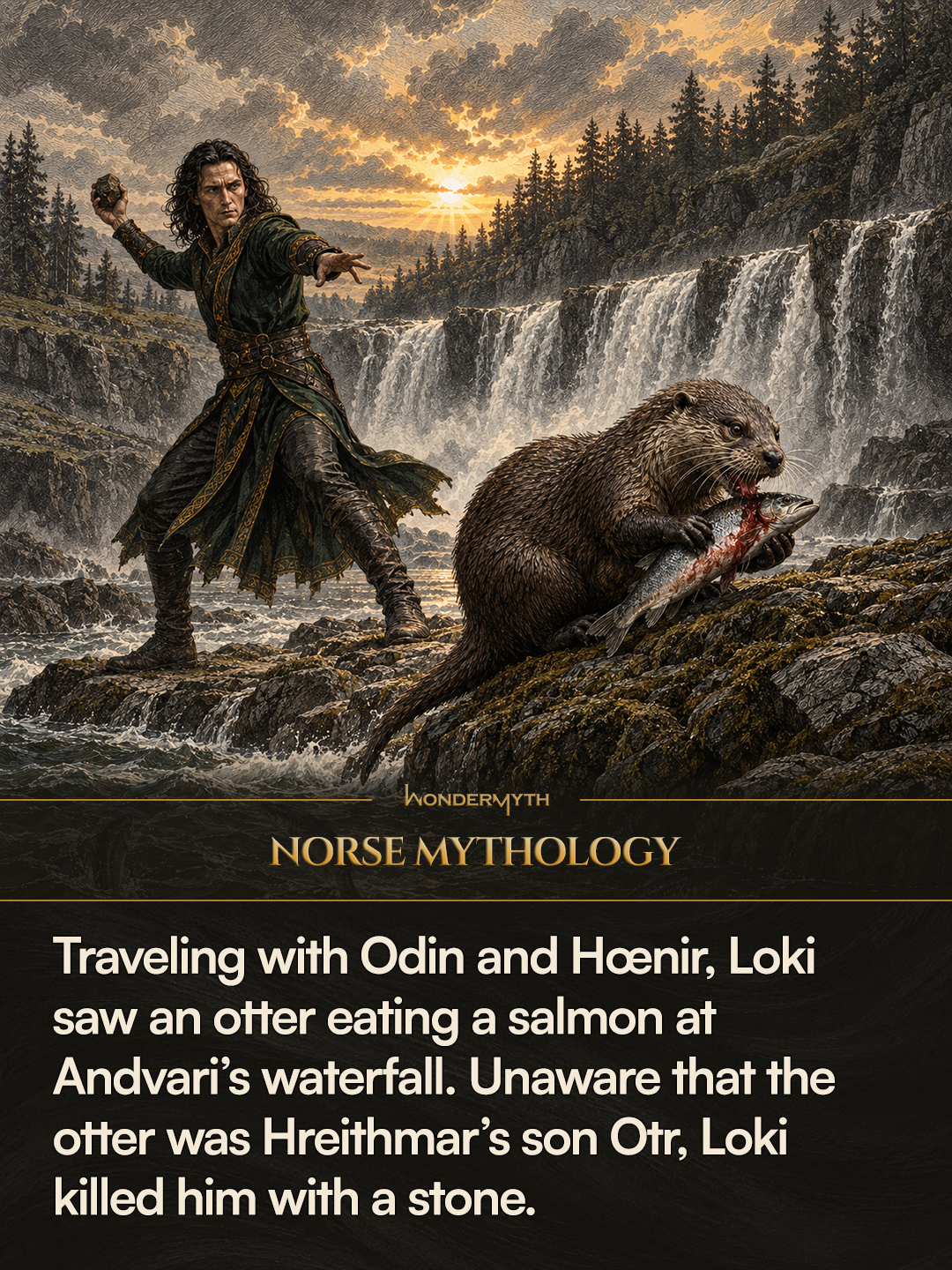
Traveling with Odin and Hœnir, Loki reached Andvari’s waterfall, where Otr sat in otter form eating a salmon. Loki struck him with a stone and killed him. The three travelers skinned the otter and later displayed the hide at Hreithmar’s house, where it was recognized as belonging to his son.
Hreithmar and his family seized them and named the price of their freedom: Otr’s skin had to be filled with gold and completely covered on the outside. Loki’s throw set the Völsung treasure’s ruinous history in motion. Sent to obtain the ransom, he took Andvari’s gold, which passed into Hreithmar’s family and led to further bloodshed.
✦ What seems small in one moment can carry weight in lives we have yet to see.