Ra
Ra stands at the center of Egyptian solar theology as creator, divine king, and the power that renews the world each dawn. His journey carries the sun across the sky and through the underworld, where order must be defended before light can return. His many forms express one recurring pattern: creation survives because it is continually renewed.
English pronunciation: RAH for Ra; RAY for Re.
Original name (Egyptian): 𓂋𓂝𓇳
Transliteration: Rꜥ / Rꜥw
Name meaning: Sun.
Who Was Ra?
Ra is one of the central gods of ancient Egyptian religion. He is a solar creator and divine king whose authority connects the sun, cosmic order, and earthly kingship. Egyptian rulers expressed this relationship through the royal title “Son of Ra.”
Ra’s identity changes according to theological context rather than remaining fixed in one form. He overlaps with Atum in Heliopolitan creation, joins Horus as Ra-Horakhty, combines with Amun as Amun-Ra, and appears through Khepri in the rising sun. These forms express different aspects of solar creation, rule, and renewal without reducing the participating gods to interchangeable aliases.
Origins & Family
In Heliopolitan creation theology, Ra overlaps with Atum as a self-generated creator with no required parents within that system. Ra or Ra-Atum brings forth Shu and Tefnut, who produce Geb and Nut; their children include Osiris, Isis, Set, and Nephthys, while the wider genealogy continues to Horus. This places Ra at the beginning of the Heliopolitan divine genealogy.
Children (Notable): Shu and Tefnut.
Domains, Appearance & Symbols
Domains & Roles
Ra governs the sun, daylight, warmth, and the life-giving power of solar light. His roles also include creation, divine kingship, the protection of maat, and the recurring renewal of life.
Each day Ra crosses the sky, and each night he travels through the Duat, where hostile forces threaten the solar cycle. His renewed appearance at dawn restores light, confirms cosmic order, and allows creation to continue.
Appearance
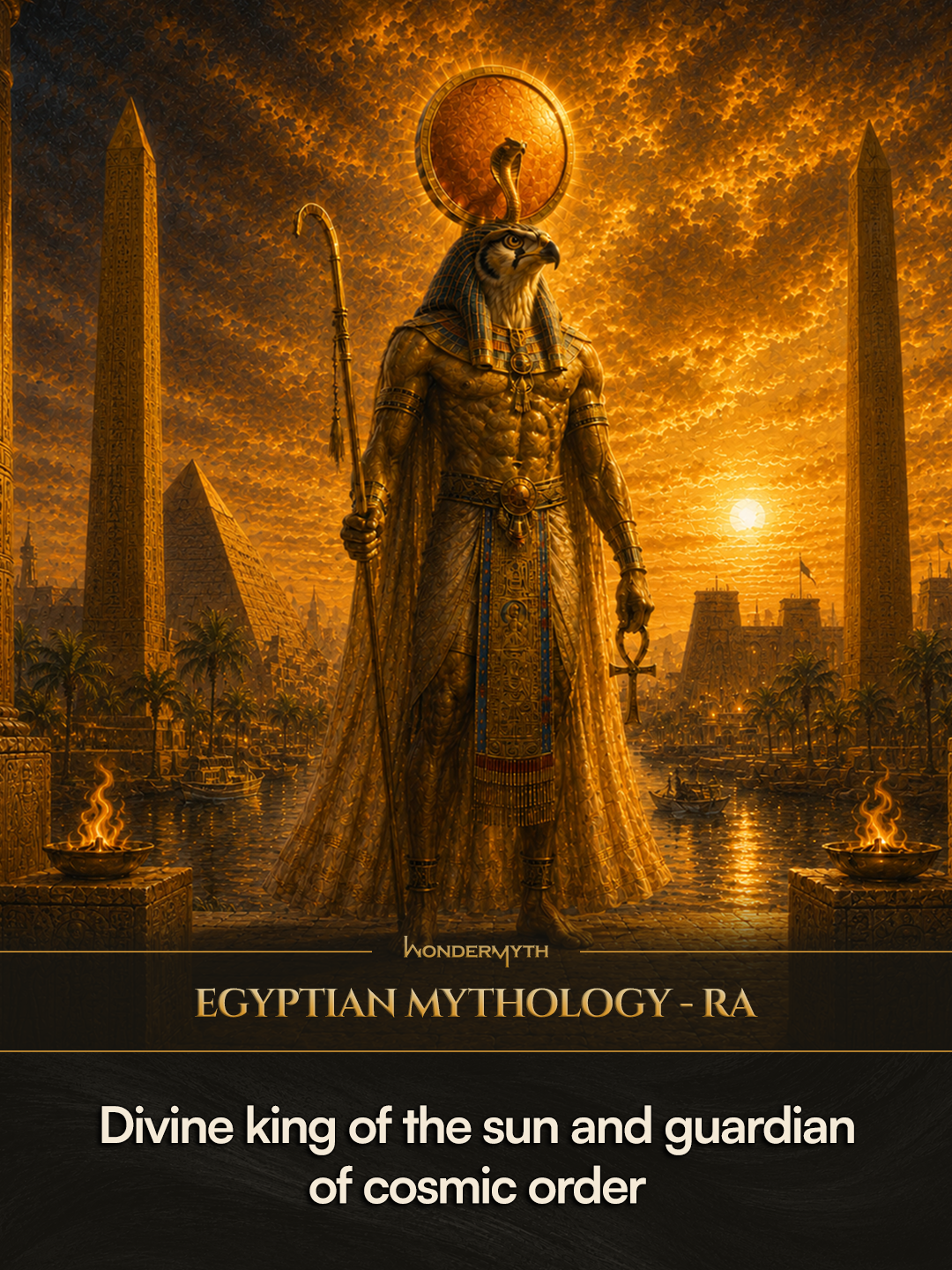
Ra has no single universal ancient form. As Ra-Horakhty, he commonly appears as a falcon-headed man wearing a solar disk encircled by a uraeus. A Third Intermediate Period stela shows Ra-Horakhty-Atum as a falcon-headed god accompanied by solar-rebirth imagery. Other contexts show the morning sun as the scarab Khepri and the nocturnal sun as a ram-headed god.
Symbols
- Solar disk: The visible sun and Ra’s most direct identifying emblem.
- Uraeus cobra: Encircles or accompanies the solar disk as a sign of divine protection and solar authority.
- Solar barque: Carries Ra across the sky and through the underworld.
- Eastern and western horizons: Mark his renewed rising and his entrance into the night journey.
- Scarab beetle: Represents Khepri, the rising sun’s coming into being and self-renewal.
- Ram-headed form: Expresses the aged or nocturnal sun in major underworld compositions.
- Obelisk and pyramidion: Monumental solar forms linked with creation, illumination, and Ra’s cult.
Key Myths
Ra Creates the First Divine Generation
In Heliopolitan creation theology, the solar creator comes into being before the differentiated world, often as Atum or Ra-Atum. He brings forth Shu and Tefnut, who produce Geb and Nut, and the divine generations continue from them. Creation unfolds through the emergence of distinct cosmic powers rather than one instant act. The myth places Ra at the beginning of the gods’ genealogy and the ordered world they inhabit.
Ra’s Night Voyage and the Battle against Apophis
At sunset, Ra enters the western horizon and travels through the Duat in his solar barque. Gods, protective beings, and the blessed dead help him pass through the night, while the serpent Apophis tries to halt or overthrow the journey. Different underworld and anti-Apophis ritual texts show Ra’s defenders binding, piercing, cutting, burning, or repelling the serpent. Apophis returns, but Ra is renewed and rises again, restoring dawn and the continuing order of creation.
The Eye of Ra and the Destruction of Mankind
In the Book of the Heavenly Cow, the aged Ra learns that humanity has rebelled against him. He sends Hathor as his Eye to punish them, and she begins a slaughter that threatens to continue beyond its intended limit. Her attack takes the form of a destructive rage associated with Sekhmet, although Hathor remains the goddess named in this account. Ra orders beer to be colored red and poured across the land. She drinks it, becomes intoxicated, and stops killing. Ra then withdraws to the sky, changing the relationship between gods and humans.
Isis Forces Ra to Reveal His Secret Name
In one magical narrative, Isis seeks the hidden name that carries Ra’s deepest power. She mixes earth with his fallen saliva, shapes a snake, and places it where the aged sun god will pass. The snake bites him, and Isis refuses to remove the poison until he yields the concealed name. Ra finally allows it to pass to her under a condition governing its transmission to Horus. Isis heals him, gaining magical authority without replacing his cosmic rule.
Worship & Ancient Impact
Iunu, later called Heliopolis, was Ra’s principal cult and theological center. Fifth Dynasty kings built sun temples in the Memphite region with open courts, altars, and monumental solar forms that joined royal power with the sun’s life-giving force. Obelisks also became major expressions of solar worship, their shining tips catching the light.
Kings maintained Ra’s cult through offerings, temples, hymns, monuments, royal names, and the title “Son of Ra.” Funerary texts allowed the dead to praise him, join or protect his barque, and hope to share in the renewal that returned the sun to the eastern horizon.
Modern Influence
The musician Sun Ra adopted an Egyptian solar identity and joined it with outer space, liberation, and experimental music, creating an Afrofuturist cosmology rather than reproducing ancient Egyptian theology.
Rick Riordan’s Kane Chronicles also adapts Ra within modern fantasy. The series uses his disappearance, recovery, solar voyage, and struggle with Apophis as major plot material. These works preserve Ra’s connection with the sun and cosmic renewal while reshaping him for new artistic and narrative worlds.
Lore Moments
-
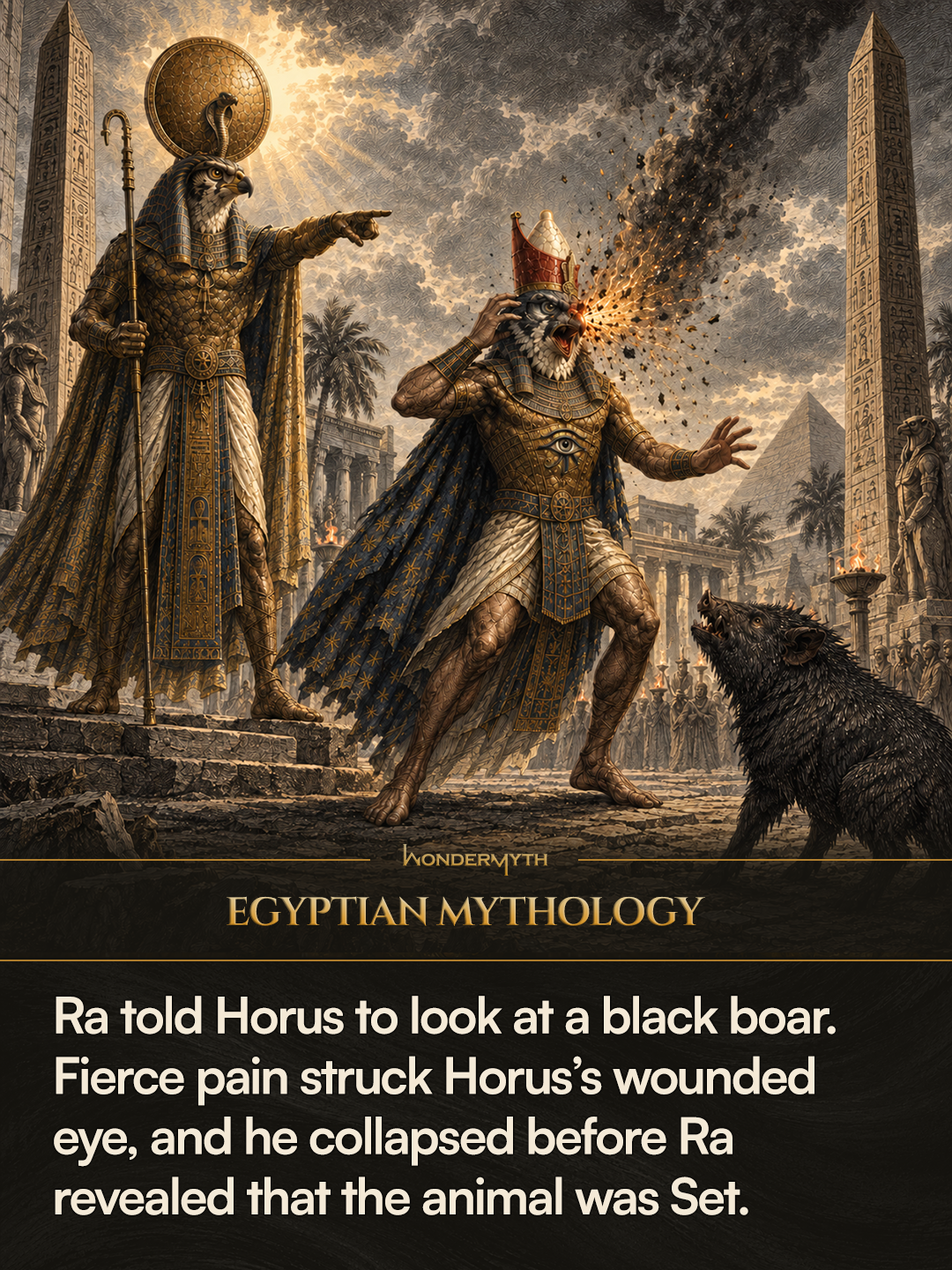
Ra examined Horus’s injured eye and told him to look at a black pig. When Horus obeyed, the eye erupted in severe pain, and he compared the agony to the blow Set had dealt it. Ra ordered the gods to place Horus on his bed until he recovered. The black pig was Set in animal form, the attacker who had wounded Horus’s eye.
The episode connected Set’s animal disguise with Horus’s wounded eye and explained why the pig became abhorrent to Horus and his divine following.