Horus
Horus stands at the center of Egyptian kingship as the divine heir whose authority survives rivalry, injury, and repeated challenge. He appears as a sky-falcon, royal protector, hidden child, wounded claimant, and restored ruler. His many forms do not create one seamless biography, but they return to the same pattern: rightful power is threatened, defended, and renewed.
English pronunciation: HOR-us
Original name (Egyptian): 𓅃, one common logographic form; hieroglyphic spellings vary.
Transliteration: Ḥr.w; later Demotic Ḥr
Who Was Horus?
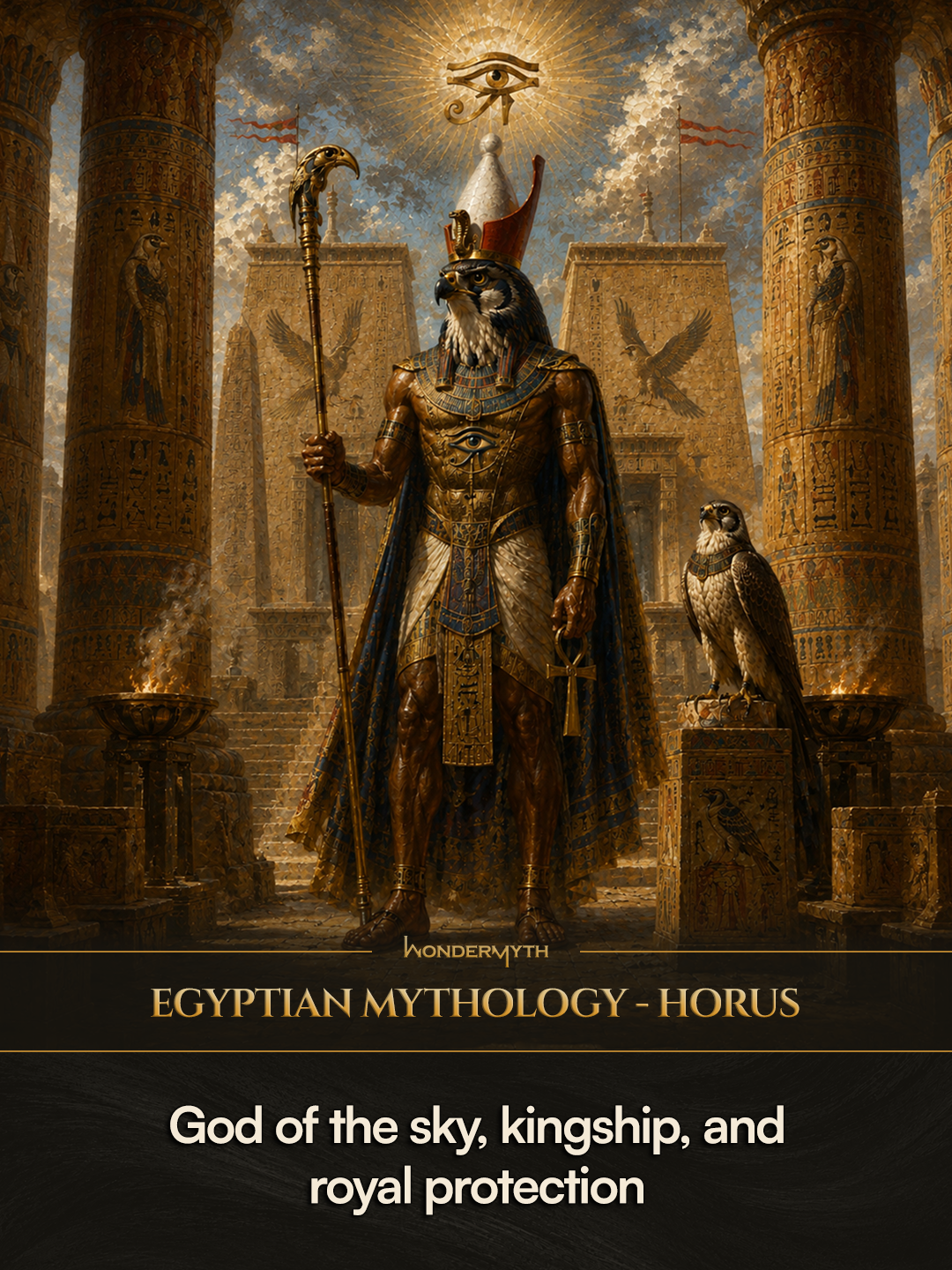
Horus is one of the oldest and most enduring gods of ancient Egypt. His identity was closely bound to the Egyptian monarchy: kings carried a Horus name and could be understood as the god’s living manifestation within royal ideology. This connection made Horus central to how divine kingship and legitimate rule were expressed.
Horus does not have one seamless biography. In the Osirian cycle, he is the son of Isis and Osiris who claims his murdered father’s throne from Seth. Other traditions present him as an older celestial god, a divine child, a solar power of the horizons, or the warrior god of Behdet. These forms developed through different local and theological traditions and should not be treated as stages in one continuous life.
Origins & Family
Horus’s earliest known identity is closely tied to the falcon, the sky, and royal authority. His connection with Egyptian rulers appears earlier than the fully developed Osirian family narrative preserved in surviving sources. In that later succession tradition, Isis conceives Horus after restoring Osiris and hides the child in the Delta marshes until he can claim his inheritance. Horus’s family relationships vary according to his form and cult tradition.
Parents: Isis and Osiris
Spouse: Hathor (as Horus of Edfu, in the Dendera–Edfu cult tradition)
Children (Notable): Imsety, Hapy, Duamutef, and Qebehsenuef (the Four Sons of Horus, in funerary tradition)
Domains, Appearance & Symbols
Domains & Roles
Horus’s primary spheres are divine kingship, legitimate royal succession, celestial power, royal protection, and victory over rival claims. In royal theology, he represents the living ruler who succeeds a dead predecessor associated with Osiris.
Specific forms of Horus carry additional functions. Horus the Child protects against venom and illness, Horakhty and Re-Horakhty express solar and horizon power, and Horus of Behdet acts as a royal and martial defender. These roles belong to particular forms and contexts rather than to one universally uniform Horus.
Appearance
Horus most often appears as a falcon or as a male figure with a falcon’s head. Royal crowns and the uraeus may identify his connection with kingship, while some images show the falcon protecting or accompanying the ruler. Horus the Child has a distinct later form: a nude child with a sidelock of youth and a finger raised toward the mouth.
Symbols
• Falcon: Horus’s most persistent symbol, though falcon form alone does not always identify him.
• Falcon-surmounted serekh: Connects Horus with the royal name and Egyptian kingship.
• Royal crowns: Identify Horus’s connection with divine kingship and royal authority.
• Uraeus: Marks his association with kingship and royal protection.
• Eye of Horus or wedjat: The restored eye represents healing, soundness, regeneration, rebirth, and protection.
Key Myths
The Struggle for Osiris’s Throne
Seth kills and dismembers Osiris, but Isis restores Osiris sufficiently to conceive Horus and hides their son until he reaches maturity. Horus then claims his father’s kingship, while Seth disputes his right before the divine assembly. Their struggle unfolds through judgments, transformations, trickery, and bodily conflict rather than one simple battle. Osiris’s authority from the realm of the dead helps settle the dispute, and Horus is recognized as the legitimate successor.
The Eye of Horus Is Restored
In many traditions, one of Horus’s eyes is injured, removed, stolen, or divided during the conflict with Seth. Other versions differ in the injury and healer, though Thoth restores the eye in prominent traditions. The repaired eye becomes the wedjat, the sound or whole eye. Horus’s restored body confirms that injury has not destroyed his claim, while the healed eye becomes a protective and regenerative symbol for both the living and the dead.
Horus the Child Is Healed
While Isis hides the young Horus in the Delta marshes, the child becomes gravely ill or poisoned. Isis cries for help, the solar boat halts, and Thoth is sent to heal him through ritual speech. Horus recovers, and his cure becomes a divine precedent for human healing. On magical stelae, the child stands on crocodiles and grasps dangerous animals, showing that their harmful power has been subdued.
Worship & Ancient Impact
Horus received temple cult at major centers including Edfu, Nekhen or Hierakonpolis, Qus, and Hebenu. At Edfu, priests cared for and served a sacred image of Horus of Behdet through offerings, purification, and dressing the image, while processions and other temple rites formed part of the wider cult. The Festival of the Living Falcon crowned a sacred falcon as a representation of Horus and the reigning king.
The Feast of the Joyous Union brought Hathor’s statue from Dendera to Edfu to celebrate her sacred marriage with Horus. Horus cippi and wedjat amulets also carried his protective power into healing and funerary practice.
Modern Influence
Rick Riordan’s The Kane Chronicles, beginning with The Red Pyramid in 2010, adapts Horus as a major supernatural figure connected with Carter Kane. The series draws on his falcon identity, combat power, kingship, and association with pharaonic authority while freely combining ancient traditions for modern fantasy.
The 2016 film Gods of Egypt similarly presents Horus as a heroic royal claimant fighting to regain power. Both works are modern fantasy adaptations rather than accounts of Horus’s ancient appearance, relationships, or mythic history.
Lore Moments
-
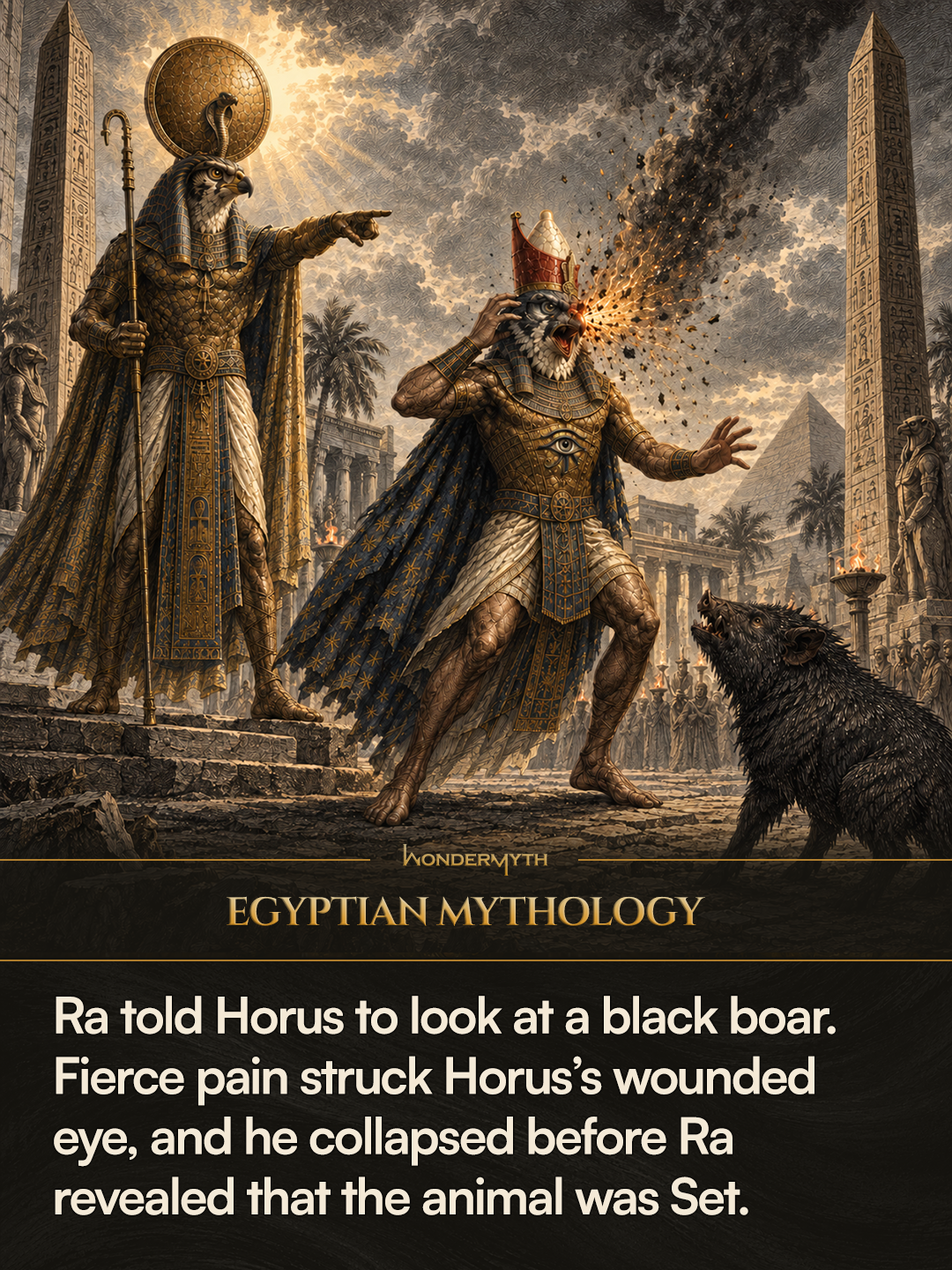
Ra examined Horus’s injured eye and told him to look at a black pig. When Horus obeyed, the eye erupted in severe pain, and he compared the agony to the blow Set had dealt it. Ra ordered the gods to place Horus on his bed until he recovered. The black pig was Set in animal form, the attacker who had wounded Horus’s eye.
The episode connected Set’s animal disguise with Horus’s wounded eye and explained why the pig became abhorrent to Horus and his divine following.