Thor
Thor meets the threats of Norse mythology with a hammer in his hand and overwhelming strength behind every blow. He protects gods and humans, crushes giants, hallows sacred acts, and repeatedly confronts forces that strength cannot fully master. His myths return to one hard limit: even the strongest defender cannot escape deception, lasting injury, old age, or fate.
English pronunciation: THOR
Original name (Old Norse): Þórr
Transliteration: Þórr
Name meaning: Thor’s name is cognate with Germanic words for “thunder.”
Who Was Thor?
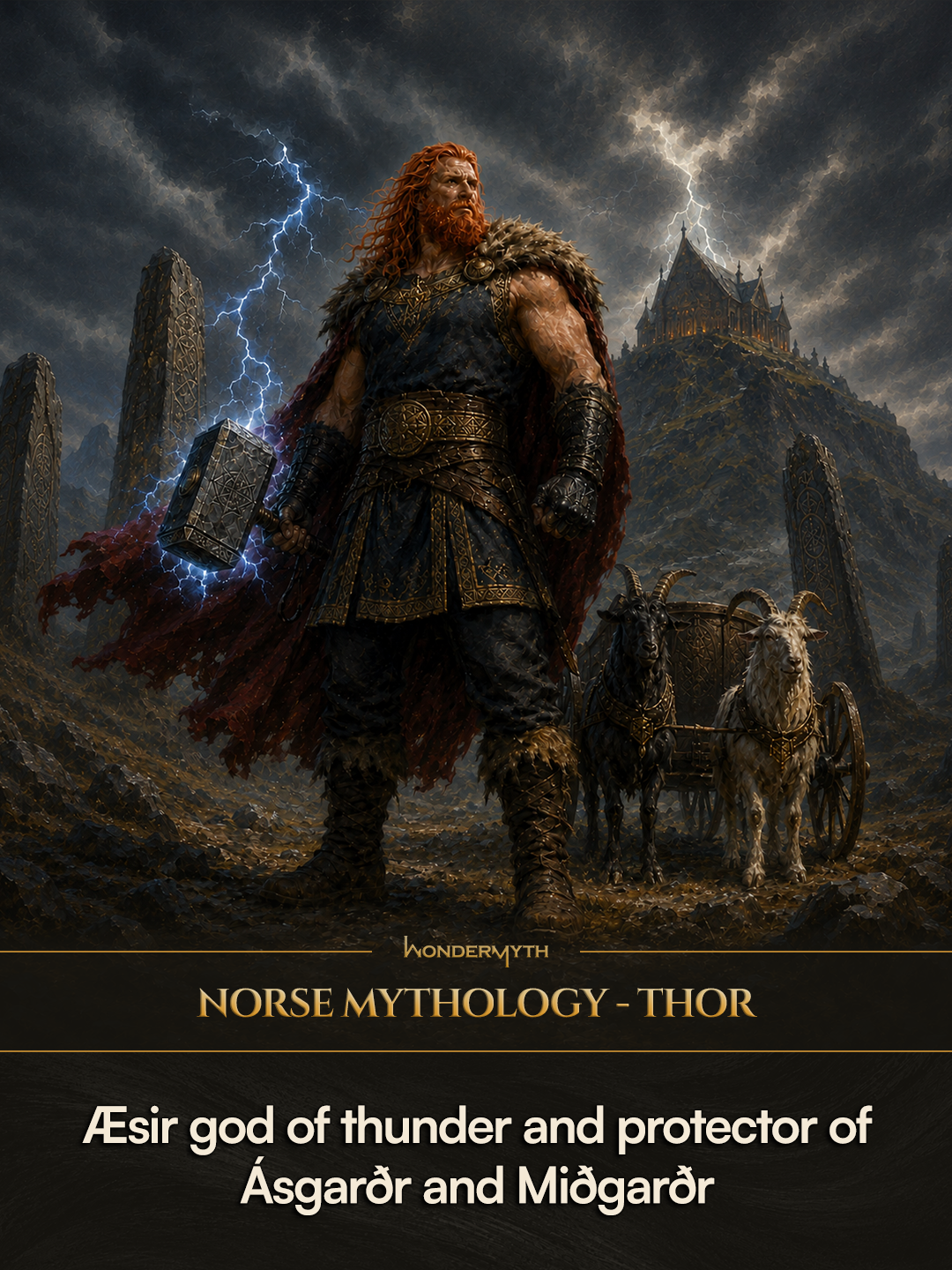
Thor is one of the principal Æsir gods and the strongest divine fighter in the surviving Norse tradition. His myths repeatedly place him where danger must be met directly, making him one of the most immediate protective forces among the gods. Mjölnir expresses both sides of that identity: it destroys threatening beings and hallows important acts.
Yet Thor’s myths do not make strength simple or unlimited. He can shatter a giant’s skull, disturb the sea, or lift part of the World Serpent, but deception, cosmic scale, old age, and fate still restrain him. This tension gives his myths their defining pattern. Thor is the defender whose victories often carry wounds, humiliation, or an unavoidable final cost.
Origins & Family
Thor is the son of Odin and Jörð, the personified earth. He belongs to the Æsir and is married to Sif. His close family connects him to both the ruling gods and the giant world he repeatedly fights, while his children continue his strength beyond Ragnarök.
Parents: Odin and Jörð.
Siblings: Meili (maternal parentage not preserved).
Half-Siblings (Notable): Baldr, Höðr, Víðarr, and Váli.
Spouse: Sif.
Consorts: Járnsaxa.
Children: Magni (with Járnsaxa), Móði, and Þrúðr (with Sif).
Domains, Appearance & Symbols
Domains & Roles
Thor is associated with thunder, violent weather, immense strength, protection, consecration, and the destruction of giants. His role is to defend Ásgarðr and Miðgarðr through direct physical intervention, confronting dangers that other gods evade, negotiate with, or cannot physically contain. He is a central protector, not a universal ruler.
Appearance
No surviving source gives Thor one universal physical portrait. Viking Age images instead identify him through action and attributes. The Eyrarland figure presents a compact seated figure holding a hammer, while the Hørdum and Altuna stones show the serpent-fishing episode. The Eddic texts do not fix Thor’s hair or beard color, costume, armor, or helmet. In the later saga Eiríks saga rauða, Thor is called Redbeard, but this source-specific detail does not establish one universal portrait.
Symbols
- Mjölnir: Thor’s defining symbol, used to strike giants and hallow important acts.
- Belt of strength: Megingjörð is one of Thor’s major pieces of equipment and is associated with his immense strength.
- Iron gloves: Thor’s iron gloves belong to the equipment associated with handling Mjölnir.
- Goat-drawn chariot: Thor’s chariot is drawn by Tanngnjóstr and Tanngrisnir.
- Hammer pendants: These objects are associated with Thor. Protection, religious identity, consecration, and divine affiliation are plausible contextual meanings, but the purpose or meaning of each surviving pendant cannot always be reconstructed.
Key Myths
The Theft of Mjölnir
Thor wakes to find Mjölnir stolen and hidden by the giant Þrymr, who demands Freyja as his bride in return. After Freyja refuses, Heimdall proposes disguising Thor as the bride, with Loki as his attendant. At the wedding feast, Thor’s appetite and fierce gaze nearly expose him, but Loki explains them away. When the hammer is placed on Thor’s knees to consecrate the marriage, he seizes it and kills Þrymr and the assembled giants.
Thor Fishes for Jörmungandr
Thor goes fishing with the giant Hymir and tears the head from Hymir’s largest ox for bait. Jörmungandr bites, and Thor pulls so violently that his feet break through the boat. He raises Mjölnir as the serpent rises from the sea, but the surviving versions differ over how it escapes. Thor nearly destroys his cosmic enemy, but Jörmungandr survives, and their conflict continues toward Ragnarök.
The Trials at Útgarða-Loki
Thor enters Útgarða-Loki’s stronghold and faces contests designed to make him appear weak. He cannot empty a drinking horn, lift more than one paw of a gray cat, or defeat an elderly woman in wrestling. Útgarða-Loki later reveals that the horn reaches into the sea, the cat is Jörmungandr, and the woman is old age itself. The revelation turns Thor’s apparent failures into evidence of extraordinary power. Even so, Útgarða-Loki’s deception denies him a true victory.
Thor’s Duel with Hrungnir
Thor meets the giant Hrungnir at Grjótúnagarðar for an arranged duel. Hrungnir throws a whetstone as Thor hurls Mjölnir. The hammer shatters the stone and crushes the giant’s skull, but a fragment lodges in Thor’s head, and Hrungnir’s leg falls across his neck. Thor’s infant son Magni lifts the leg when the other gods cannot. Thor kills Hrungnir, yet the whetstone fragment remains lodged in his head as a lasting injury.
Thor and Jörmungandr at Ragnarök
At Ragnarök, Jörmungandr rises from the sea and poisons the world around it. Thor confronts the enemy he failed to destroy during the fishing expedition and kills the serpent in the gods’ final battle. He then walks nine steps before its venom kills him. The victory fulfills Thor’s fate as the World Serpent’s destroyer, and his death confirms that fate cannot be escaped.
Worship & Ancient Impact
Thor’s consecrating role appears directly in Viking Age evidence. The Glavendrup runestone invokes him to hallow its runes, and related Scandinavian formulas ask Thor to hallow inscriptions or monuments. Hammer pendants also became widespread material signs associated with him, although their individual purposes varied.
An eleventh-century account by Adam of Bremen describes Thor at Uppsala in connection with weather, crops, plague, famine, and sacrifice. Because the report comes from an outside Christian author, it belongs to that specific setting rather than serving as a universal picture of Norse worship.
Modern Influence
Mårten Eskil Winge’s 1872 painting Thor’s Fight with the Giants helped shape the later image of Thor as a muscular, hammer-wielding warrior. Its dramatic battle style belongs to nineteenth-century Romantic and nationalist art, not Viking Age iconography.
Marvel’s superhero Thor, introduced in Journey into Mystery #83 in 1962, keeps names and objects from Norse mythology while creating a separate fictional world. Mjölnir also remains an active religious emblem among modern Heathen and Ásatrú practitioners. That living religious use should be distinguished from commercial entertainment and from claims of one unchanged Viking Age ritual tradition.
Lore Moments
-
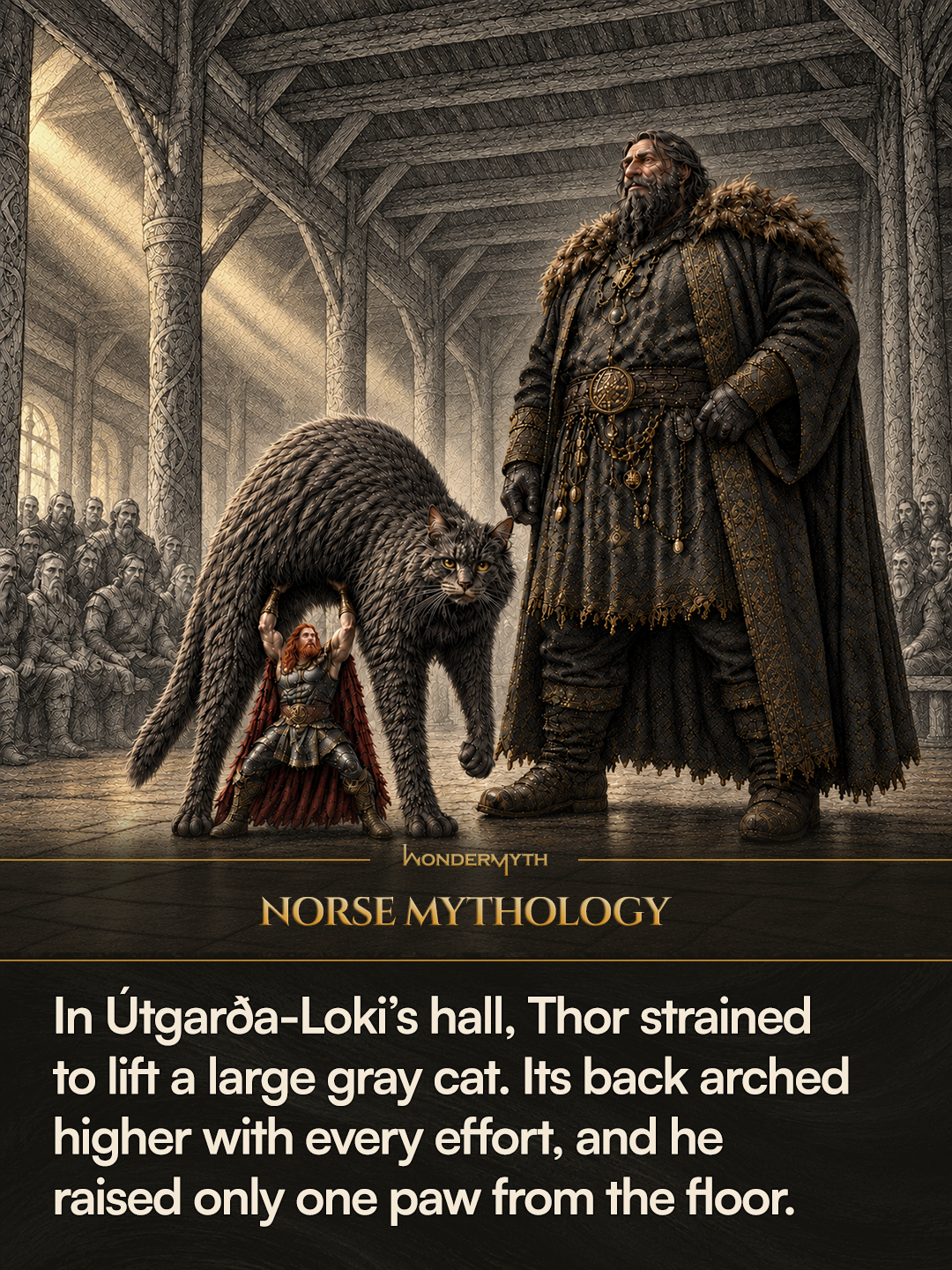
In Útgarða-Loki’s hall, Thor was offered what sounded like a trivial test: lifting the host’s large gray cat from the floor. He placed a hand beneath its body and strained upward, but the cat arched its back with every movement. Even at his full reach, Thor raised only one paw before giving up the attempt.
The next morning, Útgarða-Loki revealed that the contest had been an illusion. The cat was the Midgard Serpent, Jörmungandr, whose body encircled all lands. Thor had lifted against the immense serpent until his outstretched hand reached nearly to heaven. What appeared to be failure had terrified those who witnessed it, because lifting even one paw was an extraordinary feat.
✦ What looks like failure may actually be an extraordinary accomplishment once the true test is known.