Jörmungandr
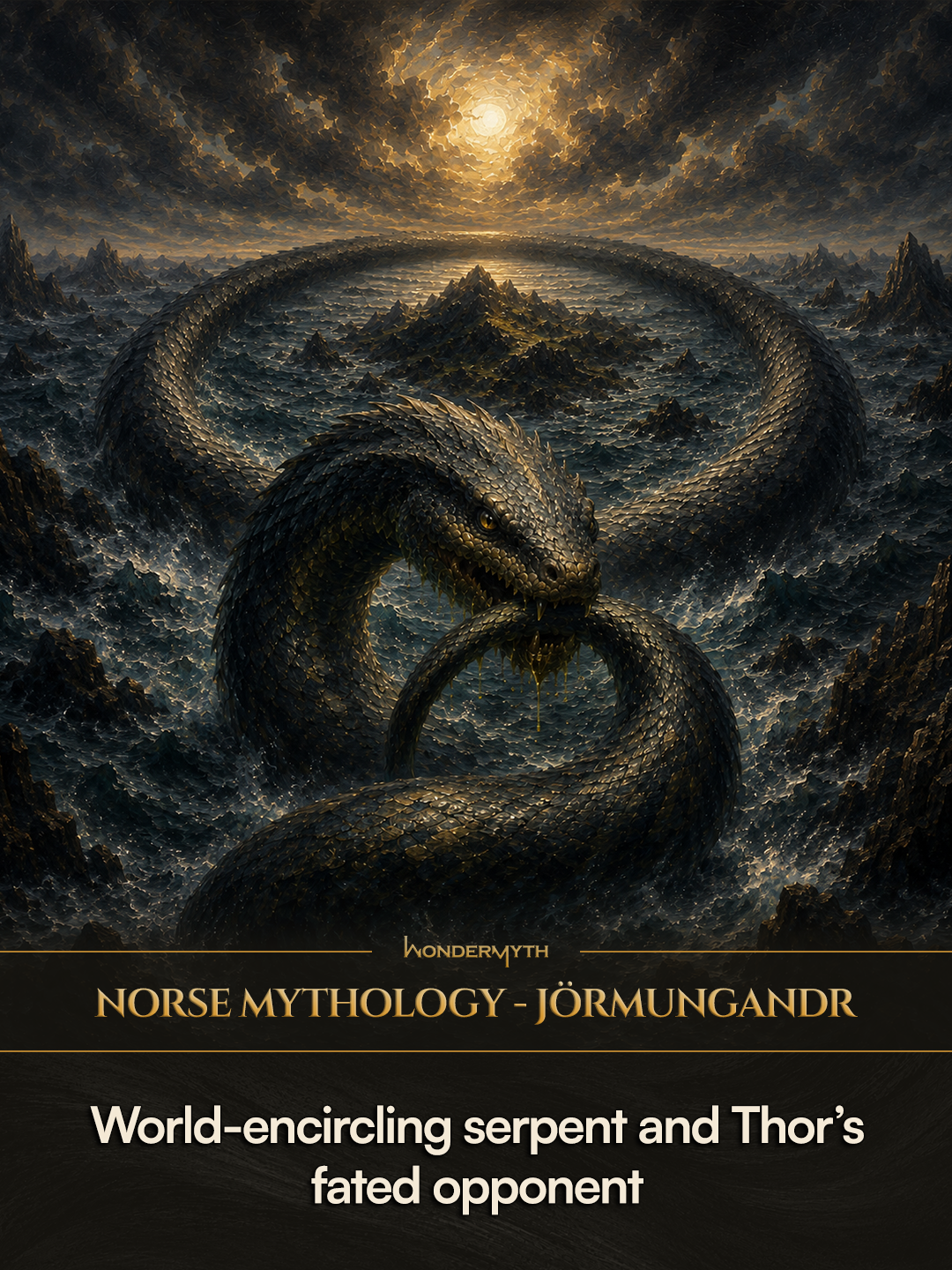
Jörmungandr coils through Norse mythology on a scale large enough to encircle the inhabited world. Cast into the surrounding sea by Odin, he becomes Thor’s recurring opponent and the source of the god’s final doom. Their encounters follow one relentless pattern: Thor can match the serpent’s strength, but he cannot escape the fate tied to him.
English pronunciation: YUR-moon-GAHN-dur
Original name (Old Norse): Jǫrmungandr
Transliteration: Jǫrmungandr
Who Was Jörmungandr?
Jörmungandr is the colossal serpent of the sea surrounding Midgard, the inhabited world. He is also called Miðgarðsormr, the Midgard Serpent. His body grows until it reaches around the land and his mouth closes upon his own tail. He is not a god or sea deity, but a living, venomous monster whose size places him beyond ordinary creatures.
His mythology is closely bound to Thor. Jörmungandr appears as the hidden measure of Thor’s strength, the serpent Thor nearly hauls from the sea, and the enemy he finally kills at Ragnarök. Yet victory does not save the god. Jörmungandr’s venom ensures that their last battle destroys them both.
Origins & Family
Jörmungandr is one of three monstrous children born to Loki and the giantess Angrboða in Jötunheim. A prophecy warns the gods that these children will bring great harm, leading Odin to remove them. Jörmungandr’s siblings, Fenrir and Hel, also become central figures in the events surrounding Ragnarök.
Parents: Loki and Angrboða.
Siblings: Fenrir and Hel.
Domains, Appearance & Symbols
Domains & Roles
Jörmungandr occupies the ocean surrounding Midgard and forms a living boundary around the inhabited world. At Ragnarök, he rises from the sea as one of the destructive forces that bring the existing cosmic order to an end. His role is geographical and apocalyptic rather than that of a god governing the sea.
Appearance
Surviving sources describe Jörmungandr as an immense serpent whose body can encircle the world. The Altuna runestone and the Hørdum picture stone preserve medieval representations of Thor’s fishing encounter with the World Serpent. They do not establish a fixed color, scale pattern, horn arrangement, fins, wings, or dragon-like head, and no single universal body design survives.
Symbols
• The encircling sea: Jörmungandr’s dwelling after Odin casts him away.
• The tail held in his mouth: A physical detail in Snorri’s account. Surviving Norse sources do not interpret it as a symbol of eternity or rebirth.
• Venom: The weapon that kills Thor after their final battle.
Key Myths
Cast into the Encircling Sea
The gods learn that Loki and Angrboða’s three children are destined to bring them great harm. Odin has the children brought before him and casts Jörmungandr into the deep sea surrounding the inhabited world. The serpent continues to grow until his body circles the land and he holds his tail in his mouth. The attempt to remove the threat instead gives the Midgard Serpent his world-spanning form and position.
The Cat at Útgarða-Loki’s Hall
At Útgarða-Loki’s hall, Thor is challenged to lift a large gray cat. The animal arches its body as he strains, and Thor manages to raise only one paw from the floor. Útgarða-Loki later reveals that the cat was Jörmungandr concealed by an illusion. The onlookers had been terrified because Thor had lifted part of the serpent whose body encircled the earth, turning an apparent failure into proof of extraordinary strength.
Thor Fishes for the World Serpent
Thor joins the giant Hymir on a fishing expedition and cuts the head from Hymir’s largest ox to use as bait. Jörmungandr takes the hook, and Thor hauls him toward the boat as the serpent blows venom. Thor braces so fiercely that his feet break through the hull and reach the sea bottom. In Snorri’s account, Hymir cuts the line as Thor raises Mjöllnir, and Jörmungandr sinks back into the sea to await their final battle.
Thor and Jörmungandr at Ragnarök
When Ragnarök begins, Jörmungandr twists through the sea, drives the waters over the land, and spreads venom through the air and water. He meets Thor on the battlefield while the other gods confront their own enemies. Thor kills the serpent, then walks only nine steps before collapsing from its poison.
Modern Influence
Later artists and storytellers continue to emphasize Jörmungandr’s immense scale and destined conflict with Thor. Henry Fuseli’s 1790 painting Thor Battering the Midgard Serpent presents the fishing expedition as a monumental Romantic struggle. Walt Simonson adapted the Ragnarök battle in Thor #380 in 1987, while the 2018 game God of War reimagines the World Serpent as a communicative and more sympathetic figure.
These works preserve his association with the world, Thor, and Ragnarök, but modern adaptations reshape his characterization, visual design, relationships, and timeline beyond what survives in medieval Norse tradition.
Lore Moments
-
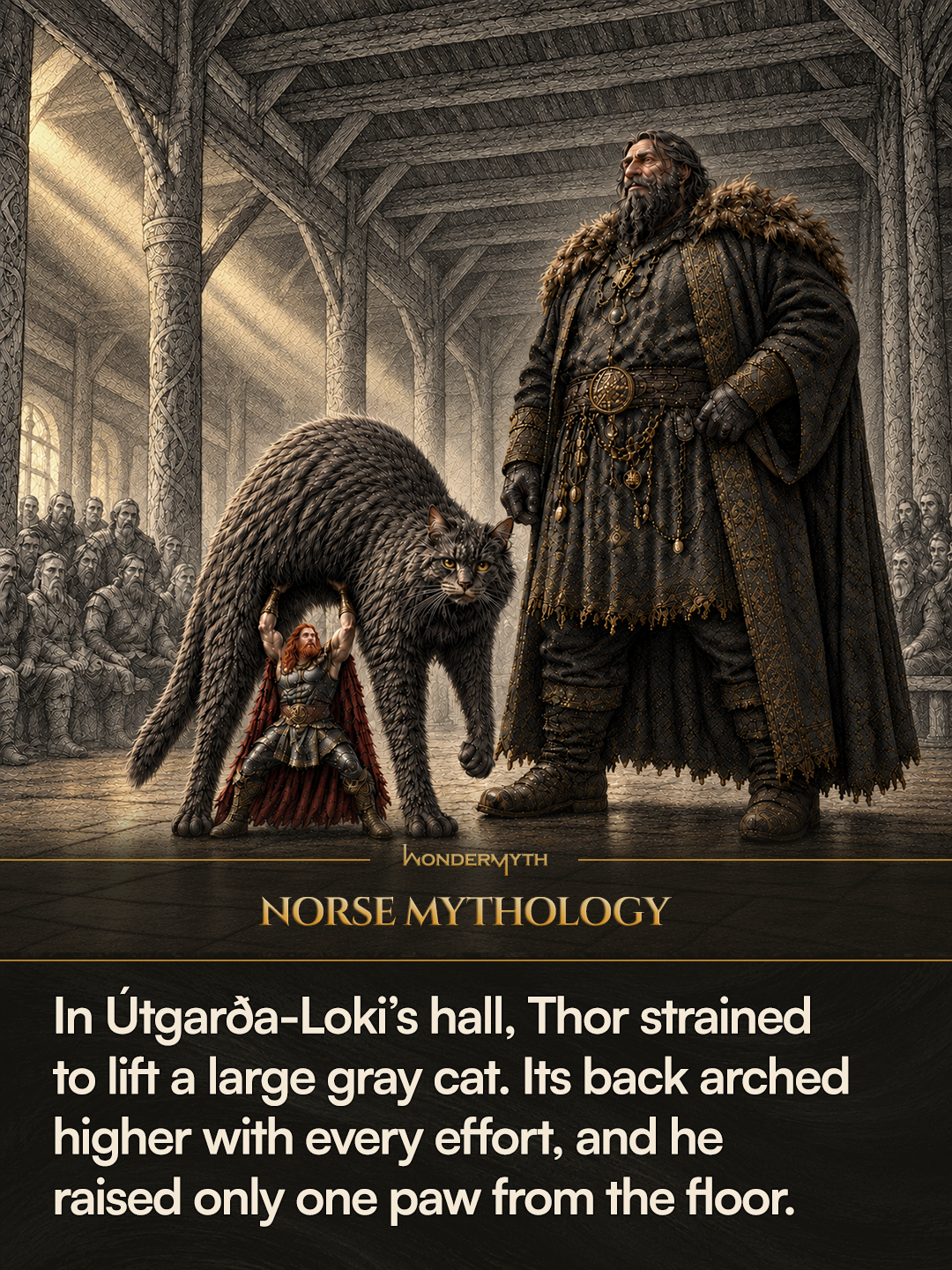
In Útgarða-Loki’s hall, Thor was offered what sounded like a trivial test: lifting the host’s large gray cat from the floor. He placed a hand beneath its body and strained upward, but the cat arched its back with every movement. Even at his full reach, Thor raised only one paw before giving up the attempt.
The next morning, Útgarða-Loki revealed that the contest had been an illusion. The cat was the Midgard Serpent, Jörmungandr, whose body encircled all lands. Thor had lifted against the immense serpent until his outstretched hand reached nearly to heaven. What appeared to be failure had terrified those who witnessed it, because lifting even one paw was an extraordinary feat.
✦ What looks like failure may actually be an extraordinary accomplishment once the true test is known.