
Odin
Odin rules among the Æsir through knowledge, warfare, magic, and relentless preparation. He gives victory, gathers selected battle-slain warriors, steals poetry, questions the dead, and sacrifices part of himself for wisdom. His myths return to one severe pattern: knowledge always has a price, and even the greatest foresight cannot defeat fate.
English pronunciation: OH-din
Original name (Old Norse): Óðinn
Transliteration: Óðinn
Name meaning: The furious one.
Who Was Odin?
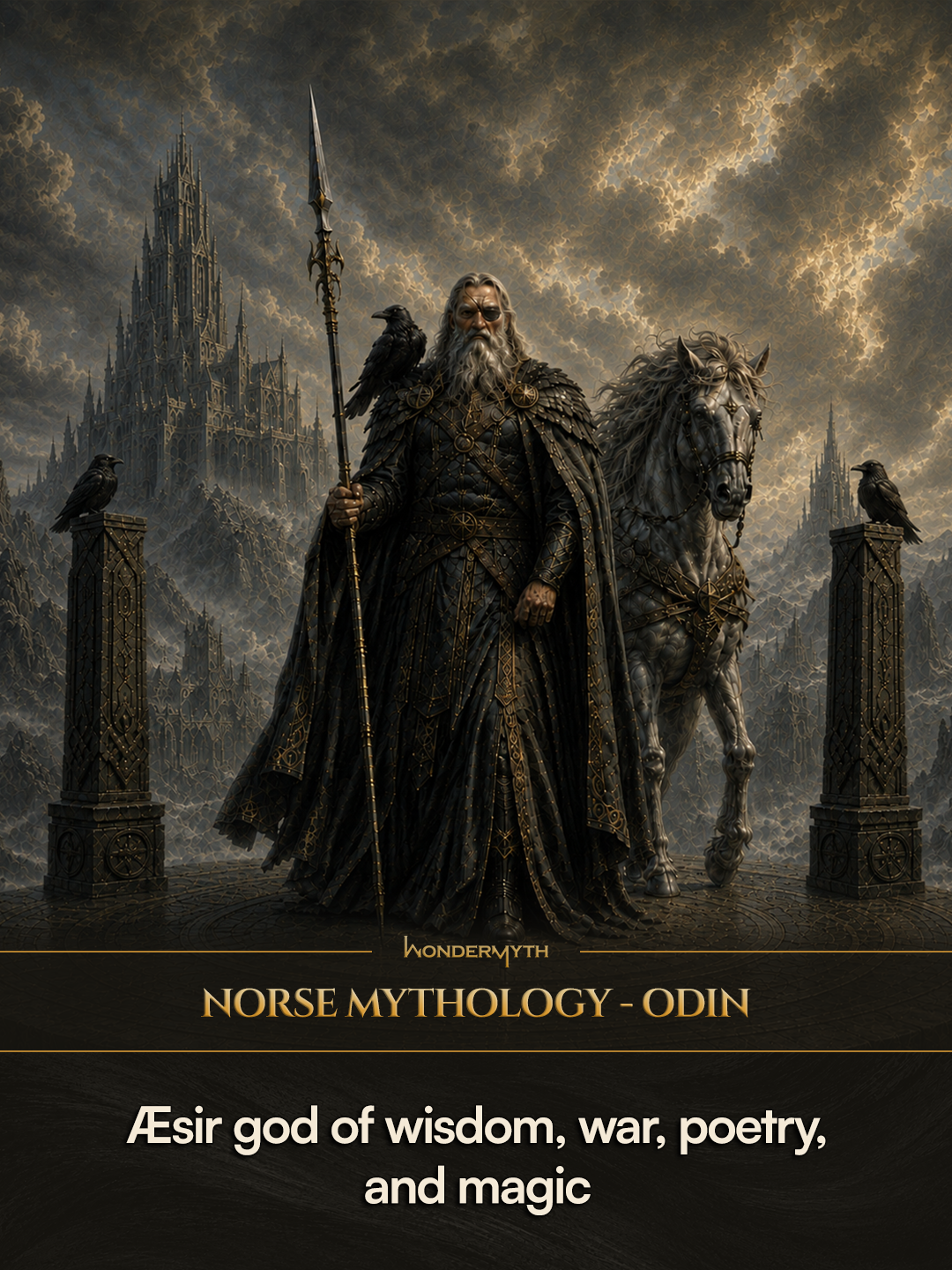
Odin is a male god of the Æsir and one of the foremost divine rulers in Norse mythology. His title Allfather is an ancient epithet, but it does not mean that every god or supernatural being is literally his child.
What makes Odin distinct is the severity of his search for knowledge. He seeks counsel from Mímir, dead seeresses, ravens, runes, and contests with other beings. He can inspire poets and guide rulers, yet he also deceives, breaks promises, provokes conflict, and abandons favored warriors. His knowledge remains incomplete, his authority and methods can be morally dangerous, and all his preparation still cannot prevent his death.
Origins & Family
Odin is the son of Borr and Bestla. In Snorri’s creation account, he works with his brothers Vili and Vé to kill Ymir and shape the world from the primordial being’s body. Frigg is Odin’s central spouse, and his notable sons connect him to several major myth cycles.
Parents: Borr and Bestla.
Siblings: Vili and Vé.
Spouse: Frigg.
Consorts (Notable): Jörð, Gríðr, and Rindr.
Children (Notable): Thor (with Jörð); Baldr (with Frigg); Víðarr (with Gríðr); and Váli (with Rindr; relationship details vary by source).
Domains, Appearance & Symbols
Domains & Roles
Odin’s domains and recurring roles include sovereignty, warfare, victory, poetry, runes, prophecy, magic, disguise, and the pursuit of hidden knowledge. He receives part of the warriors slain in battle and prepares the einherjar in Valhalla for Ragnarök. He is not the only Norse war god, and he does not receive every fallen warrior, since Freyja receives half of the battle-slain.
Appearance
Odin is most clearly identified by his single eye, the lasting result of his pledge at Mímir’s well. In literary wandering disguises, he appears as an old, grey-bearded man wearing a cloak or broad hat and carrying a staff. Martial descriptions connect him with armor, a helmet, and the spear Gungnir, though no single costume defines every surviving tradition.
Possible Viking Age images of one-eyed figures, mounted riders, or birds are often associated with Odin, but many remain uncertain. Later manuscripts and art present clearer named images, although they postdate Scandinavia’s conversion to Christianity.
Symbols
• Missing eye: One of Odin’s strongest attributes and the lasting result of his pledge at Mímir’s well.
• Gungnir: Odin’s spear and one of his strongest attributes.
• Huginn and Muninn: Ravens who travel through the world and return with information.
• Geri and Freki: Wolve who accompany Odin at his table.
• Sleipnir: The eight-legged horse that carries Odin between worlds.
• Valhalla and the valkyries: They express Odin’s authority over selected battle-slain warriors.
• Hanging and the windswept tree: They recall his ordeal for the runes.
Key Myths
Odin Helps Shape the World and Humanity
In Snorri’s account, Odin, Vili, and Vé kill the primordial Ymir and use his body to form the ordered world. In the Völuspá, a different divine trio, Odin, Hœnir, and Lóðurr, finds Ask and Embla without life and gives them human faculties. Both traditions show Odin acting with other gods rather than creating alone: Snorri’s trio shapes the world, while the Völuspá trio gives life and human faculties to Ask and Embla.
Odin Pledges an Eye for Wisdom
Mímir guards a well beneath Yggdrasil that contains wisdom and understanding. When Odin asks to drink, Mímir demands a pledge, and Odin leaves one of his eyes in the well as payment. The exchange permanently marks his appearance and reveals one of his defining traits: he accepts bodily loss when knowledge is valuable enough.
Odin Hangs for the Runes
Odin hangs for nine nights on a windswept tree, commonly understood as Yggdrasil. Wounded with a spear and deprived of food and drink, he sacrifices himself to himself and peers downward until he sees and seizes the runes. The ordeal links his magical knowledge with hanging, suffering, death-like initiation, and knowledge gained through deliberate self-sacrifice.
Odin Steals the Mead of Poetry
Under the name Bölverkr, Odin gains help drilling into the mountain where Suttungr guards the mead of poetry. He reaches Gunnlöð and spends three nights with her. She grants him three drinks, and he empties one entire vessel with each. Odin escapes in eagle form with all the mead, leaving Gunnlöð betrayed and grieving. Poetry enters the divine sphere through deception, seduction, theft, and broken trust.
Odin Seeks the Fate of Baldr
After Baldr suffers ominous dreams, Odin rides into the realm of the dead and forces a dead seeress to answer him. She foretells Baldr’s death and the birth of Váli, the son of Rindr who will avenge Baldr. Odin gains the knowledge he seeks, but he cannot prevent the loss, making the episode one of the clearest limits on his foresight and authority.
Odin Faces Fenrir at Ragnarök
Odin gathers warriors, seeks counsel from Mímir, and leads the gods and chosen slain into the final battle. Armed with Gungnir, he confronts Fenrir directly, but the wolf swallows and kills him. Odin’s son Víðarr then avenges him by killing the wolf. All Odin’s knowledge allows him to prepare for his fate, but not to escape it.
Worship & Ancient Impact
Evidence links Odin especially with rulers, warriors, poets, magical specialists, violent death, and elite authority. A medieval saga describing an earlier sacrificial feast places Odin’s ceremonial cup first and connects it with victory and royal power. The account preserves valuable ritual memory, though it is not a contemporary pagan ritual manual.
Adam of Bremen describes Wotan as a god worshipped at Old Uppsala and associated with war and strength against enemies. His report is late, Christian, and partly dependent on external testimony, so its architectural and sacrificial details require caution. Place names such as Odense preserve Odin’s name across different periods, while the Vindelev inscription referring to “Odin’s man” suggests an early connection between Odin and elite authority.
Modern Influence
Richard Wagner transforms Odin into Wotan in The Ring of the Nibelung, combining Norse and continental Germanic traditions into a new dramatic ruler bound by contracts and political failure. J. R. R. Tolkien described Gandalf as an “Odinic wanderer,” drawing especially on the grey, disguised traveler rather than Odin’s complete mythology.
Marvel presents Odin as the armored king of Asgard and father of Thor within a separate fictional continuity. Its adoption of Loki as Odin’s son is a modern invention, not a surviving Norse relationship. Modern Heathen and Ásatrú communities may also honor Odin as a living religious figure, with practices that vary across communities and cannot be reduced to medieval descriptions.
Lore Moments
-
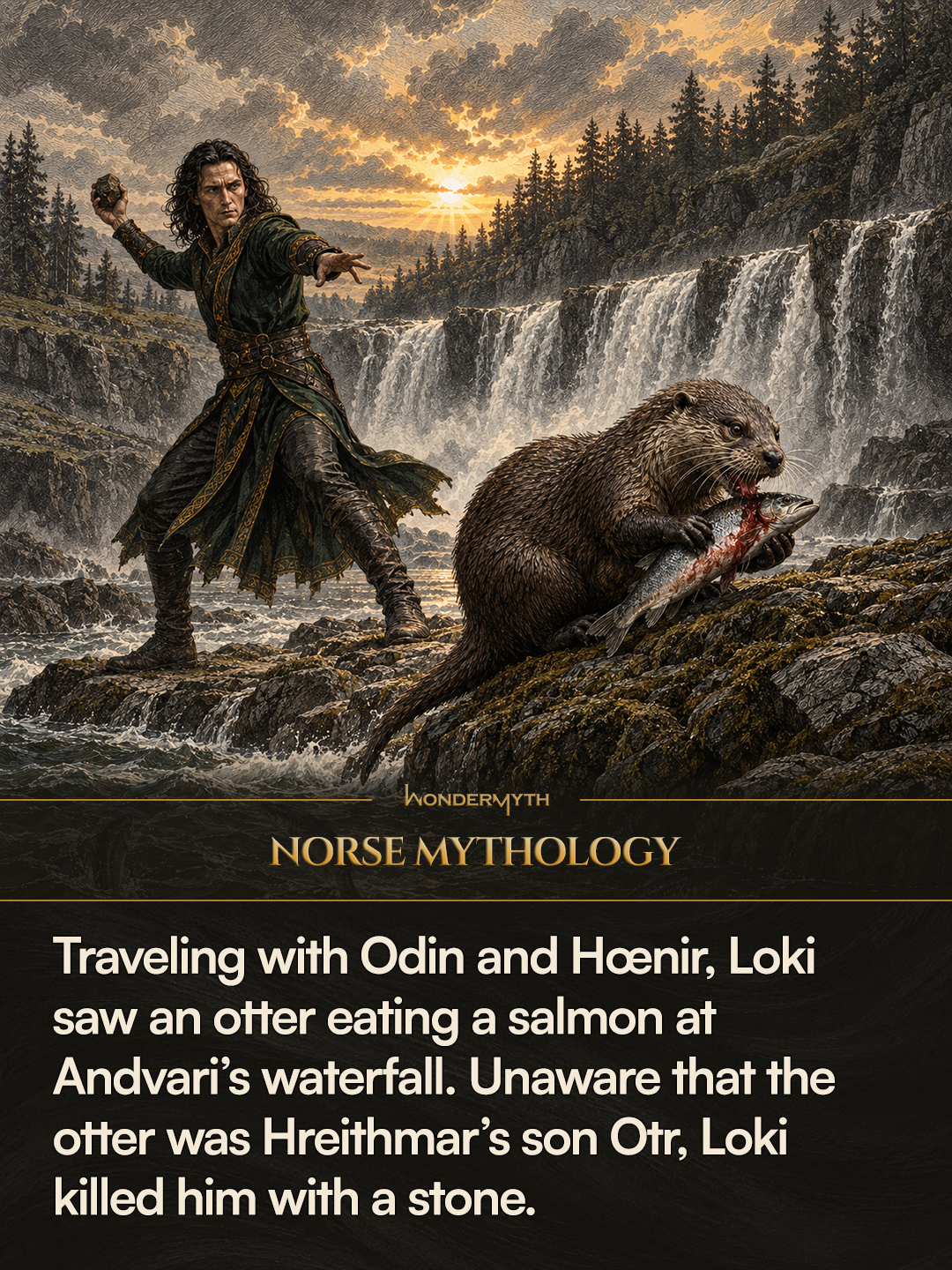
Traveling with Odin and Hœnir, Loki reached Andvari’s waterfall, where Otr sat in otter form eating a salmon. Loki struck him with a stone and killed him. The three travelers skinned the otter and later displayed the hide at Hreithmar’s house, where it was recognized as belonging to his son.
Hreithmar and his family seized them and named the price of their freedom: Otr’s skin had to be filled with gold and completely covered on the outside. Loki’s throw set the Völsung treasure’s ruinous history in motion. Sent to obtain the ransom, he took Andvari’s gold, which passed into Hreithmar’s family and led to further bloodshed.
✦ What seems small in one moment can carry weight in lives we have yet to see.