
Yamata-no-Orochi
Yamata-no-Orochi was the gigantic eight-headed, eight-tailed serpent that terrorized a family in the land of Izumo. Seven daughters had already been devoured when Susanoo intervened to save the last. The creature’s death ended the attacks and led to the discovery of a sword that became one of Japan’s sacred treasures.
Table of Contents
Table of Contents
Who Was Yamata-no-Orochi?
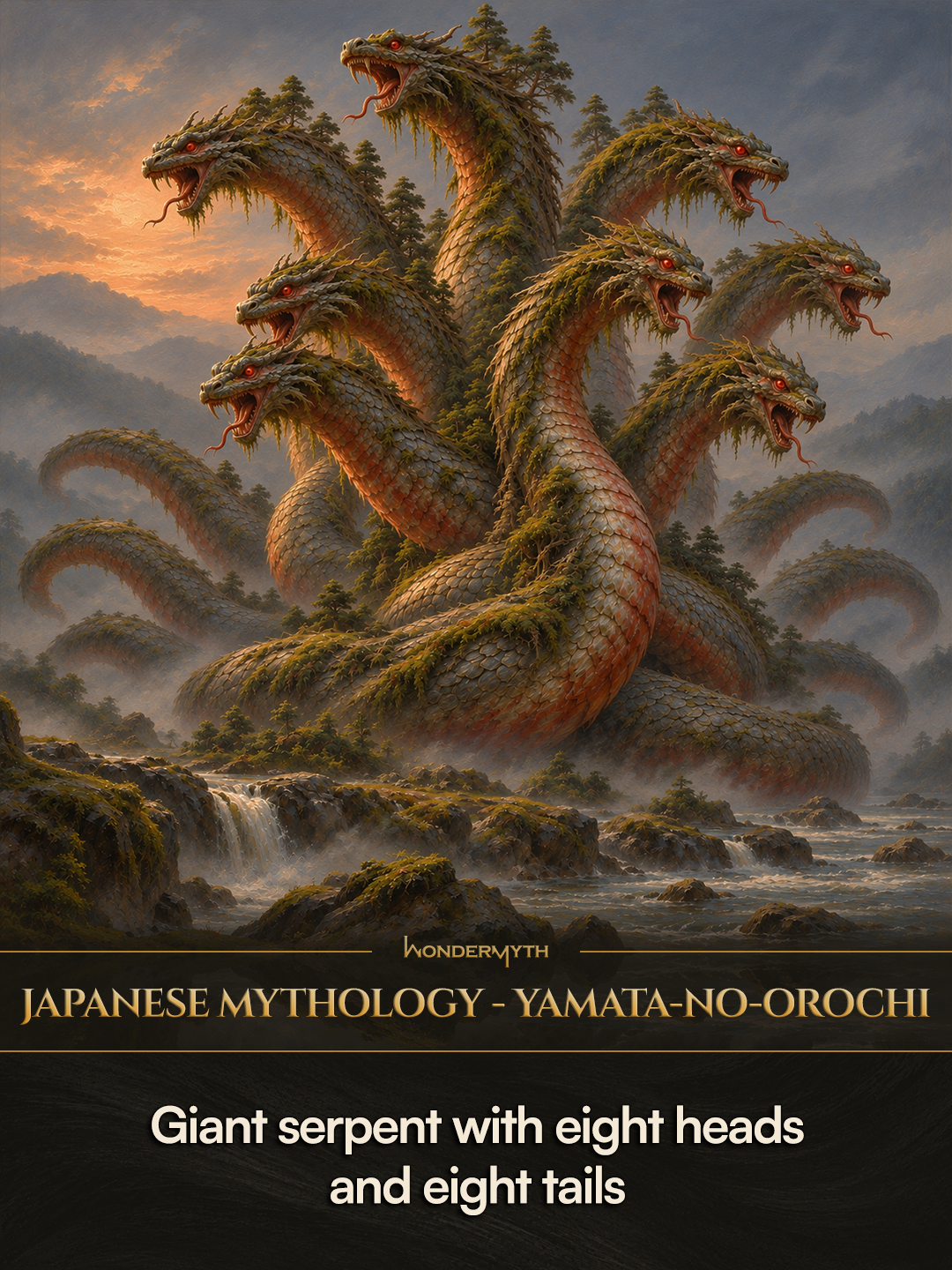
Orochi was a monstrous serpent whose body stretched across eight valleys and eight hills. Its immense size, multiple heads and tails, and repeated attacks made it the central threat in one of Japanese mythology’s best-known encounters between a deity and a monster.
The Kojiki, compiled in 712 CE, and the Nihon Shoki, completed in 720 CE, both preserve accounts of Susanoo’s victory over the serpent. The story also connects the mythology of Izumo with the sacred sword later known as Kusanagi. The chronicles differ in some details. The account of eight threatened daughters is separate from the version in which a couple’s newborn children were repeatedly eaten.
Domains, Appearance & Symbols
Domains & Roles
Orochi’s narrative role was that of a recurring predator. Its yearly arrival threatened the last surviving daughter of a divine family, and its destruction became the decisive act in Susanoo’s rescue. The sword found inside its tail also links the serpent’s defeat to the later history of Japan’s sacred regalia.
Appearance
The Kojiki describes a body so vast that it crossed eight valleys and hills, with a belly continually bloody and inflamed. Later artists portrayed the creature in dragon-like forms. An oil study by Harada Naojirō, dated to around 1895 and held by the Okayama Prefectural Museum of Art, offers a later artistic interpretation of Susanoo confronting the serpent.
Symbols
Orochi’s identifying features are bodily attributes rather than a documented set of sacred emblems.
- Eight heads and tails: Its defining anatomy also determines how Susanoo sets his trap, with one vessel of sake for each head.
- Red eyes: The Kojiki compares them to red ground-cherry fruit.
- Moss and trees: Cypress and cedar grow upon the serpent’s enormous body, according to the Kojiki.
- Bloody belly: Its underside is described as continually bloody and inflamed, a distinctive detail of the early account.
Key Myths
The Eight-Headed Serpent and the Sword in Its Tail
After descending to Izumo, Susanoo met parents grieving for seven daughters devoured by Orochi. To save their last daughter, Kushinada-hime, he transformed her into a comb and prepared eight vessels of strong sake behind eight gates. Orochi drank from every vessel, became drunk, and fell asleep. Susanoo cut the serpent apart, and the Hi River ran with blood. His sword was damaged as he cut its middle tail, where he discovered another sword that he later presented to Amaterasu.
The Serpent That Devoured Every Newborn Child
In a separate Nihon Shoki account, a divine couple living by the River Ye in Aki feared that Orochi would devour their next child, as it had their previous children. Susanoo had fruit sake brewed and eight jars prepared. When the serpent approached, he offered it the drink as a feast. It fell asleep after drinking, and Susanoo killed it and found a sword in its tail. The threatened child survived.
Modern Influence
Orochi remains a major figure in Iwami Kagura, a traditional form of performance in Shimane. Elaborate serpent costumes turn the encounter with Susanoo into a large-scale staged battle, continuing a regional performance tradition.
The serpent also appears in Japanese visual art. Utagawa Kuniyoshi depicted its confrontation with Susanoo in a nineteenth-century print, while Kawanabe Kyōsai reimagined the creature emerging from a turbulent sea. Kyōsai’s version changes the setting of the encounter rather than documenting a different early myth.
Free Mythic Guide to
Resourcefulness