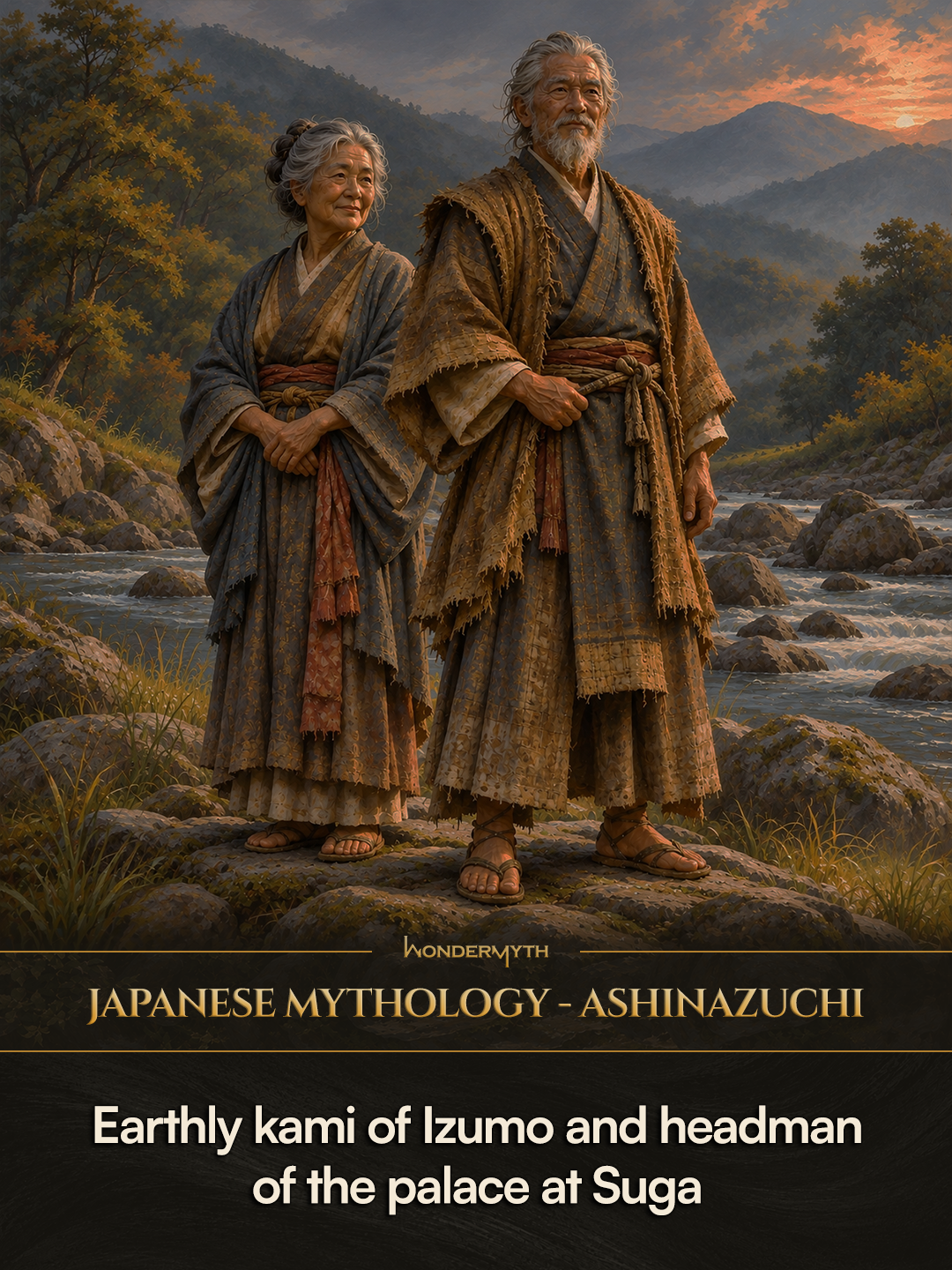
Tenazuchi
Seven of Tenazuchi’s eight daughters had been devoured by Yamata no Orochi. When the eight-headed serpent threatened the last, she and her husband helped prepare the trap that allowed Susanoo to kill it. An earthly kami of the Izumo myths, Tenazuchi is remembered for her family’s ordeal and her part in saving Kushinadahime.
Table of Contents
Table of Contents
Who Was Tenazuchi?
Tenazuchi was an earthly kami in Japanese mythology, appearing alongside her husband Ashinazuchi and their daughter Kushinadahime. The family encountered Susanoo near the upper Hi River in Izumo after losing seven daughters to the serpent Yamata no Orochi. Although Ashinazuchi explained the family’s suffering in the Kojiki, Tenazuchi was named and helped prepare the trap that saved their remaining daughter.
Other early accounts gave her a more explicit role. In one Nihon Shoki variant, both parents demanded that Susanoo kill the serpent before marrying their daughter. In the chronicle’s main account, Tenazuchi and Ashinazuchi later received responsibility for a palace.
Domains, Appearance & Symbols
Domains & Roles
Tenazuchi’s mythic responsibilities centered on her family and the preparations for the serpent’s defeat. She and Ashinazuchi brewed strong sake and prepared the eight drinking stations under Susanoo’s direction. In the main Nihon Shoki account, both parents later became masters of the palace of Susanoo’s son and received the title Inada no Miya-nushi no Kami.
Appearance
Early accounts portrayed Tenazuchi as an elderly woman grieving beside her husband and daughter. The Nihon Shoki described both parents caressing Kushinadahime as they wept.
A later depiction survives in the painted deity panels from Yaegaki Shrine in Matsue. The southern panel portrays Tenazuchi with Ashinazuchi. Classified as Muromachi-period works, these paintings represent medieval shrine art rather than a fixed appearance established by the earliest myths.
Key Myths
Tenazuchi and the Eight-Headed Serpent
After being expelled from heaven, Susanoo encountered Tenazuchi and Ashinazuchi grieving beside Kushinadahime. Yamata no Orochi had devoured their other seven daughters and was approaching again. Susanoo asked to marry Kushinadahime, and the parents agreed after he identified himself as Amaterasu’s brother.
He transformed their daughter into a comb and placed her in his hair, then instructed both parents to prepare strong sake at eight drinking stations. The serpent drank, fell asleep, and Susanoo cut it apart. Kushinadahime survived and became his wife.
Tenazuchi Becomes a Guardian of the Inada Palace
After killing the serpent, Susanoo established a palace at Suga and married Kushinadahime. In the main Nihon Shoki account, they had a son named Onamuchi.
Susanoo appointed Tenazuchi and Ashinazuchi as masters of his son’s palace, giving both the title Inada no Miya-nushi no Kami. This responsibility was specific to that version. The Kojiki instead granted the corresponding title to Ashinazuchi alone.
Worship & Ancient Impact
At Yaegaki Shrine in Matsue, Tenazuchi is honored at Temasuri Shrine, a subsidiary sanctuary dedicated to her. Ashinazuchi has a separate sanctuary within the precinct, while Susanoo and Inadahime are the shrine’s principal deities.
Tenazuchi is also among the deities enshrined at Susa Shrine in Izumo and Onsen Shrine in Unnan. A local tradition associated sacred stones with Tenazuchi and Ashinazuchi, describing them as divine tombs. The divine-tomb identification belongs to regional religious tradition, not verified burial history.
Modern Influence
Tenazuchi remains a named character in Orochi, the traditional serpent drama performed in Iwami Kagura. Alongside Ashinazuchi, Kushinadahime, and Susanoo, she appears in performances that preserve the family’s crisis and the serpent’s defeat.
The 2026 theatrical production Yamata no Orochi: Hajimari no Omohi by Iwami Kagura Tokyo Shachu also included Tenazuchi as a character. Such performances continue her place in the story, although their costumes, dialogue, and staging reflect later theatrical traditions rather than the details preserved in the ancient chronicles.
Free Mythic Guide to
Resourcefulness