
Skírnir
Skírnir carried Freyr’s message to the giantess Gerðr, but the mission turned from offers of gifts to threats and a magical curse. This attendant of the Norse god Freyr also appears as Odin’s messenger in the story of Fenrir’s binding.
Table of Contents
Table of Contents
Who Was Skírnir?
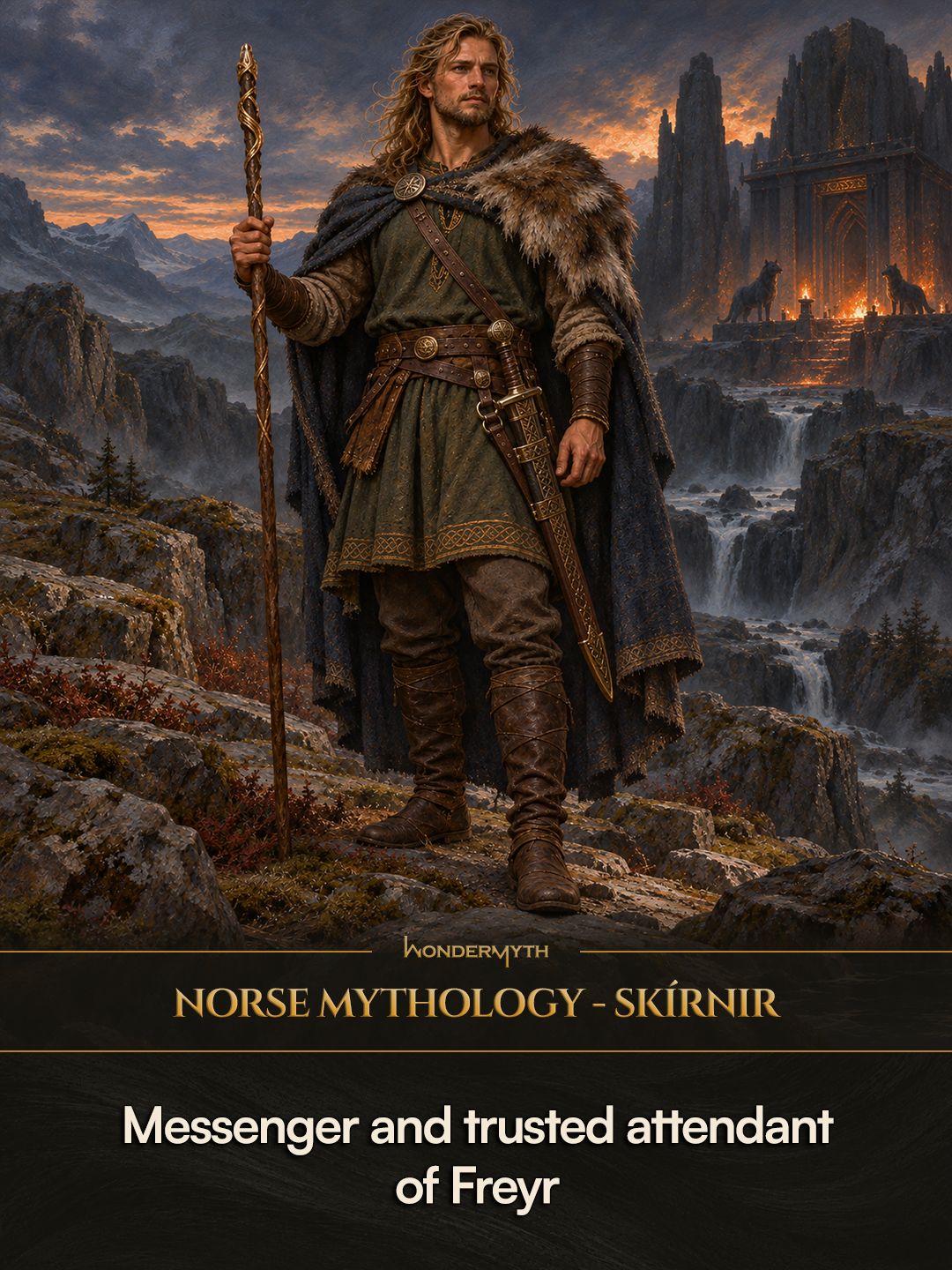
Skírnir was Freyr’s attendant and a trusted messenger in Norse mythology. His relationship with Freyr was longstanding: in Skírnismál, he recalled knowing the god from youth. The poem placed him at the center of Freyr’s pursuit of Gerðr, but it also revealed the troubling means by which he accomplished his task. His gifts failed to persuade her, and threats ultimately secured the promised meeting.
A separate narrative connected Skírnir to Odin’s efforts to restrain Fenrir. Despite these ties to the gods, his own status remained uncertain. When asked whether he belonged to the elves, the offspring of gods, or the Vanir, he denied belonging to those groups. Serving a major Vanir god did not establish him as one.
Domains, Appearance & Symbols
Domains & Roles
Skírnir carried out Freyr’s request in Jötunheimr and another mission for Odin among the dwarves. These errands brought him into contact with beings beyond the gods’ own households.
In Skírnismál, he negotiated, threatened Gerðr with Freyr’s sword, and invoked a magical curse. These actions defined his role in that narrative, but the surviving sources do not establish him as an independent god of magic, sunlight, or another cosmic domain.
Appearance
Ancient sources do not describe a distinct visual form for this aspect. In the illustrated 1895 edition of Den ældre Eddas Gudesange, Lorenz Frølich portrayed him during his encounter with Gerðr. The human-shaped figure belongs to nineteenth-century artistic interpretation, not an established Viking-Age representation.
Symbols
Skírnir’s identifying attributes come mainly from his mission to Gerðr rather than from an established collection of sacred emblems.
- Magical wand: During his threats against Gerðr, Skírnir invoked a wand and a charm involving three runes. These belonged to the poem’s coercive magical scene, not an independently attested cult symbol.
- Freyr’s sword: Freyr entrusted Skírnir with a sword capable of fighting by itself when carried by a worthy wielder. Skírnir used it to threaten Gerðr, but the weapon originally belonged to Freyr.
Key Myths
Skírnir’s Mission to Gerðr
From Hliðskjálf, Freyr saw Gerðr in Jötunheimr and fell into longing. Skírnir agreed to approach her after Freyr gave him a flame-crossing horse and his extraordinary sword. At Gymir’s dwelling, Gerðr rejected gifts of eleven golden apples and a gold-producing ring. Skírnir threatened to behead her, then invoked a magical wand and a curse of isolation and suffering, reinforced with three runes. Under these threats, Gerðr agreed to meet Freyr at Barri after nine nights. Skírnir returned with her answer, but Freyr found the wait unbearable.
Skírnir and the Binding of Fenrir
After Fenrir broke two fetters, Odin sent Skírnir to the dwarves of Svartálfaheimr for a stronger restraint. The dwarves fashioned Gleipnir from six impossible ingredients, including the sound of a cat’s footfall and a woman’s beard. Skírnir brought back the soft, ribbon-like binding, which the gods later placed around Fenrir. As a pledge, Týr put his hand into the wolf’s mouth. When Fenrir could not escape and the gods refused to release him, he bit off Týr’s hand.
Modern Influence
Skírnir appeared in nineteenth-century retellings of Norse mythology. Annie Keary’s The Heroes of Asgard and the Giants of Jötunheim (1857) adapted Norse stories for younger readers and included an illustrated scene associated with him.
Later, W. G. Collingwood’s wood engraving Skirnir’s Message to Gerðr appeared in Olive Bray’s 1908 edition of The Elder or Poetic Edda. The illustration returned to Skírnir’s encounter with Gerðr, bringing the medieval narrative into a new artistic setting.
Free Mythic Guide to
Resourcefulness