Sekhmet
Sekhmet was a lioness goddess whose power could threaten human lives or preserve them. Ancient Egyptians associated her with warfare, disease, and the protection of kings, but also sought her help in healing. In her best-known myth, Ra’s destructive Eye nearly destroyed humanity before a drink the color of blood finally stopped the slaughter.
Table of Contents
Table of Contents
Who Was Sekhmet?
Sekhmet was one of ancient Egypt’s most formidable goddesses, associated with the fierce power of the sun. She could act as the Eye of Ra, punishing enemies and defending divine authority. Other goddesses, including Hathor, Tefnut, Bastet, and Mut, shared aspects of this solar identity in different traditions, though they were not permanently identical.
Her power extended beyond destruction. Sekhmet could send dangerous illnesses, but she could also protect people from disease and help restore their health. This combination made her both feared and sought after. Her influence also extended to royal protection, funerary beliefs, and religious practices seeking safety from sickness.
Domains, Appearance & Symbols
Domains & Roles
Sekhmet embodied the destructive force of the solar Eye, which could strike the enemies of Ra and protect divine authority. She was associated with warfare and the strength that defended Egyptian kingship. Disease was another expression of her dangerous power, sometimes carried by divine arrows or messengers in later religious texts. Yet the goddess who threatened life could also preserve it, making protection and healing central to her identity.
Appearance
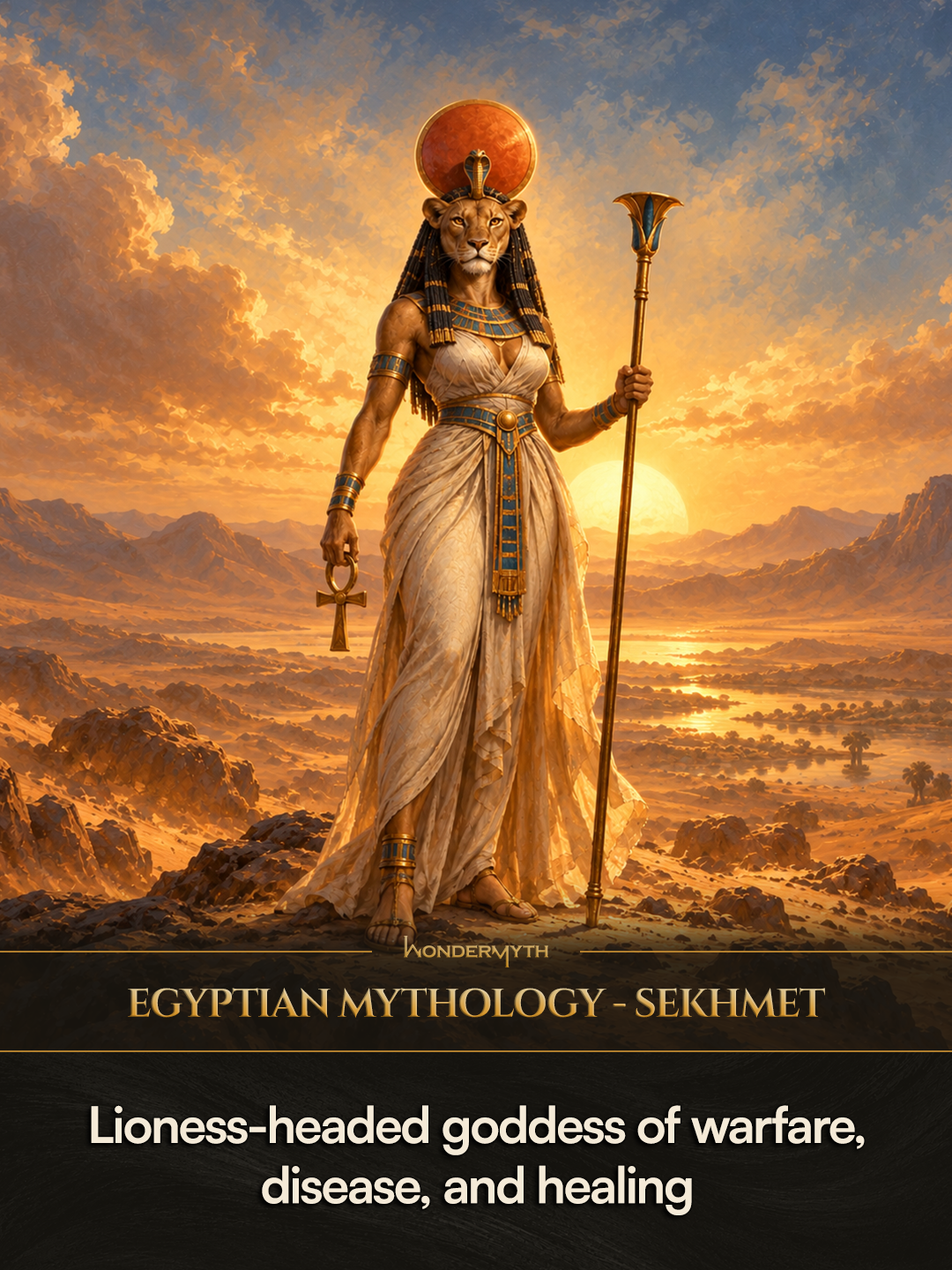
Ancient Egyptian artists commonly depicted Sekhmet as a woman with the head of a lioness. A large granodiorite statue from the reign of Amenhotep III, now at the Metropolitan Museum of Art, shows her seated with a solar disk and uraeus upon her head and an ankh in her hand. Other surviving statues portray her standing with a papyrus scepter. These are established artistic forms, though clothing and attributes vary between representations.
Symbols
- Lioness: Her defining animal form, associated with fierce strength and destructive power.
- Solar disk: Worn above her head in many representations, expressing her connection with Ra and the sun.
- Uraeus cobra: The protective serpent often shown with her solar disk, associated with divine and royal power.
- Ankh: The symbol of life, commonly held in her statues and associated with the life-preserving side of her power.
- Papyrus scepter: An attribute carried in some surviving standing statues, including an example from the reign of Amenhotep III.
Key Myths
The Destruction of Humanity
When humans plotted against the aging Ra, he consulted the gods and sent his Eye to punish them. The goddess first descended as Hathor and killed the rebels. As the slaughter continued, the goddess was identified as Sekhmet. Ra then decided to save the survivors. He ordered 7,000 jars of barley beer colored with red ocher to resemble blood and spread across the land. The goddess drank the liquid and became intoxicated, unable to recognize the people she intended to kill. The slaughter stopped, and humanity survived.
The Return of the Distant Goddess
In a wider Eye-of-Ra tradition, a fierce solar goddess left Egypt after becoming estranged from Ra and withdrew toward Nubia. Ra sought her return, and a divine messenger was sent to persuade her. In an important later Demotic version, the wandering goddess was Tefnut, and Thoth used stories and conversation to bring her home. Her return brought reconciliation and restored divine order. Sekhmet was among the lioness goddesses associated with this tradition, although the complete Demotic story was not an independent adventure specifically attributed to her.
Worship & Ancient Impact
Memphis was a principal center of Sekhmet’s worship, where she was honored alongside Ptah and Nefertem. Her priests were associated with healing, although not every Egyptian physician belonged to her priesthood. A New Kingdom statue identifies Yuny as an overseer of Sekhmet’s lay-priests, while his father was a chief physician.
At Thebes, Amenhotep III commissioned hundreds of monumental statues of Sekhmet. Many were later placed in Mut’s precinct at Karnak. Their inscriptions and repeated forms have been interpreted as part of an effort to appease the goddess and secure protection. Ritual texts also sought safety from her dangerous powers during the transition between years.
Modern Influence
Sekhmet’s surviving sculptures continue to shape modern understanding of ancient Egyptian religion. The Metropolitan Museum of Art’s exhibition The Art of Medicine in Ancient Egypt (2005–2006) presented large statues of the goddess in connection with ancient medicine, including her associations with both illness and healing. In 2023, the Michael C. Carlos Museum’s exhibition Life and the Afterlife included a bronze image of Sekhmet, presenting her as both a dangerous solar goddess and a protective divine figure.
Free Mythic Guide to
Resourcefulness