Isis
After Osiris’s death, Isis restores him through magic so they can conceive Horus, then protects their son as the heir to Egypt’s divine kingship. A powerful goddess of magic, maternal protection, and funerary renewal, she uses knowledge as decisively as her spells. Her myths place a mother’s determination at the center of a struggle over divine kingship.
Table of Contents
Table of Contents
Who Was Isis?
Isis was one of ancient Egypt’s major goddesses, closely tied to the fate of Osiris and Horus. When Osiris was killed, her search and protective magic helped restore him sufficiently for the conception of their son. She then raised Horus in hiding to protect him from Seth and defended his right to inherit his father’s royal position. Her place within this divine family connected her to Egyptian ideas of legitimate kingship.
Her importance reached beyond the royal succession. Healing narratives show her confronting poison and protecting endangered children, while funerary traditions place her beside the dead as a mourner and guardian. Over centuries, her worship spread into new regions, and later Egyptian and Greco-Roman traditions gave her increasingly wide-ranging powers and titles. Yet her older identity as the protector of Osiris and Horus remained central.
Domains, Appearance & Symbols
Domains & Roles
Isis’s magic operates through spoken words, secret knowledge, and protective acts. She restores Osiris enough to conceive Horus, counters deadly poison in healing narratives, and obtains Ra’s hidden name through deception and a demand for its disclosure. As Horus’s mother, she guards his life and defends his inheritance. Her funerary role joins mourning with the protection and restoration of the dead.
Appearance
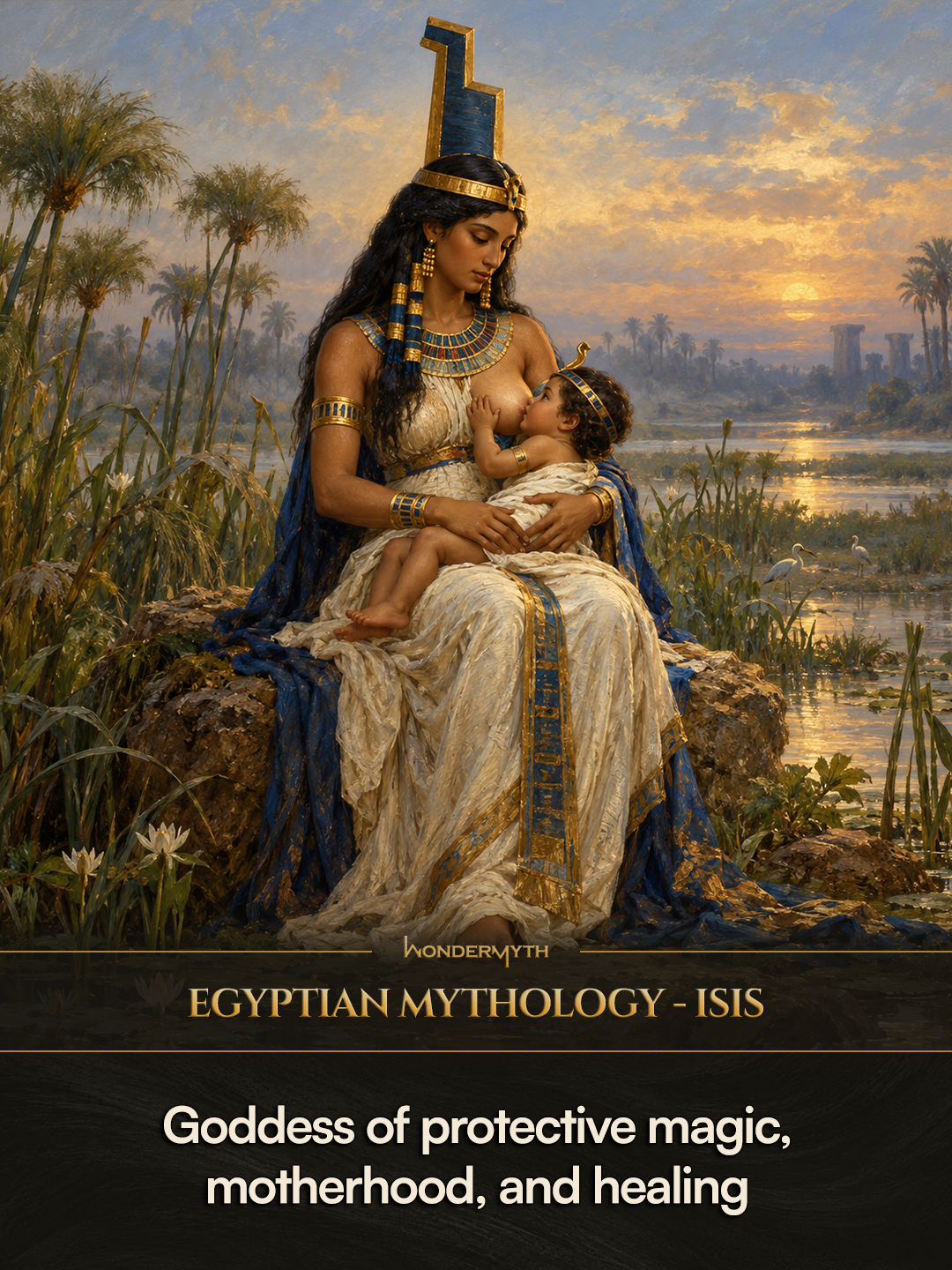
Ancient Egyptian images often show Isis as a woman wearing a throne-shaped sign on her head. Other depictions give her cow horns surrounding a sun disk, reflecting her association with Hathor. A Late Period–Ptolemaic bronze in the Metropolitan Museum of Art portrays her nursing the young Horus. Funerary images also show her kneeling in mourning or spreading protective wings.
Symbols
- Throne sign: An identifying hieroglyph in Isis’s name, frequently worn as a headdress in Egyptian art.
- Tyet knot: A protective amulet closely associated with Isis. Egyptian funerary texts connect it with her blood.
- Cow horns and sun disk: A crown associated with Isis through her connection to Hathor, especially prominent in later depictions.
- Protective wings: Represent her power to shelter and revive, particularly in funerary imagery associated with Osiris and the dead.
- Sistrum: A ritual rattle associated with her worship, especially in later Egyptian and Roman traditions.
- Situla: A ritual vessel appearing among the attributes of Isis in Greco-Roman religious imagery.
Key Myths
Isis Restores Osiris
After Seth brought about Osiris’s death, Isis searched for her husband and refused to abandon him. In an Egyptian hymn, her laments and protective wings helped restore him, allowing her to conceive their son, Horus. Isis then hid and raised the child while the succession remained contested. Osiris did not return to ordinary earthly kingship, but Horus survived as his heir, whose claim Isis would defend.
Isis and the Seven Scorpions
While traveling with the infant Horus, Isis was guarded by seven scorpions. A wealthy woman refused her shelter, but a poorer woman welcomed her. The scorpions combined their venom, and one named Tefen stung the wealthy woman’s son. Though the child was innocent, Isis used her magic to draw out the poison and save him. The wealthy woman then gave food and possessions to the woman who had sheltered Isis.
Isis Saves the Poisoned Horus
Isis concealed the young Horus in the marshes of Khemmis to protect him from Seth. When she returned, she found him gravely ill from poison. Her desperate cries drew Nephthys and Selket into the crisis, and the solar boat was halted while help was sought. Thoth arrived with powerful healing words and overcame the poison. Horus survived, and his rescue became a divine model for spells against bites and stings.
Isis Defends Horus’s Inheritance
Horus and Seth disputed who should inherit Osiris’s kingship. Isis disguised herself as a young woman and told Seth that a stranger was trying to seize a dead herdsman’s estate from his son. Seth condemned the stranger’s actions, and Isis revealed that his judgment also applied to his own claim against Horus. The struggle continued through further disputes, but Horus eventually received his father’s royal office.
Isis Takes Ra’s Secret Name
Isis sought the secret name of the ageing sun god Ra, whose hidden identity carried extraordinary power. She shaped a serpent from his spittle and earth, and its bite poisoned him. When Ra sought relief, Isis demanded his secret name before she would heal him. At last, he entrusted the name to her, and she commanded the poison to leave his body. Through cunning and powerful magic, Isis gained privileged knowledge from the sun god himself.
Worship & Ancient Impact
Isis was worshipped at major sanctuaries across Egypt. At Philae near Aswan, her temple became an important religious center, with a birth house depicting the goddess nursing Horus. Behbeit el-Hagar in the Nile Delta housed another major sanctuary dedicated to her.
Her protective role also shaped funerary and healing practices. Egyptians used inscribed Horus stelae in rituals against venom, reciting spells and pouring water over their surfaces. During the Greco-Roman period, her worship spread widely through the Mediterranean. The Temple of Isis at Pompeii preserves archaeological evidence of her cult in a Roman city, where rituals included distinctive objects such as the sistrum.
Modern Influence
Isis continues to appear in museum exhibitions, scholarship, and modern adaptations of Egyptian mythology. The Metropolitan Museum of Art’s 2005 exhibition The Art of Medicine in Ancient Egypt presented objects such as the Metternich Stela, preserving stories of Isis’s protective magic and ancient healing practices.
In Rick Riordan’s The Red Pyramid (2010), Isis appears within a fantasy world where Egyptian gods interact with modern characters, choosing Sadie Kane as her host. This fictional adaptation brings her divine identity into a contemporary setting while departing from the ancient narratives.
Free Mythic Guide to
Resourcefulness