Hathor
Hathor could nourish a king as a divine cow and, at Ra’s command, slaughter humans who plotted against him. One of ancient Egypt’s major goddesses, she was associated with love, music, celebration, motherhood, and protection. Her myths held these powers together: a goddess who offered care and joy could also become the terrifying Eye of Ra.
Table of Contents
Table of Contents
Who Was Hathor?
Hathor’s religious identity developed across centuries, and different places emphasized different aspects of her power. She could protect a king, receive the dead in the western afterlife, or take part in the fierce power of the sun. She was neither simply a gentle mother nor exclusively a dangerous goddess.
Her relationships also depended on the tradition being told. At Dendera she belonged to a divine family with Horus of Edfu and their child Ihy. Elsewhere she appeared as Ra’s daughter, while a New Kingdom tale made her the healer of Horus, the son of Isis. These roles reflect different settings within Egyptian religion rather than one continuous family story.
Domains, Appearance & Symbols
Domains & Roles
Hathor presided over love, sexuality, music, dance, fertility, and nurturing care. Her protective role extended to kings, whom she could nourish in bovine form, and to the deceased, whom she could welcome and sustain in the western afterlife. Yet as the Eye of Ra she could also turn against humans with deadly force.
Appearance
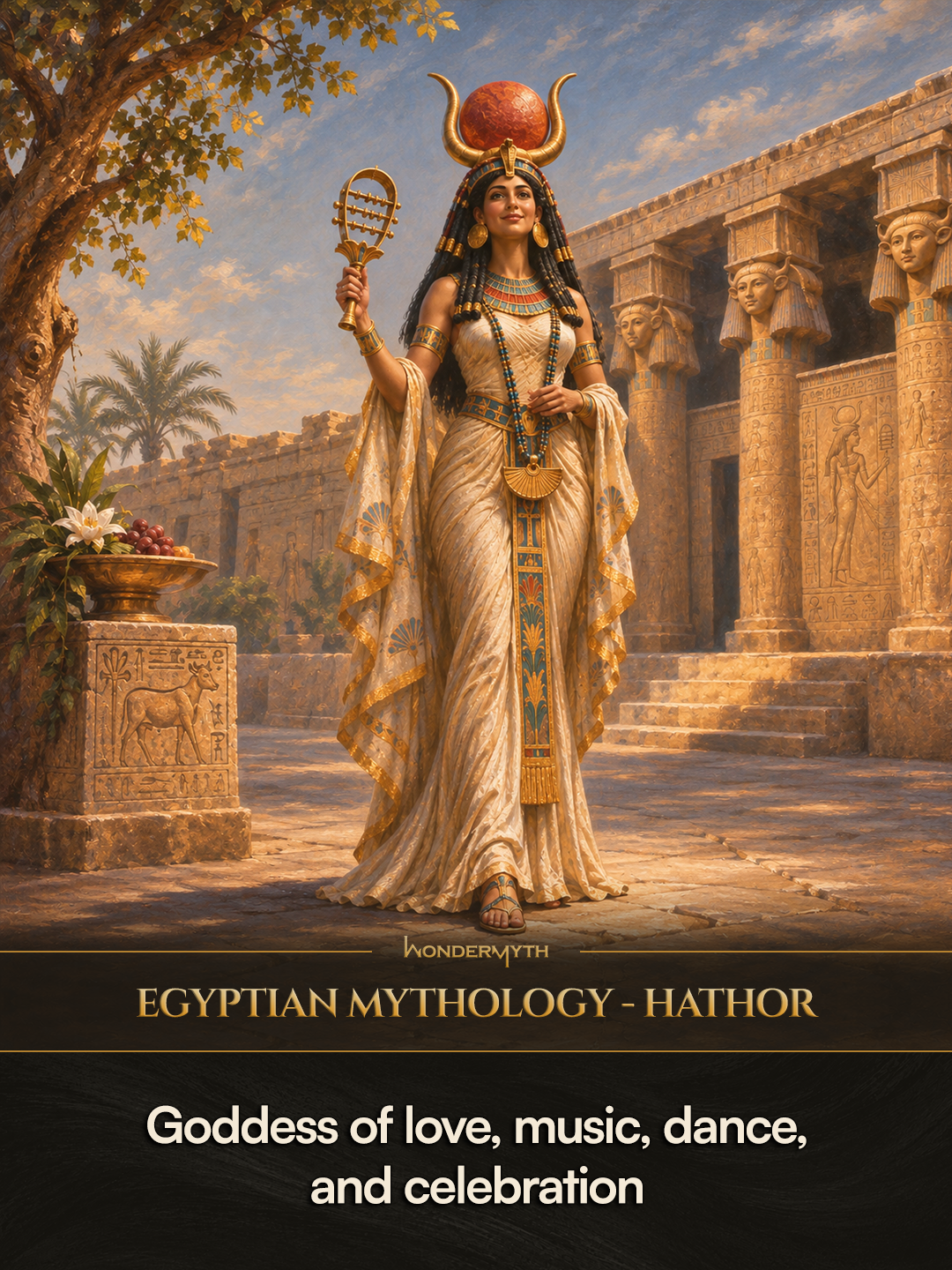
Artists represented Hathor as a cow or as a woman wearing cow horns around a solar disk. Her face could also appear frontally with bovine ears, particularly on ceremonial objects and temple columns. A Fourth Dynasty statue group from Menkaure’s valley temple at Giza depicts her beside the king with her horned solar headdress, an early example of her royal imagery.
Symbols
- Cow: Her divine animal form, associated with nurturing, protection, and the sky.
- Cow horns and solar disk: A characteristic headdress linking her bovine and solar identities, later shared with Isis.
- Sistrum: A rattling musical instrument used in Hathor’s worship, often decorated with her face.
- Menat: A beaded collar and counterweight that could be worn or shaken in ritual.
- Sycamore tree: A protective form through which Hathor could nourish the dead.
- Turquoise: Her distinctive local association at the Sinai sanctuary where she was called “Lady of Turquoise.”
Key Myths
Hathor and the Destruction of Humanity
As Ra grew old, humans plotted against him, and he sent his daughter Hathor to kill them. Her slaughter became so terrible that he sought to stop it before humanity was destroyed. Beer mixed with red ochre was spread on the ground to resemble blood. Hathor drank it, became drunk, and ceased killing. Humanity survived, but in the wider account Ra later withdrew from the human world.
Hathor Makes the Sun God Laugh
During the gods’ dispute over whether Horus or Seth should inherit Osiris’s throne, the sun god Re-Harakhty took offense and withdrew from the council. Hathor, called Lady of the Southern Sycamore, approached him and exposed her vagina. Re-Harakhty laughed, got up, and returned to the gathering. With the sun god present again, the interrupted proceedings resumed.
Hathor Restores Horus’s Eyes
During the struggle for Osiris’s throne, Seth found Horus alone and tore out both his eyes. Hathor came upon the injured god, caught a gazelle, and milked it. She put the milk in his right and left eyes, restoring his sight, then told Re-Harakhty what she had done. Horus could return to the dispute, while Hathor’s act marked her as his healer rather than his mother in this account.
The Hathors Foretell the Doomed Prince’s Death
When an Egyptian king finally had a son, the Hathors foretold that the child would die through a crocodile, a snake, or a dog. The king kept his son in a specially prepared house to protect him, but the prince later ventured into the world and encountered the predicted dangers. The surviving story breaks off before his fate is settled, leaving the Hathors’ prophecy without a preserved conclusion.
Worship & Ancient Impact
Dendera was Hathor’s principal cult center, although the main temple standing there today was built largely in Ptolemaic and Roman times. During the Feast of the Beautiful Meeting, her sacred image traveled by boat to Edfu to meet that of Horus. At Dendera’s New Year ritual, her image was brought to the temple roof to encounter the rising sun.
Ritual music involved sistra and menat collars. Hathor also received worship in the royal funerary landscape of Deir el-Bahri. At Serabit el-Khadim in Sinai, mining expeditions dedicated offerings and inscriptions to her as Lady of Turquoise.
Modern Influence
Hathor has continued to appear in modern portrayals of Egyptian mythology, often with a new personality or story. The film Gods of Egypt (2016) presents a fictionalized Hathor rather than adapting one ancient narrative. Marvel’s Moon Knight (2022) places her in an imagined council of Egyptian gods, represented through her avatar Yatzil. These screen versions draw on her identity while changing the setting and events.
Museums offer another way to encounter Hathor. Exhibitions such as the Metropolitan Museum of Art’s Divine Egypt use ancient artworks to explain how Egyptian divine identities and appearances developed over time.
Free Mythic Guide to
Resourcefulness