
Futodama
Futodama helped the heavenly gods bring Amaterasu back from the rock cave where she had shut herself away. He presented sacred offerings and later stretched a rope behind the returning sun goddess to prevent her retreat. As the ancestral kami of the Inbe ritual lineage, he also links the myths of the heavenly gods to Japan’s hereditary court ceremonies.
Table of Contents
Table of Contents
Who Was Futodama?
Futodama was a heavenly kami whose importance came from ritual action rather than rule over a natural force. During the effort to recover Amaterasu, he worked beside Ame-no-Koyane in a ceremony involving divination and sacred offerings. He handled the ritual objects and stretched the rope that kept the sun goddess from returning to the cave.
He accompanied Ninigi on his descent from heaven and is remembered as the ancestral deity of the Inbe, a lineage associated with preparing sacred objects and offerings for court rites. The later Kogoshūi, written from the Inbe perspective, assigns Futodama a wider role directing the specialist kami who made ritual implements.
Domains, Appearance & Symbols
Domains & Roles
Futodama’s chief mythic duties involved presenting offerings and taking part in divination. In the cave episode, he held a decorated sakaki bearing sacred objects and later stretched a rope behind Amaterasu. The Kogoshūi gives him a broader role overseeing specialist deities who prepared ritual materials. He was also one of the five named heavenly attendants sent with Ninigi on his descent to earth.
Symbols
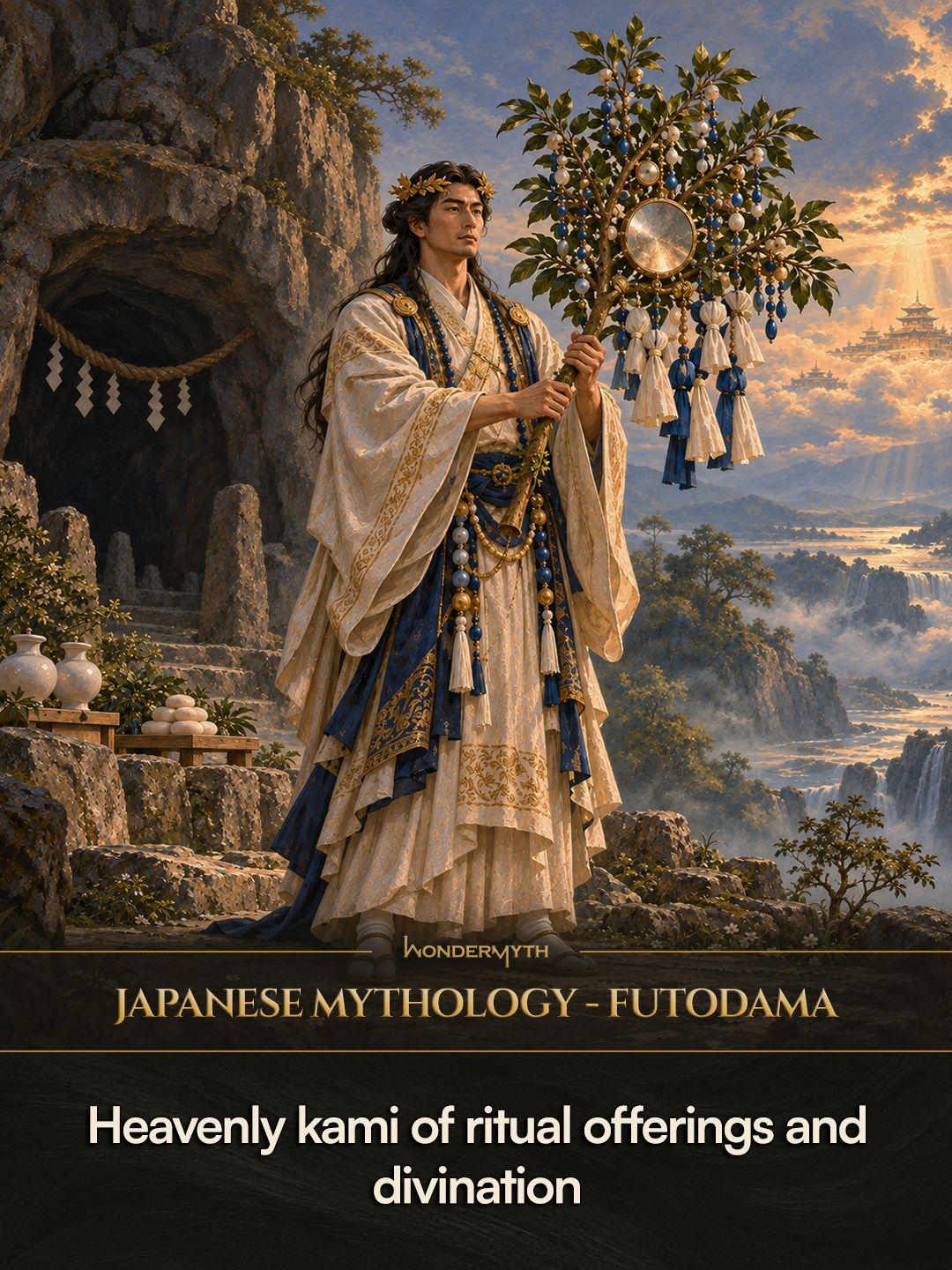
These are ritual attributes from Futodama’s cave story, not objects exclusive to him.
- Sakaki branch: Futodama held the sacred evergreen used to present offerings before Amaterasu.
- Blue and white nigite: Cloth or fiber offerings hung from the lower branches of the sakaki.
- Sacred mirror: Futodama helped present it to Amaterasu, though another deity had made it.
- Shirikume-nawa rope: Futodama stretched this rope behind Amaterasu to bar her return to the cave.
Key Myths
Futodama and the Heavenly Rock Cave
Susanoo hurled a flayed horse into Amaterasu’s weaving hall, fatally injuring a weaver. Amaterasu then hid in a rock cave, and darkness fell. Omoikane devised a plan to draw her out. Futodama and Ame-no-Koyane performed divination, then Futodama held a sakaki decorated with jewels, a mirror, and cloth offerings as Ame-no-Koyane recited a blessing. The gods’ laughter brought Amaterasu to the entrance, where the pair showed her the mirror. Ame-no-Tajikarao pulled her out, and Futodama stretched a sacred rope behind her to prevent her return.
Futodama and the Heavenly Descent
When the heavenly deities sent Ninigi to the earthly realm, they assigned five attendants to accompany him: Ame-no-Koyane, Futodama, Ame-no-Uzume, Ishikoridome, and Tamanoya. All five had taken part in the events surrounding Amaterasu’s retreat into the rock cave. In the Kojiki, Futodama is identified as the ancestral deity of the Inbe lineage. His place in the descent story connects the heavenly order to the hereditary ritual responsibilities claimed by that clan.
Worship & Ancient Impact
The Inbe were hereditary court ritual specialists who prepared and presented offerings, while the Nakatomi lineage was associated especially with spoken rites. The Kogoshūi defended the importance of the Inbe’s ceremonial duties and traced their authority to Futodama.
The Engishiki later recorded rites involving the Inbe and listed Awa Shrine in present-day Tateyama, Chiba, where Futodama is venerated. He is also associated with a shrine in Kashihara, Nara, and, in regional tradition, with Oasahiko Shrine in Tokushima. His continuing worship includes later associations with industry and craftsmanship, distinct from his early mythic duties.
Free Mythic Guide to
Resourcefulness