
Erysichthon
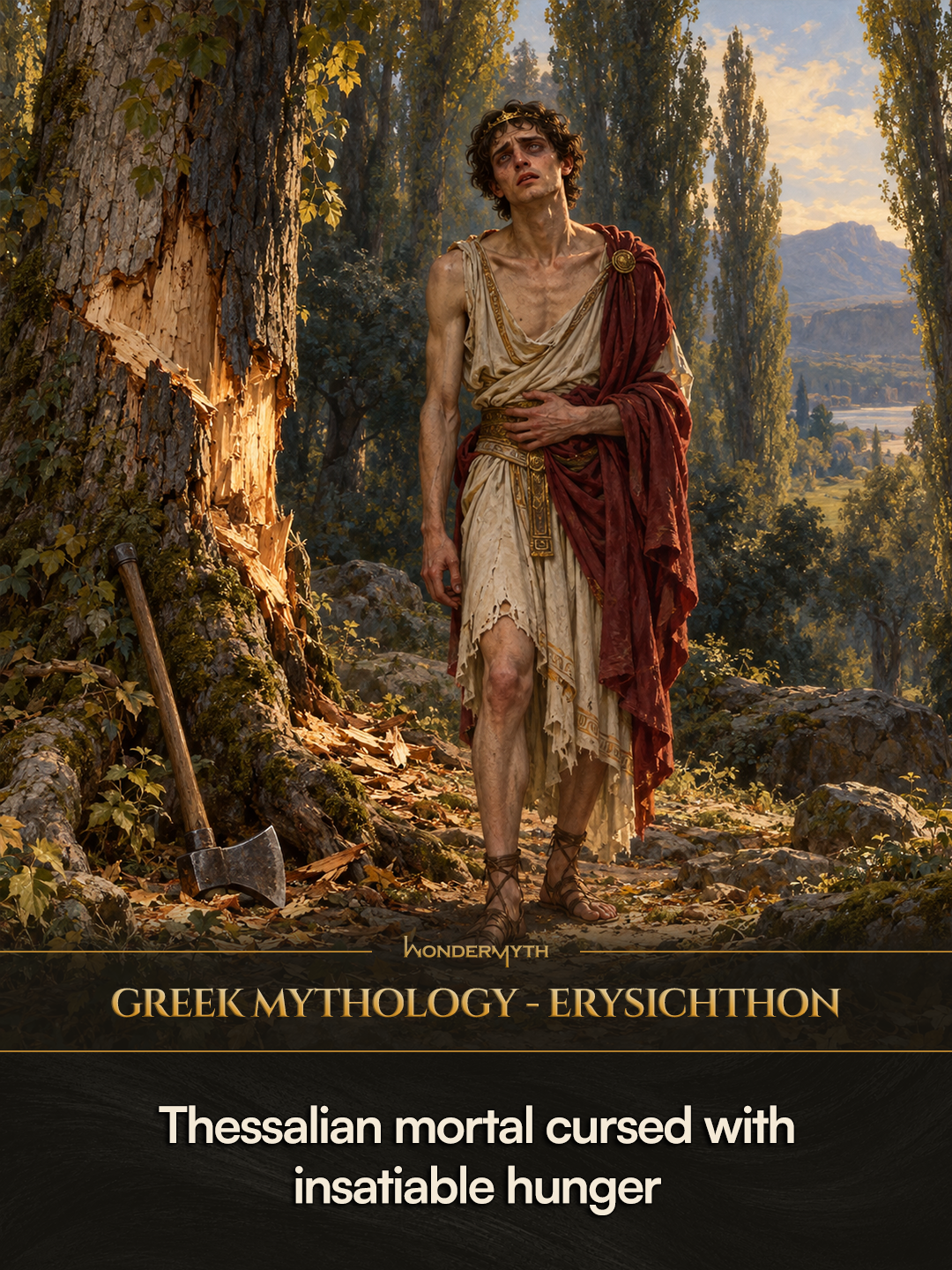
Erysichthon was a mortal figure of Thessalian mythology who brought ruin upon his household by cutting trees sacred to Demeter. The goddess punished him with hunger that no amount of food could satisfy. One telling ends with him begging for scraps; another follows his desperate pursuit of food until he begins eating his own flesh.
Table of Contents
Table of Contents
Who Was Erysichthon?
Erysichthon belongs to the Thessalian royal world of Greek myth. His story survives in different forms, especially in Callimachus’ Hymn to Demeter and Ovid’s Metamorphoses. Both describe his offense against Demeter and the insatiable appetite that follows, but they differ in the details of his punishment and its final outcome.
In Callimachus, his hunger drains his father’s household and leaves him begging. Ovid gives the punishment a harsher ending, involving the personified Famine and Erysichthon’s daughter Mestra, whom he repeatedly sells to obtain more food. An older, fragmentary Hesiodic tradition preserves a separate account of Mestra’s marriage and escape. Erysichthon is also called Aithon, a name associated with burning hunger.
Domains, Appearance & Symbols
Domains & Roles
Erysichthon is a mortal transgressor rather than a god with a domain of his own. His defining role is to violate land sacred to Demeter and suffer a punishment that he cannot escape. The hunger is imposed upon him, not a power he controls. His story places his destructive appetite in conflict with the goddess associated with agricultural nourishment.
Appearance
Jan Steen’s painting Erysichthon Selling His Daughter (1650–1660) shows Erysichthon seated on a tree trunk as he sells Mestra. Food and an axe appear around the scene. This is a seventeenth-century artistic interpretation rather than a standard ancient portrait.
Key Myths
Demeter’s Sacred Grove and the Endless Hunger
At Dotium in Thessaly, Erysichthon led twenty attendants into a grove sacred to Demeter, intending to cut its trees for a banquet hall. When they struck a great poplar, Demeter appeared disguised as the priestess Nicippe and ordered him to stop. Erysichthon threatened her with his axe. The goddess revealed herself and cursed him with endless hunger. His family exhausted its food and wealth trying to feed him, until he consumed their remaining animals and ended at a crossroads, begging for scraps.
Mestra’s Transformations and Erysichthon’s Final Hunger
In Ovid’s version, Erysichthon cut down a sacred oak, killing its resident nymph, and killed a man who tried to stop him. Ceres sent Famine to fill him with hunger as he slept. After consuming his wealth, he repeatedly sold his daughter Mestra to obtain more food. Neptune, who had earlier sexually violated her, changed her into a fisherman so she could escape her first buyer. She then evaded later buyers by assuming different forms and returning home. Even these sales failed to satisfy her father, who finally began eating his own flesh.
Modern Influence
Ted Hughes retold Erysichthon’s story in “Erisychthon,” included in his 1997 collection Tales from Ovid. His English poetic treatment follows Ovid’s account of sacred-tree destruction, consuming hunger, and Mestra’s involvement in her father’s attempts to obtain more food. It is a modern literary adaptation rather than a separate ancient version of the myth.
Free Mythic Guide to
Resourcefulness