
Demeter
Demeter governs cultivated grain and the food that sustains mortal life. When Hades takes her daughter Persephone with Zeus’s permission, she searches for her and stops the earth’s crops from growing. The resulting famine forces the gods to confront her demands. Yet Demeter is also a giver: at Eleusis, her stories connect cultivation with sacred rites.
Table of Contents
Table of Contents
Who Was Demeter?
Demeter is an Olympian goddess and one of the six children of Cronus and Rhea. Greek mythology gives her power over cultivated grain, but her importance extends beyond ensuring a harvest. She can withhold the crops on which humans depend, and her grief for Persephone becomes a conflict involving Zeus, Hades, and the survival of mortals.
Her myths also place her among people. At Eleusis, she receives hospitality, attempts to make a mortal child immortal, and establishes a sanctuary and sacred rites. Other stories credit her with giving humanity the means to cultivate grain. These accounts connect her divine authority with both everyday food and the religious hopes associated with Eleusis.
Domains, Appearance & Symbols
Domains & Roles
Demeter’s power concerns grain, cultivated fields, and the growth of food crops. When she stops grain from sprouting, ploughing and sowing cannot produce a harvest; when she relents, the earth becomes fruitful again. In the story of Triptolemos, she also gives mortals grain and the means to spread cultivation. Her role is agricultural rather than a general command over all weather or nature.
Appearance
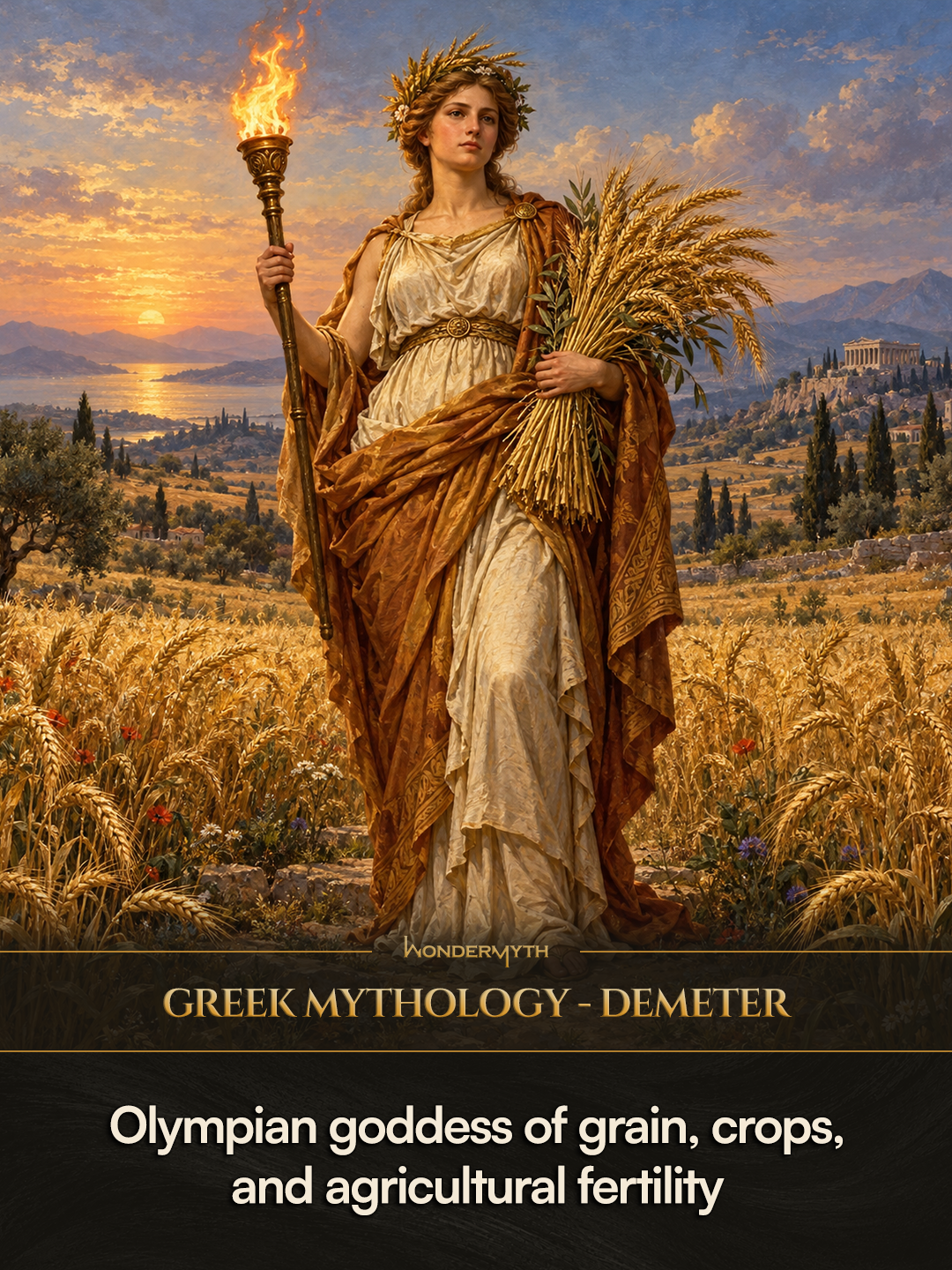
Ancient Greek art commonly shows Demeter as a clothed goddess carrying attributes such as grain or a scepter. In the fifth-century BCE Great Eleusinian Relief, she stands beside Triptolemos and Persephone, holding a scepter. Her extended gesture is associated with the gift of grain, although details of the original object are not fully preserved. This is one important ancient depiction, not a fixed portrait.
Symbols
- Ears of grain: Her clearest agricultural attribute, associated with cultivated wheat and barley and the gift of farming.
- Torches: Demeter carries flaming torches while searching for Persephone, and torches also appear in Eleusinian imagery.
- Scepter: A sign of her divine standing, shown in the Great Eleusinian Relief.
- Poppies: Associated with her in specific literary and visual traditions; Callimachus depicts her holding a poppy while disguised as a priestess.
- Sacred basket: Connected with particular religious processions and ceremonies, rather than an attribute found in every depiction.
Key Myths
The Abduction of Persephone and Demeter’s Search
While Persephone gathers flowers, the earth opens and Hades emerges in his chariot to carry her unwillingly into the underworld. Zeus has permitted the abduction without Demeter’s knowledge. Hearing her daughter’s cry, Demeter searches for nine days with burning torches. Hecate heard the cry but did not see who took her, so she accompanies Demeter to Helios. He reveals what happened and Zeus’s part in it. Demeter withdraws from Olympus and wanders among mortals.
Demeter at Eleusis and the Child Demophoon
Disguised as an elderly woman, Demeter comes to Eleusis and enters the household of King Celeus. Iambe’s jokes finally make her smile, and she accepts a drink of barley, water, and mint. Entrusted with the infant Demophoon, she nourishes him with ambrosia and places him in fire at night to make him immortal. His mother Metaneira interrupts in terror. Demeter reveals herself, and the child remains mortal; she orders the Eleusinians to build her a temple.
The Great Famine and Persephone’s Return
Demeter keeps the earth from growing grain while Persephone remains below, bringing humans close to starvation and threatening the gods’ offerings. When she refuses Zeus’s appeals, he sends Hermes to retrieve Persephone. Hades lets her depart but secretly makes her eat a pomegranate seed. Mother and daughter reunite, yet Persephone must spend one-third of each year in the underworld and two-thirds above. Demeter restores the harvest and teaches sacred rites to figures at Eleusis.
Demeter’s Gift of Grain to Triptolemos
In a later Greek mythographic account, Demeter gives the Eleusinian Triptolemos wheat and a chariot drawn by winged dragons. He flies across the inhabited world sowing grain, so her gift reaches people beyond Eleusis. The story makes her the source of agricultural knowledge as well as crop fertility. The earlier Homeric Hymn to Demeter includes Triptolemos among those taught sacred rites, but does not tell this flying-chariot story.
Erysichthon and the Punishment of Endless Hunger
Erysichthon orders trees cut down in a grove sacred to Demeter to obtain timber for a feasting hall. She appears as the priestess Nicippe and warns him to stop, but he insults and threatens her. Demeter reveals herself and curses him with hunger no meal can satisfy. He consumes his household’s food and livestock, grows wasted, and ends up begging for scraps. In Callimachus’s account, his punishment is ruinous hunger, not the self-devouring ending found in a later Roman version.
Demeter and Poseidon in Arcadian Tradition
When Poseidon pursues Demeter during her search for Persephone, she turns into a mare to evade him. He becomes a stallion and has intercourse with her despite her flight. The Thelpusian story connects her anger to the name Erinys and her later bathing in the River Ladon to Lousia, and names Arion among her offspring. At Phigalia, a distinct account names Despoina and tells of Demeter withdrawing into a cave.
Worship & Ancient Impact
Demeter and Persephone were worshipped together at Eleusis, near Athens, where the Eleusinian Mysteries became a major ancient Greek initiation tradition. Participants took part in secret rites associated with hope for a better fate after death, although the ceremonies’ inner details cannot be fully reconstructed. A procession from Athens to Eleusis formed part of the historical cult.
The Thesmophoria was another important festival honoring Demeter and Kore, observed in many Greek communities. Its central rites were associated with women, agricultural fertility, fasting, and ritual seclusion. Such practices differed by place and should not be confused with the Eleusinian Mysteries.
Modern Influence
Demeter’s loss of Persephone continues to appear in modern art. Evelyn De Morgan’s Demeter Mourning for Persephone (1906) places the grieving goddess in a barren landscape, with grain and poppies reinforcing the painting’s agricultural imagery. The work is a modern interpretation of an ancient myth, not evidence for Demeter’s original appearance.
In Supergiant Games’ Hades (2020), Demeter appears as an Olympian with powers based on cold and winter. This is a creative reimagining of her agricultural and seasonal identity, not an established set of ancient Greek powers.
Free Mythic Guide to
Resourcefulness