
Fenrir
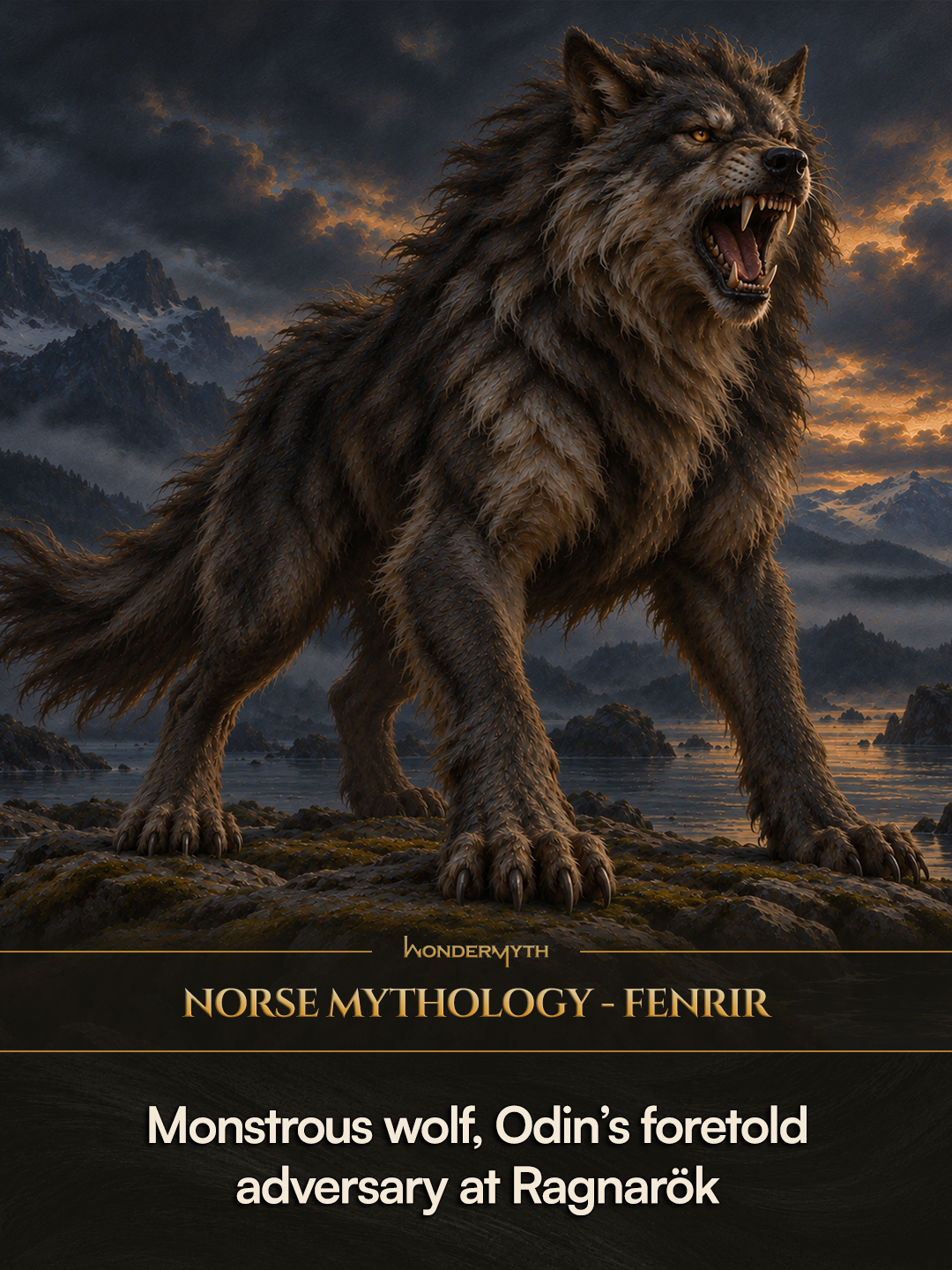
Fenrir was the monstrous wolf the Norse gods feared would one day kill Odin. Raised among the Æsir, he grew so powerful that they sought a way to restrain him. He broke their first two fetters, but the third held him until Ragnarök, when the prophecy they had feared was fulfilled.
Table of Contents
Table of Contents
Who Was Fenrir?
Fenrir was an extraordinary wolf who could speak, reason, and recognize danger. Unlike gods who governed particular realms or forces, his importance came from the threat he posed to the Æsir and the future foretold for him. The gods knew that Fenrir was destined to bring them great harm, yet their attempts to control him became a defining part of his story.
His growing strength led them to seek increasingly powerful restraints, while his suspicion made the final binding a dangerous undertaking. Týr lost his right hand in that encounter, and Odin would eventually lose his life when the wolf escaped. Fenrir’s story connects the gods’ fear of prophecy with the catastrophe of Ragnarök, when even their greatest efforts could no longer prevent the foretold destruction.
Domains, Appearance & Symbols
Domains & Roles
Fenrir’s principal role was as the wolf destined to kill Odin at Ragnarök. One Eddic poem also names Fenrir as the wolf who takes the sun, while other accounts describe the celestial wolves Sköll and Hati pursuing the heavenly bodies.
Appearance
Fenrir appeared as a wolf whose size and strength grew far beyond what the Æsir could control. His enormous form became especially fearsome in descriptions of Ragnarök.
Later Icelandic artists also depicted his captivity. An illustrated manuscript from about 1680, known as Edda Oblongata, includes an image of Fenrir bound. Such illustrations record later interpretations of his appearance rather than one fixed ancient design.
Symbols
Fenrir’s defining attributes come from his physical form and the events of his myths, rather than a documented personal religious emblem.
- Wolf form: Fenrir was himself a monstrous wolf, not a god accompanied by a sacred wolf.
- Enormous jaws: At Ragnarök, his lower jaw reached toward the earth while his upper jaw stretched toward the sky in Snorri’s account.
- Fire: During the final battle, fire came from his eyes and nostrils.
- River Ván: After the gods bound him, saliva flowed from his mouth and formed the river called Ván.
Key Myths
The Binding of Fenrir
After Fenrir broke two powerful fetters, the gods obtained Gleipnir, a seemingly delicate band made by dwarves from six impossible ingredients. Fenrir suspected deception and refused to be bound unless a god placed a hand in his mouth as a pledge. Týr offered his right hand. When Fenrir discovered that Gleipnir could not be broken, he bit Týr’s hand off. The gods secured the wolf and placed a sword between his jaws. Fenrir remained trapped until Ragnarök, while Týr carried the permanent cost of the binding.
Fenrir at Ragnarök
When Ragnarök came, Fenrir broke free and entered the final battle against the gods. Odin confronted him, but the wolf swallowed and killed him. Odin’s son Víðarr then avenged his father. In Snorri’s account, Víðarr placed his foot, protected by a specially thick shoe, against Fenrir’s lower jaw. He gripped the upper jaw and tore the wolf’s mouth apart. In Völuspá, Víðarr instead drove a sword into the wolf’s heart. Both accounts end with Fenrir’s death, though they preserve different details of his defeat.
Modern Influence
Fenrir remained a powerful subject in later art and storytelling. In an 1895 illustration for the Poetic Edda, Lorenz Frølich depicted the wolf about to devour Odin, returning to one of the most dramatic moments of Ragnarök.
Modern adaptations have reimagined the character in different ways. Marvel’s Thor: Ragnarok (2017) featured Fenris, a giant wolf revived by Hela, while Assassin’s Creed Valhalla (2020) adapted the conflict surrounding Fenrir’s restraint into its mythological storyline. Both retain the recognizable image of a formidable Norse wolf while reshaping the original mythology for new stories.
Free Mythic Guide to
Resourcefulness