Baldur
Baldur was one of the most admired gods of the Norse Æsir, praised for his fairness, brightness, and wisdom. Yet even the protection arranged by his mother Frigg could not save him: Loki found its one exception and caused his death. The gods’ failed attempt to bring Baldur back made his absence one of the great losses of their world.
Table of Contents
Table of Contents
Who Was Baldur?
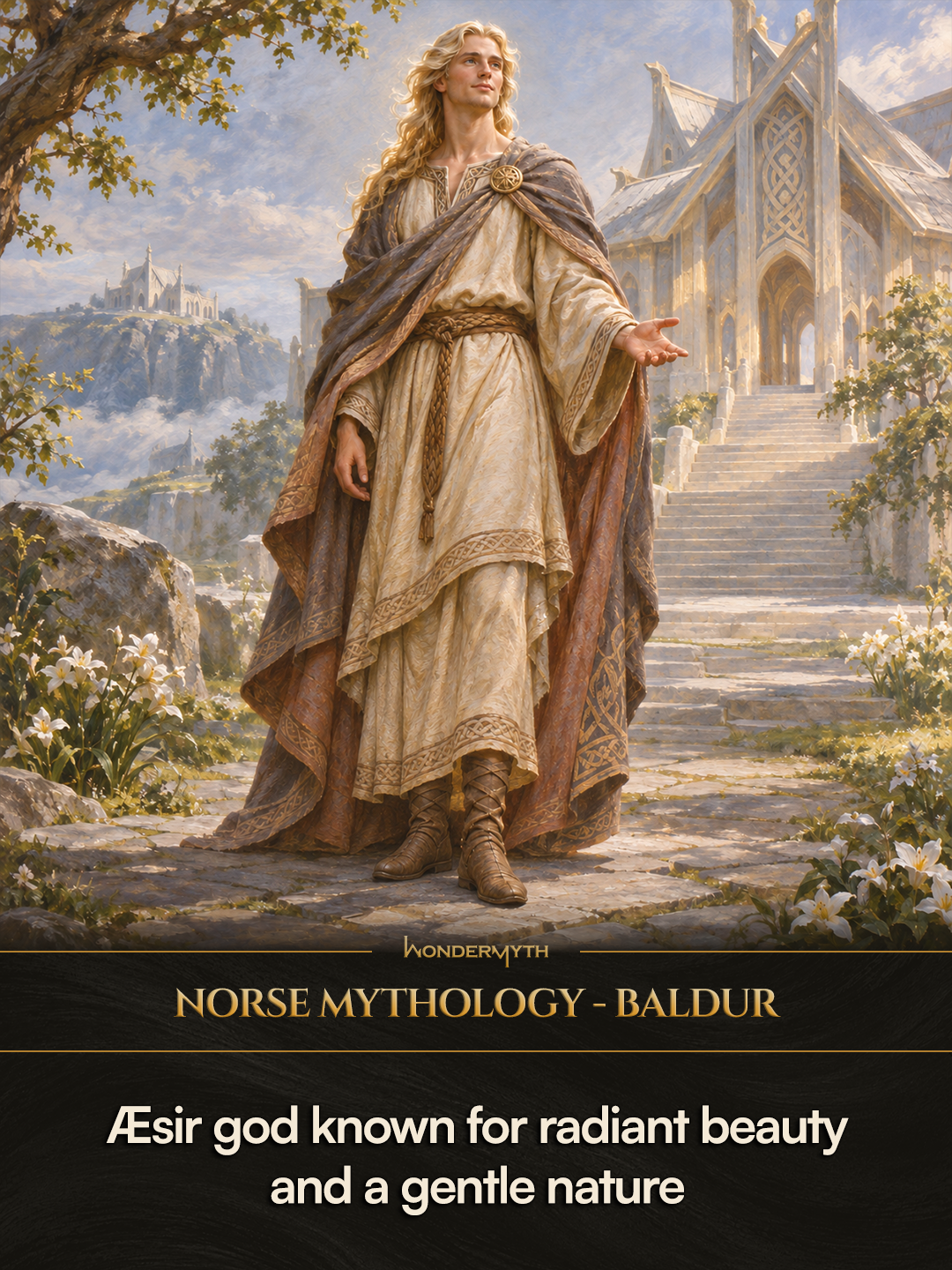
Baldur belonged to the Æsir, and Snorri Sturluson described him as fair, bright, gracious, and wise. He lived at Breiðablik, a hall associated with purity. Although his radiance is central to this portrait, the surviving sources do not securely give him rule over the sun or daylight.
His stories concentrate less on feats of power than on the response to his threatened death. The gods try to protect him, grieve when he is killed, and seek his release from Hel’s realm, but he does not return before Ragnarök. A separate Danish account by Saxo Grammaticus gives him a more combative character and a different death. These traditions preserve different versions of Baldur rather than one continuous story.
Domains, Appearance & Symbols
Domains & Roles
Baldur is not securely described as ruling the sun or another distinct natural sphere. His narrative role is shaped by the actions of the other gods around him: Frigg seeks protection, the Æsir mourn, and Hermóðr travels to the dead. His return with Höðr after Ragnarök also gives him a place in the renewed divine world, beyond the loss that defines his earlier story.
Appearance
Snorri described Baldur as strikingly fair and so bright that light shone from him. The account does not give him a fixed costume, weapon, or solar crown. A 1760 Icelandic manuscript illustration by Jakob Sigurðsson depicts Loki guiding Höðr in Baldur’s killing. This is a later artist’s interpretation, not a standard portrait established for the Viking Age.
Symbols
These are attested personal attributes and defining settings, not a fixed set of cult emblems.
- Breiðablik: Baldur’s heavenly dwelling, named in Grímnismál and described by Snorri as a place where nothing unclean can remain.
- Hringhorni: His great ship, used as the vessel for his funeral after his death.
- Baldrs brá (“Baldur’s brow”): A very white plant whose name is linked to his fair appearance in Snorri’s account, not evidence of a flower cult.
- Radiant appearance: His extraordinary brightness is a defining description, but it does not establish a separate power over the sun.
Key Myths
Baldur’s Dreams and Death by Mistletoe
In Snorri’s account, troubling dreams warn of danger to Baldur, so Frigg obtains oaths from beings and things not to harm him. The gods then hurl objects at Baldur, confident he cannot be hurt. Loki, disguised as a woman, learns that Frigg overlooked a young mistletoe shoot. He gives it to the blind Höðr and guides his throw. The mistletoe pierces Baldur and kills him, leaving the gods grieving the death they tried to prevent.
Baldur’s Funeral on Hringhorni
The gods bring Baldur’s body to the shore for a funeral aboard Hringhorni, but cannot move the huge ship. The giantess Hyrrokkin pushes it into place so forcefully that its rollers ignite. When Nanna sees Baldur’s body, her heart bursts from grief, and she is laid beside him on the pyre. Thor hallows the pyre with his hammer and kicks the dwarf Litr into the fire, while Odin places his ring Draupnir there. Gods and giants gather to mourn Baldur.
Hermóðr’s Journey and the Failure to Release Baldur
Hermóðr rides Odin’s horse Sleipnir for nine nights to Hel’s realm, where he finds Baldur among the dead. Hel promises to release him if every living and dead thing in the world weeps for him. Nearly all do, but a figure called Þökk refuses. Snorri reports that people believed Þökk was Loki in disguise. Because Hel’s condition is not fulfilled, Hermóðr’s journey cannot bring Baldur home, and he remains in the realm of the dead.
Váli’s Vengeance for Baldur
With Baldur dead at Höðr’s hand, Odin’s son Váli is born to Rindr to avenge him. The Eddic poems say that Váli takes revenge when only one night old, without first washing his hands or combing his hair. He kills Höðr, but the killing does not bring Baldur back. Baldur’s death has now been answered by another death within Odin’s family.
Baldur’s Return After Ragnarök
After Ragnarök destroys the earlier divine order, the earth rises again and surviving gods gather. Baldur and Höðr return from Hel and dwell together in the renewed world. Snorri describes the gathered gods recalling events of the former age. This return comes only after Ragnarök, not through the earlier attempt to secure Baldur’s release.
Balderus and Hotherus in Saxo’s Danish Account
In Saxo Grammaticus’s Danish narrative, Balderus desires Nanna, but she loves the mortal Hotherus. They become rivals, and Hotherus obtains a special sword from Miming that can wound Balderus. After several conflicts, Hotherus strikes him in the side, and Balderus dies three days later. Here Hotherus is not the blind, unwitting thrower of Snorri’s story; Nanna chooses Hotherus rather than becoming Balderus’s wife. The two accounts describe different causes of Baldur’s death.
Worship & Ancient Impact
Verses from the late tenth-century poet Úlfr Uggason’s Húsdrápa describe Baldur’s funeral, preserving evidence that the story was known in the Viking Age. The later Laxdæla saga associates the poem with mythological images decorating an Icelandic hall, although those panels have not survived. These works attest to Baldur’s presence in Scandinavian poetry and visual storytelling. No secure archaeological or literary evidence attests to organized cult worship. Place names proposed as evidence of a dedicated Baldur cult remain inconclusive.
Modern Influence
Matthew Arnold’s 1855 poem Balder Dead retells Baldur’s death, the journey to the realm of the dead, and the funeral for an English literary audience. Santa Monica Studio’s video game God of War (2018) reimagines Baldur as a major antagonist who confronts Kratos and Atreus. The game reshapes his character and relationships for its fictional story rather than reproducing the Eddic accounts. Both works show how later creators have adapted Baldur’s tragedy in different forms.
Free Mythic Guide to
Resourcefulness