
Ashinazuchi
Ashinazuchi was an earthly kami of Izumo whose seven daughters had been devoured by the eight-headed serpent Yamata no Orochi. When Susanoo arrived, only Kushinadahime remained. Ashinazuchi and his wife Tenazuchi helped prepare the trap that saved her, and he later received a position in Susanoo’s new palace at Suga.
Table of Contents
Table of Contents
Who Was Ashinazuchi?
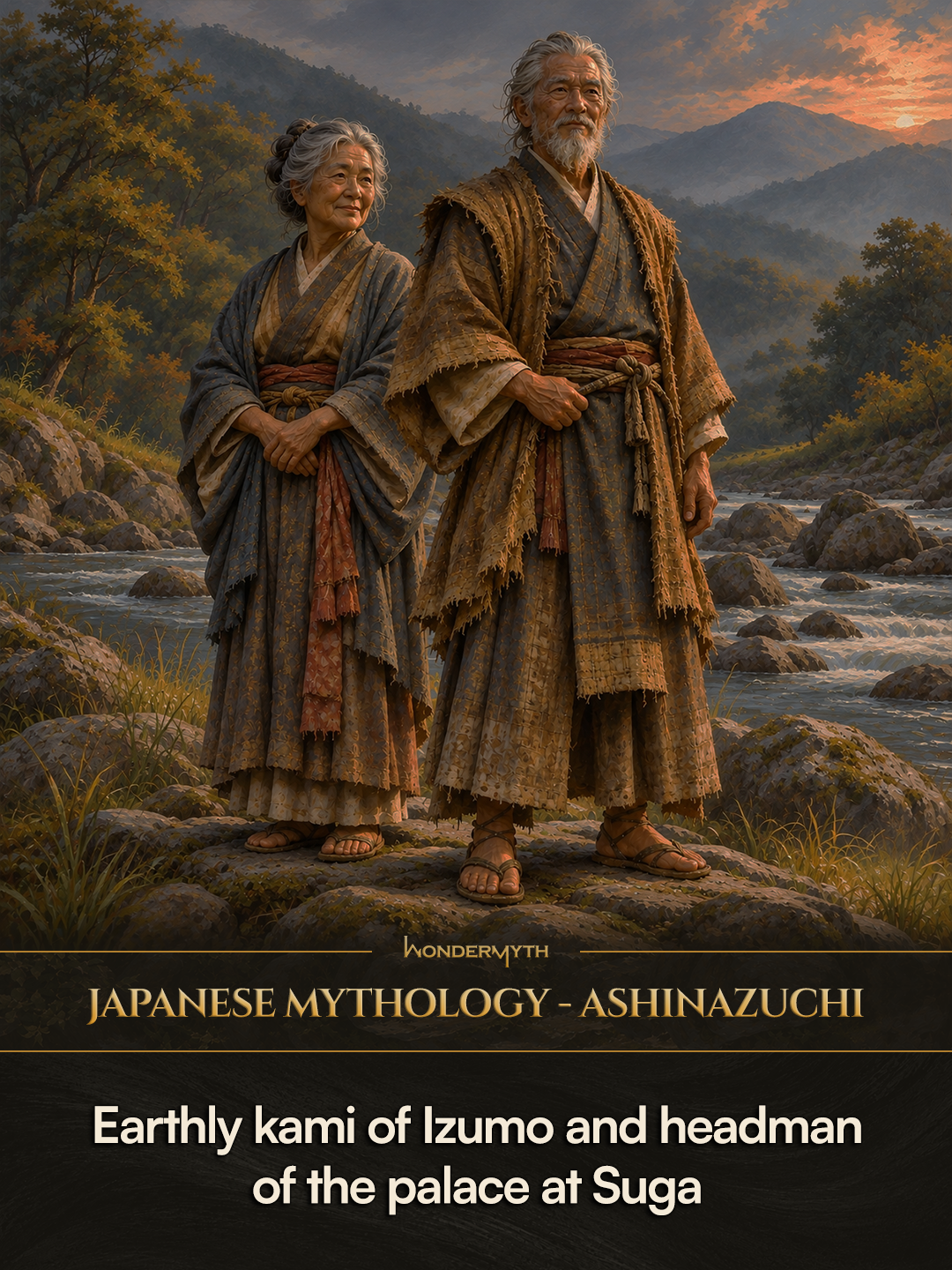
Ashinazuchi appears in the Kojiki and Nihon Shoki as an elderly earthly kami encountered by Susanoo near the upper Hi River in Izumo. He is not presented as a ruler of the river or the serpent. Instead, he speaks for a family that has lost seven daughters and faces the loss of its last surviving child.
In the Kojiki, he identifies himself as a child of Ōyamatsumi. Once Susanoo reveals his identity, Ashinazuchi and Tenazuchi agree to the marriage and prepare the sake trap on Susanoo’s instructions. After the serpent is killed, Ashinazuchi receives an appointment at Suga. That second episode gives him a position in Susanoo’s household beyond his role as Kushinadahime’s father.
Domains, Appearance & Symbols
Domains & Roles
Ashinazuchi is an earthly kami, but the early accounts do not assign him a broad independent domain. In the serpent episode, he explains the danger threatening his family and, with Tenazuchi, follows Susanoo’s instructions to prepare the sake trap. In the Kojiki, Susanoo later makes him headman of the palace at Suga and gives him a longer divine name.
Appearance
The early chronicles portray Ashinazuchi as an old man with his wife and daughter, without a fixed costume or distinctive personal emblem. A much later depiction survives at Yaegaki Shrine in Matsue, where a painted wooden panel represents Ashinazuchi alongside Tenazuchi. The work is classified as Muromachi-period art, reflecting a medieval religious portrayal rather than an appearance prescribed by the eighth-century chronicles.
Key Myths
Ashinazuchi and the Eight-Headed Serpent
Susanoo came upon Ashinazuchi, Tenazuchi, and their daughter Kushinadahime weeping near the upper Hi River. Ashinazuchi explained that Yamata no Orochi, an eight-headed serpent, had eaten seven of their eight daughters and would return for the last. After learning Susanoo’s identity, the parents agreed to give Kushinadahime in marriage. Susanoo transformed her into a comb, then directed her parents to prepare eightfold sake in eight vats. The serpent drank and fell asleep, and Susanoo cut it apart. Kushinadahime survived.
Ashinazuchi Becomes Headman of the Palace at Suga
After killing Yamata no Orochi, Susanoo built a palace at Suga. Clouds arose, and he composed a song about an eightfold enclosure. He then summoned Ashinazuchi, appointed him headman of the palace, and bestowed the name Inada-no-Miyanushi-Suga-no-Yatsumimi-no-Kami. The Kojiki gives this office and title to Ashinazuchi alone; the Nihon Shoki’s main account instead assigns palace responsibility to both him and Tenazuchi. Ashinazuchi thus received a defined position in Susanoo’s newly established household.
Modern Influence
Shrine traditions continue to honor Ashinazuchi. At Yaegaki Shrine in Matsue, a precinct shrine enshrines him separately from Tenazuchi. At Tsuno Shrine in Miyazaki, the pair share a subsidiary shrine whose recorded history includes nineteenth-century rebuilding. These are examples of continuing religious practice rather than modern fictional adaptations.
His role in the serpent story also appears in contemporary cultural presentations. The Shinjo Festival’s 2008 Yamata no Orochi float included Ashinazuchi in its retelling of the threatened daughter and the serpent’s defeat. Such presentations preserve the myth as public cultural storytelling without establishing the events as historical fact.
Free Mythic Guide to
Resourcefulness