Ame-no-Uzume
Ame-no-Uzume was a heavenly kami whose dance before the Heavenly Rock Cave helped end the darkness covering heaven and earth. Her performance drew Amaterasu’s attention as the assembled deities laughed. In another myth, she confronted an unknown figure at a heavenly crossroads. In both stories, her actions change the course of divine affairs.
Table of Contents
Table of Contents
Who Was Ame-no-Uzume?
Ame-no-Uzume belonged to the heavenly kami of early Japanese mythology and was among the deities accompanying Ninigi’s descent to earth. Her stories connect Amaterasu’s divine assembly with the world below, where Sarutahiko awaited the heavenly descendant. Unlike a deity defined by rule over a natural element, Uzume is distinguished by what she does when the other kami face uncertainty.
The Kojiki identifies her as an ancestral kami of the Sarume lineage, whose ceremonial service later gave her stories a place in court ritual history. Her connection with inspired performance also became important to later religious traditions that honor her in relation to dance and the performing arts.
Domains, Appearance & Symbols
Domains & Roles
At the Heavenly Rock Cave, Uzume stirred the divine assembly to laughter through an inspired dance, drawing Amaterasu toward the entrance. Before Ninigi’s descent, she approached Sarutahiko and established his intention to guide the journey. Afterward, she escorted him and received the name associated with the Sarume lineage. These actions define her early mythic roles more precisely than a fixed list of natural domains.
Appearance
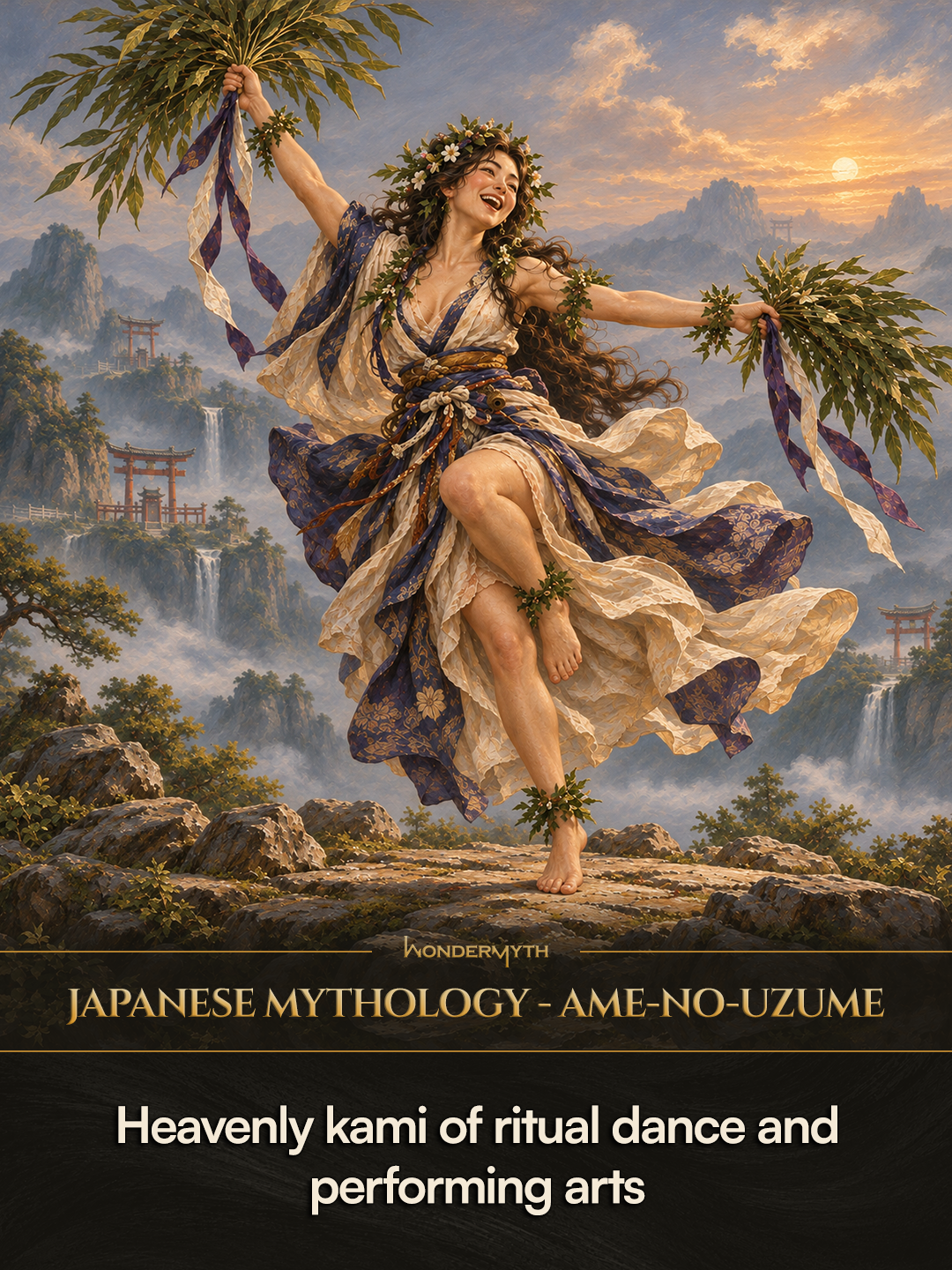
The Kojiki describes Uzume adorned with plants and holding bamboo-grass leaves as she dances on an overturned vessel. During the performance, she exposes her breasts and lowers her skirt band. These are details of a particular mythic scene, not a complete description of her usual appearance. A kagura mask identified with Uzume and made before 1873 records a later visual tradition, not a fixed ancient facial type.
Symbols
These are attributes of Uzume’s cave performance rather than a universal set of personal emblems.
- Overturned tub: Uzume stamped on it during her inspired dance outside the Heavenly Rock Cave.
- Plant adornments: In the Kojiki, she wore plant material around her head and body for the performance.
- Bamboo-grass leaves: She held bundles of these leaves in her hands during the same episode.
- Grass-wreathed spear: A spear entwined with eulalia grass belongs to the Nihon Shoki version of the cave ritual.
Key Myths
The Dance at the Heavenly Rock Cave
Susanoo flayed a horse and threw it through the roof of the heavenly weaving hall. A frightened weaving maiden struck her genitals against her shuttle and died. Amaterasu hid in the Heavenly Rock Cave, darkening heaven and earth.
Uzume stamped on an overturned tub, danced in an inspired state, and exposed her breasts and genitals. The kami laughed, so Amaterasu opened the cave and asked why. Uzume claimed a greater deity was present; others showed Amaterasu a mirror.
As she approached, Ame-no-Tajikarao pulled her outside. A boundary rope kept her from returning, and light returned.
The Meeting with Sarutahiko
As Ninigi prepared to descend from heaven, an unknown radiant kami stood at a crossroads on his route. Uzume approached him and asked who he was. He identified himself as Sarutahiko and explained that he had come to welcome and guide Ninigi, not block his descent.
Uzume accompanied Ninigi and later escorted Sarutahiko back. The Kojiki connects her ensuing designation with the Sarume no Kimi lineage, whose ancestral kami she was said to be.
The Silent Sea Cucumber
After escorting Sarutahiko, Uzume gathered the creatures of the sea and asked whether they would serve Ninigi. The fish agreed, but a sea cucumber said nothing. Uzume took a small blade and slit its mouth, which the Kojiki presents as the explanation for the creature’s appearance.
The account also links Uzume and the Sarume women to first marine offerings associated with the Shima region.
Worship & Ancient Impact
The Sarume lineage claimed descent from Uzume, and its women took part in imperial court ceremonies. Their roles included dance during chinkonsai, a rite concerned with recalling or strengthening the spirit, and heralding during the Daijōsai. The Nihon Shoki records a chinkonsai in 685 CE.
The later Kogoshūi connects the rite to Uzume’s performance at the rock cave. This is a traditional explanation of the ritual, not proof that every later form of kagura descended directly and unchanged from the mythic dance.
Modern Influence
Uzume remains honored at Sarume Shrine within Sarutahiko Shrine at Ise, where she is associated with the performing arts and harmony. At Aratate Shrine in Takachiho, the local tradition honors her alongside Sarutahiko and remembers their marriage. These are continuing religious practices rather than simply modern artistic adaptations.
In 1879, Tsukioka Yoshitoshi depicted Uzume’s cave dance in a woodblock print, interpreting the episode for a nineteenth-century audience. A historic kagura mask identified with Uzume likewise records a later performance representation, without establishing one timeless costume or facial design.
Free Mythic Guide to
Resourcefulness