
Ame-no-Tajikarao
Ame-no-Tajikarao was the heavenly kami whose strength helped bring back the light when Amaterasu hid inside the Heavenly Rock Cave. He waited beside the entrance and pulled the sun goddess into the open. He later accompanied Ninigi’s descent to earth, another major episode of Japanese mythology.
Table of Contents
Table of Contents
Who Was Ame-no-Tajikarao?
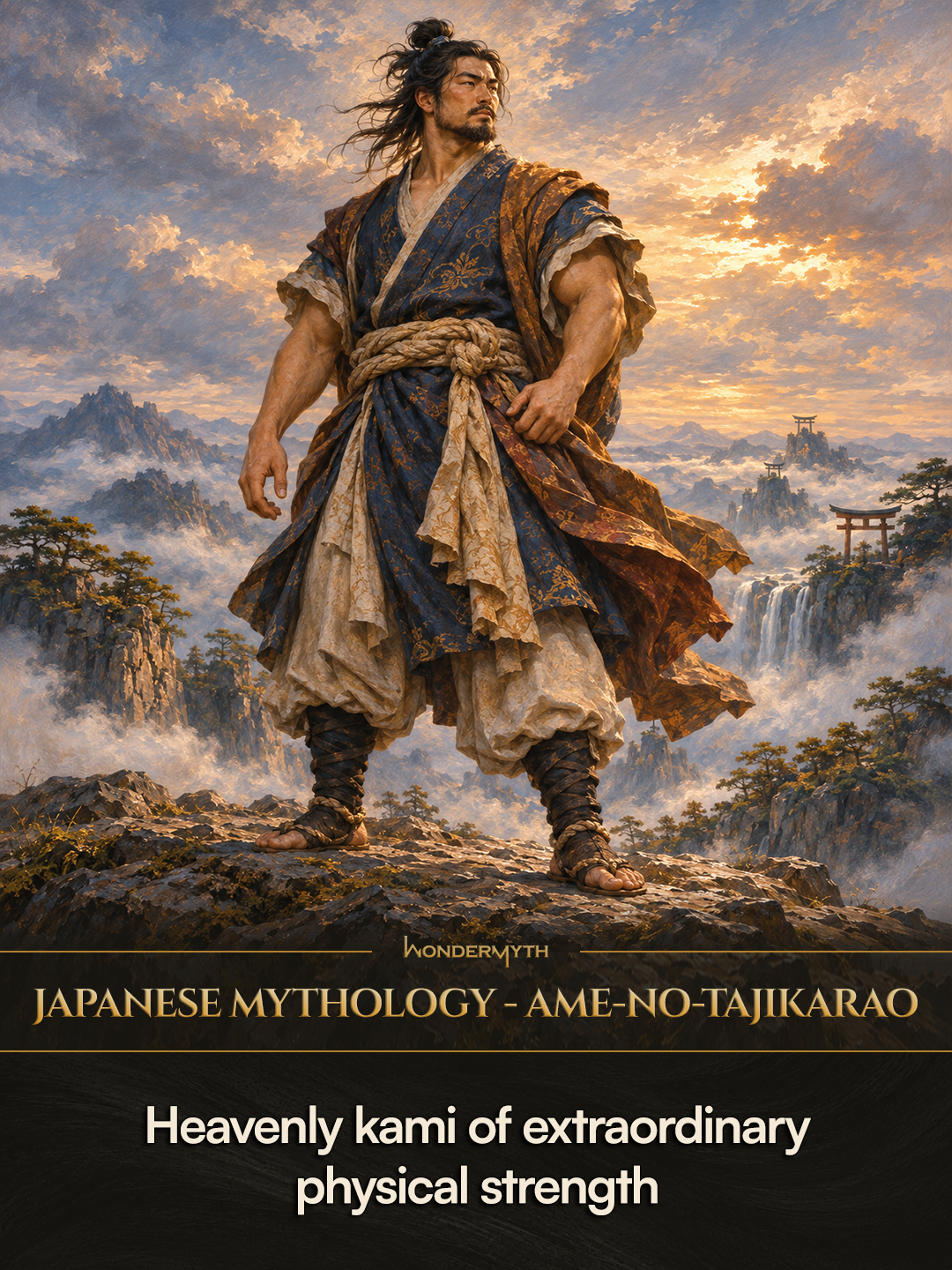
Ame-no-Tajikarao belongs to the heavenly kami in Japan’s early mythological chronicles. His name refers to powerful hands, but the chronicles do not describe a long series of feats. Instead, he receives one decisive task during the gods’ attempt to bring Amaterasu out of hiding. While other deities plan, pray, present a mirror, or dance, Tajikarao provides the physical action that completes their effort.
The Kojiki also includes him among the deities accompanying Ninigi to the earthly realm. Together, these episodes place him at two important moments: the return of light and the descent of heavenly authority to earth. His role is specific rather than a broad catalogue of divine powers.
Domains, Appearance & Symbols
Domains & Roles
Tajikarao’s principal mythic function is strength applied at a decisive moment. In the Kojiki, he draws Amaterasu fully out of the cave after she opens its door and approaches the mirror. Other versions credit him with opening the stone door itself. He later accompanies Ninigi to the earthly realm, although the surviving accounts do not assign him a separate mission or an extensive range of powers.
Appearance
Ancient sources do not describe a distinct visual form for this aspect. In an 1825 woodblock print, Totoya Hokkei portrayed Tajikarao as a powerfully built male figure carrying a large rectangular rock or door-like slab, with elaborate garments and pronounced hair and facial features. This Edo-period image is a later artistic interpretation, not an established ancient appearance.
Symbols
His strongest identifying attributes come from the Heavenly Rock Cave story rather than a separate collection of personal emblems.
- Powerful hands: His name refers to exceptional hand strength, expressed in his defining action of taking Amaterasu’s hand and drawing her outside.
- Heavenly Rock Cave doorway: The setting of his most famous intervention. In specific later versions, he opens or throws aside the stone door, while the Kojiki has Amaterasu open it herself.
Key Myths
The Opening of the Heavenly Rock Cave
Susanoo’s misconduct culminated when he threw a flayed horse into Amaterasu’s weaving hall, fatally injuring a weaving woman. Amaterasu withdrew into the Heavenly Rock Cave, leaving heaven and earth dark. Guided by Omoikane, the gods prepared offerings and a mirror while Ame-no-Uzume danced, exposing her breasts and lowering her skirt until the gods laughed. Amaterasu opened the door and moved outward to inspect the mirror. Tajikarao took her hand and pulled her from the cave. Futodama stretched a rope behind her to prevent her return, and light returned.
Tajikarao and the Descent of Ninigi
As the gods prepared Ninigi’s descent to the earthly realm, Amaterasu and Takamimusuhi authorized his mission. Ninigi received sacred regalia and was accompanied by a company of deities. The Kojiki names Tajikarao, Omoikane, and Ame-no-Iwatowake as companions, separately from the five principal attendants. Later, the account places Tajikarao in Sana in Ise.
The Rock Door and Mount Togakushi
The Kojiki describes Tajikarao taking Amaterasu’s hand as she emerged, without saying he moved the stone door. In a later local tradition at Togakushi, however, he removed the door and cast it from heaven. It came down to earth and became associated with Mount Togakushi.
Worship & Ancient Impact
Tajikarao has an early regional connection with Sana in Ise, where the Kojiki places him. Sana Shrine, in present-day Mie Prefecture, enshrines him as its principal deity and appears in the historical Engishiki shrine register. Its original foundation date is not securely established.
His worship also continues as a living religious tradition. Togakushi Shrine’s inner shrine honors him as a deity of strength, with associations that include success in competition. In Gifu, the Tejikarao Shrine Fire Festival preserves a distinctive local religious tradition that was revived after an earlier interruption.
Modern Influence
Later Japanese artists developed visual interpretations of Tajikarao’s strength. An 1860 woodblock print by Utagawa Yoshifuji includes him among the figures in the Heavenly Rock Cave story. Such depictions preserve the myth in visual culture but do not establish a universal ancient character design.
Free Mythic Guide to
Resourcefulness