Amaterasu
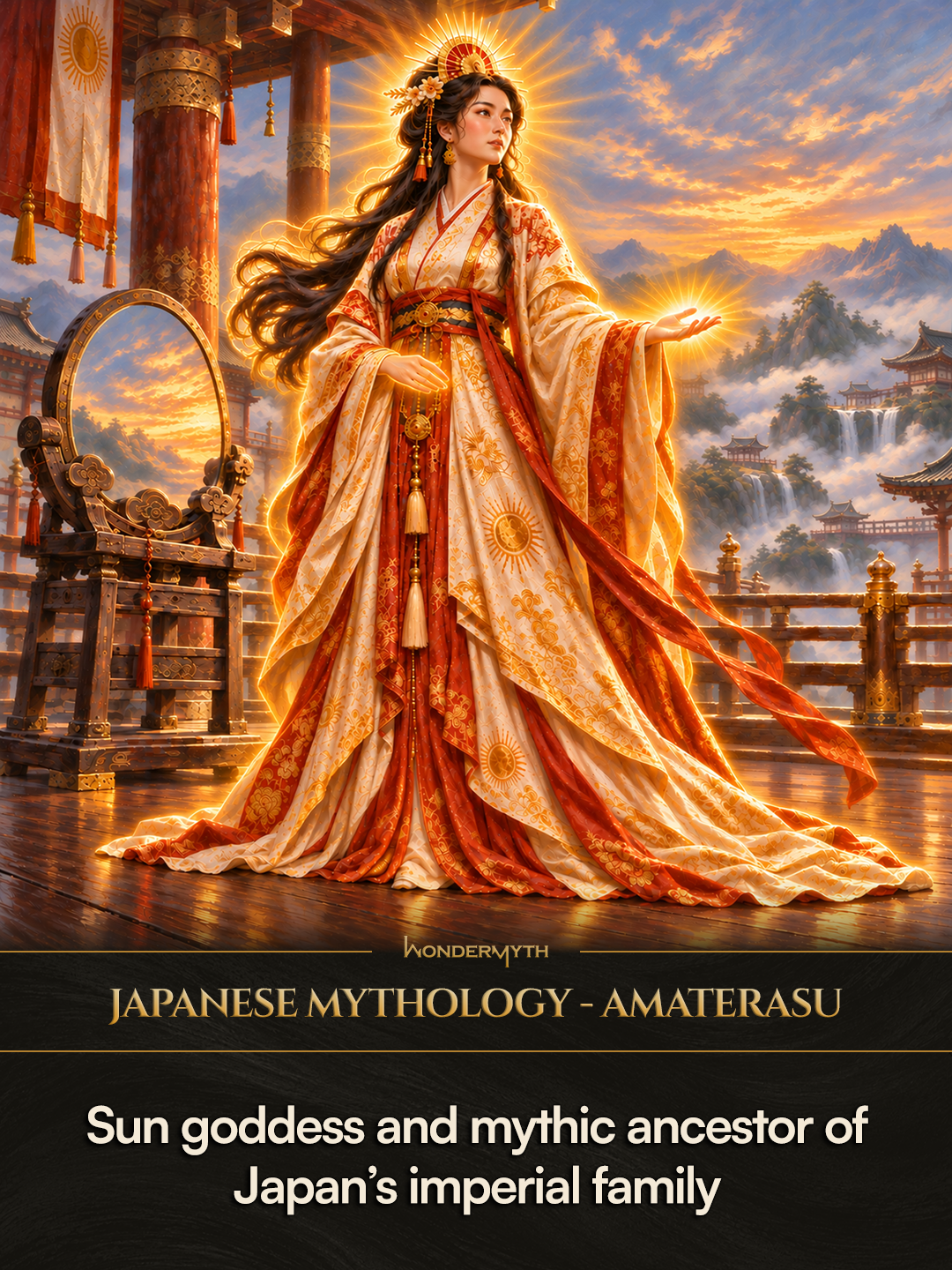
Amaterasu is the sun goddess who rules the Plain of High Heaven. When she shuts herself inside a rock cave, heaven and earth go dark, and the other kami must bring her back. Her authority also reaches the earthly realm: her grandson Ninigi carries her sacred treasures there, linking her to Japan’s imperial lineage.
Table of Contents
Table of Contents
Who Was Amaterasu?
Amaterasu is one of the principal heavenly kami in the Kojiki and Nihon Shoki, early Japanese chronicles preserving different versions of the divine past. In the Kojiki, Izanagi appoints her to govern Takamanohara, the Plain of High Heaven. She exercises authority among other heavenly kami, but their counsel and actions also matter to the outcome of her myths.
Her withdrawal into a cave deprives both heaven and earth of light, while the assembled kami work together to draw her out. Later, her grandson’s descent with sacred treasures links heavenly rule to the imperial family’s mythic ancestry. This connection also helps explain Amaterasu’s enduring importance at Ise, where she remains an actively revered kami.
Domains, Appearance & Symbols
Domains & Roles
Amaterasu governs Takamanohara and is associated with the sun’s light. Her concealment leaves the heavenly and earthly realms dark; her reappearance restores light. She joins Takamimusuhi in the heavenly decisions that lead to the transfer of the earthly realm and Ninigi’s descent. Her heavenly rice fields and her role in an account of food crops also link her to agriculture in those specific mythic contexts.
Appearance
Ancient sources do not describe a distinct visual form for this aspect. In the Kojiki, she arranges her hair, puts on jewels, and equips herself before facing Susanoo, but that is an episode-specific appearance. Centuries later, Tsukioka Yoshitoshi’s 1879 woodblock triptych depicted the heavenly cave story with a female Amaterasu, reflecting nineteenth-century artistic interpretation rather than a uniform ancient portrait.
Symbols
- Sacred mirror (Yata no Kagami): Central to the cave episode, passed to Ninigi, and revered as a representation of Amaterasu’s presence at Ise.
- Sunlight: Her defining celestial association; her disappearance leaves heaven and earth in darkness, though a visible sun halo is not a fixed early attribute.
- Jeweled necklace and beads: Izanagi gives her a necklace, and jewels belonging to her become the source of five sons during the divine pledge.
- Rice and grain: Linked to her heavenly fields, a source-specific food-origin myth, and traditions of grain passed to the heavenly descendants.
Key Myths
Birth from Izanagi’s Purification
After returning from Yomi, the land of the dead, Izanagi washes away the impurity of his visit. Amaterasu appears when he cleanses his left eye; Tsukuyomi emerges from his right eye, and Susanoo from his nose. Recognizing these three as distinguished children, Izanagi gives Amaterasu a jeweled necklace and entrusts her with rule of the Plain of High Heaven. In the Kojiki, this origin gives her a place of authority among the heavenly kami.
The Trial by Pledge with Susanoo
When Susanoo approaches heaven, Amaterasu suspects he has hostile intentions and prepares to confront him. They make a divinatory pledge: three goddesses arise from Susanoo’s sword, while five male kami arise from Amaterasu’s jewels. She claims the sons because they came from her possessions. Susanoo declares the outcome proof of his innocence and celebrates his victory, yet he soon acts destructively in heaven. The five sons become part of Amaterasu’s divine lineage.
Amaterasu and the Heavenly Rock Cave
In the Kojiki, Susanoo damages Amaterasu’s rice fields, then flays a horse backwards and throws it into her sacred weaving hall. A startled weaving maiden strikes her genitals against her shuttle and dies. Amaterasu shuts herself inside a rock cave, leaving heaven and earth in darkness. The gathered kami prepare a mirror and ritual offerings, while Ame-no-Uzume performs and draws laughter. Curious, Amaterasu looks out toward the mirror, and Ame-no-Tajikarao pulls her from the cave. Light returns, and Susanoo is punished and expelled.
The Transfer of the Earthly Land and Ninigi’s Descent
Amaterasu and Takamimusuhi seek to bring the earthly land under heavenly rule, but their first envoys fail. A later mission led by Takemikazuchi brings the transfer from Ōkuninushi after negotiations and resistance, including that of his son Takeminakata. Amaterasu’s son Ame-no-Oshihomimi is first designated to descend, but the task passes to his son Ninigi. He receives the sacred mirror, jewel, and sword, and Amaterasu instructs him to honor the mirror as her presence. His descendants become the mythic ancestors of Japan’s emperors.
Tsukuyomi and the Food Kami
In an alternative account in the Nihon Shoki, Amaterasu sends Tsukuyomi to visit Ukemochi, a food-producing kami. When Ukemochi brings forth food from her mouth, Tsukuyomi kills her in disgust. Amaterasu condemns her brother and separates herself from him, explaining the estrangement of sun and moon in this version. She then sends a messenger to inspect Ukemochi’s body, where food plants and animals have appeared, and uses the grain as seed for cultivation.
Worship & Ancient Impact
Ise Jingū in present-day Mie Prefecture is Amaterasu’s principal center of worship. Its Inner Shrine, Kōtai Jingū (Naikū), enshrines her, and its sacred mirror is not ordinarily shown to visitors. Shrine foundation traditions connect her worship there with Princess Yamatohime, though the legendary early imperial chronology is not a verified foundation date.
Amaterasu continues to receive sacred-food offerings, including rice at the annual Kanname-sai harvest rite. Ise’s Shikinen Sengū renews sanctuary buildings and furnishings on a twenty-year cycle and includes a ritual transfer into the renewed sanctuary. These are practices within an ongoing Shinto tradition, not merely remnants of ancient worship.
Modern Influence
Amaterasu’s mythology has inspired later art and contemporary adaptations, while traditional worship at Ise continues independently. Tsukioka Yoshitoshi’s 1879 woodblock triptych portrays the heavenly cave narrative, including Ame-no-Uzume’s performance. The print reflects a nineteenth-century retelling rather than a standard appearance described in the early chronicles.
In Masashi Kishimoto’s Naruto, Amaterasu lends her name to a powerful black-flame technique used by Itachi and Sasuke Uchiha, rather than appearing as the goddess herself.
Capcom’s video game Ōkami (2006) reimagines Amaterasu as a sun goddess in the form of a white wolf, an artistic invention rather than an ancient depiction. Her divine ancestry has also figured in modern Japanese imperial and state-religious interpretations, notably during the Meiji period and in State Shinto. Those political uses do not encompass the full range of her religious traditions.
Free Mythic Guide to
Resourcefulness