Dionysus
Dionysus is the Greek god of wine, vines, and ecstatic experience, whose arrival often unsettles those who encounter him. He can fill a ship with growing vines, spare a sailor who recognizes his divinity, or destroy a king who denies it. His myths bring celebration and danger together, and mortals cannot safely dismiss him.
Table of Contents
Table of Contents
Who Was Dionysus?
Dionysus was one of the major Greek gods, but his importance extended far beyond wine and festivity. He brought extraordinary transformations, inspired ecstatic worship, and challenged people who refused to acknowledge his divinity. In his myths, recognition could mean survival, while resistance sometimes ended in madness or death. His power could be joyful, frightening, or both.
Although several myths portray Dionysus as an unfamiliar god arriving in a city or kingdom, his presence in Greek religion was much older than those stories suggest. Forms of his name appear in Mycenaean records from the Bronze Age. Centuries later, festivals held in his honor at Athens became major occasions for tragedy, comedy, and other performances.
Domains, Appearance & Symbols
Domains & Roles
Dionysus governed wine, grapevines, and the extraordinary effects associated with them. His power also extended to ecstatic experience, divine frenzy, and sudden transformation. He could make vines grow miraculously, change the forms of living creatures, or alter human perception. His stories repeatedly bring him into conflict with rulers who attempt to suppress his rites, while other encounters reveal his ability to protect, reward, or restore.
Appearance
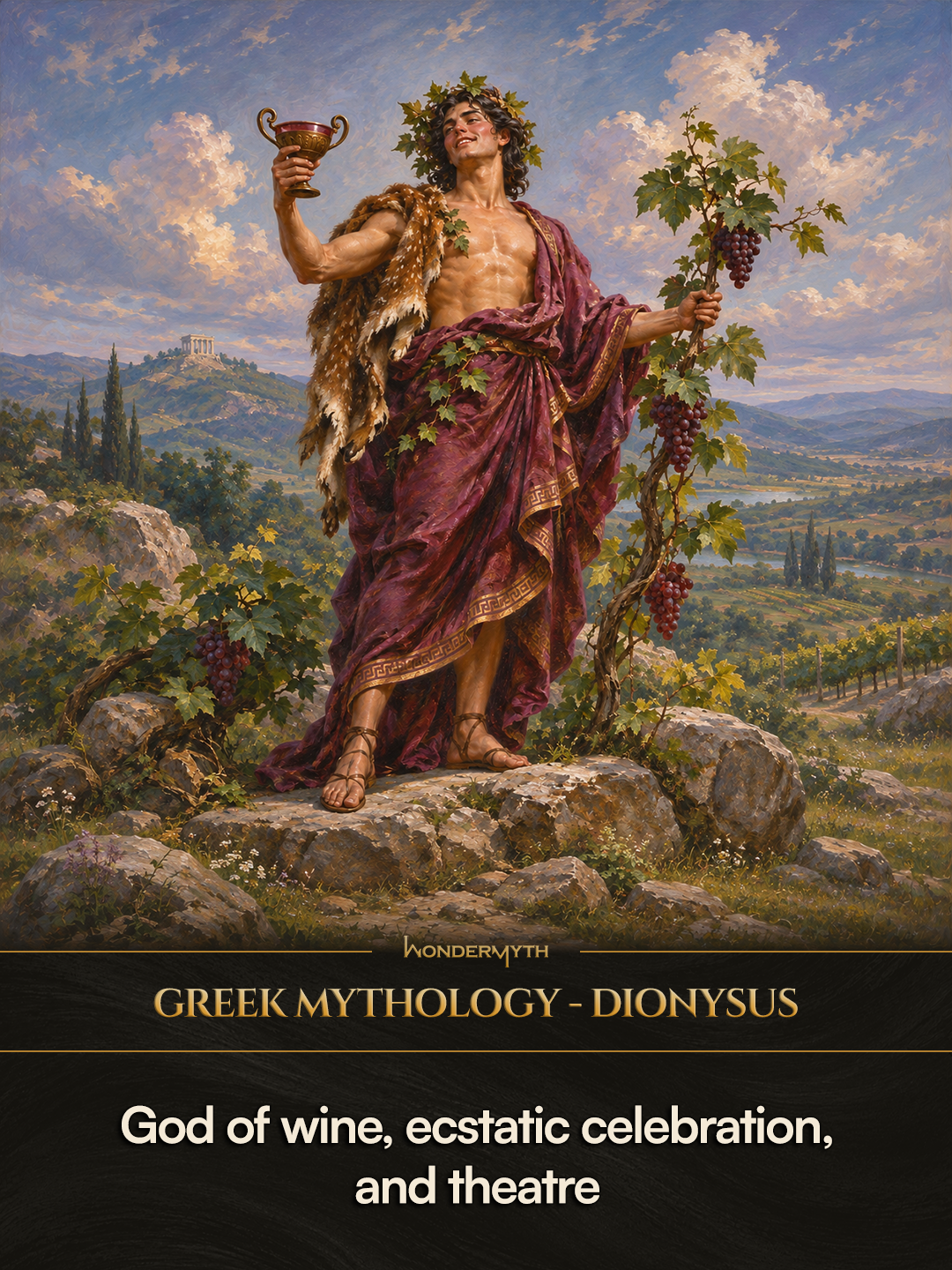
Greek artists represented Dionysus in different forms rather than with one fixed appearance. Older images often show him bearded, while later depictions frequently present a youthful, beardless god. On an Attic red-figure krater attributed to the Pan Painter, dating to about 470–460 BCE, Dionysus wears an ivy wreath and cloak beside a satyr carrying a drinking cup. Ivy, animal skins, and attendant figures are recurring features of Dionysian imagery.
Symbols
- Grapevines and grapes: His defining association with wine and the extraordinary growth of vegetation.
- Ivy: A recurring plant in Dionysian imagery, worn in wreaths and associated with his manifestations and followers.
- Thyrsus: A staff associated with Dionysian rites, commonly wrapped with ivy or other vegetation.
- Kantharos: A drinking cup frequently associated with Dionysus in ancient Greek art.
- Animal skins: Clothing associated with Dionysian worship and the appearance of Bacchic followers.
- Panther: A large feline closely associated with the god in ancient visual traditions, though not present in every depiction.
- Bull and lion: Animal forms or manifestations appearing in particular Dionysian myths rather than one permanent divine appearance.
Key Myths
Semele’s Death and the Twice-Born Dionysus
Hera deceived Semele into asking Zeus to appear before her as he did before Hera. Bound by his promise, Zeus came amid thunder and lightning, and Semele died. He rescued their unborn child, sewed him into his thigh, and later opened the stitches to bring Dionysus into the world. In Pseudo-Apollodorus’s account, Hermes then carried the child to Ino and Athamas for protection. Dionysus survived his mother’s death and received a second birth through his divine father.
Dionysus and Lycurgus
When Lycurgus attacked Dionysus’s nursing attendants with an ox-goad near Nysa, they scattered their ritual wands and fled. Dionysus himself became afraid and escaped into the sea, where Thetis sheltered him. Zeus punished Lycurgus by striking him blind, and the king did not live long afterward. In this early account from the Iliad, Dionysus survives through another deity’s protection, while the mortal who persecuted him suffers divine punishment.
Dionysus and the Pirates
Pirates seized Dionysus near the sea, believing they could sell him. Their attempts to bind him failed, and the helmsman warned that their captive was divine. The captain refused to listen. Wine flowed through the ship as vines and ivy spread over it, and Dionysus appeared as a terrifying lion, while a bear also manifested aboard. The lion seized the captain, and the remaining pirates leapt into the sea, where they became dolphins. Dionysus spared the helmsman who had recognized him.
Dionysus and the Destruction of Pentheus
Dionysus returned to Thebes in human disguise, where King Pentheus rejected his worship and tried to restrain him. The god escaped confinement and persuaded Pentheus to disguise himself as a woman to observe the frenzied Bacchic women on Mount Cithaeron. The women mistook him for a wild animal and tore him apart. His own mother, Agave, carried his severed head back to Thebes, believing it belonged to a lion. When she recognized her son, the destruction of Pentheus became a catastrophe for the royal family.
Dionysus and Ariadne
After Theseus brought Ariadne from Crete to Naxos, Dionysus took her away in a later mythographic account. Hesiod names Ariadne as Dionysus’s wife and says Zeus granted her immortality and freedom from aging for the god. Their union became an important divine marriage and established a family lineage in later traditions. Ancient accounts do not agree on Ariadne’s fate: the Odyssey preserves a different story in which Artemis kills her on Dia.
Dionysus Brings Semele from the Underworld
After surviving his mother’s death, Dionysus went into the underworld to bring her back. In Pseudo-Apollodorus’s account, he recovered Semele from Hades and ascended with her to heaven. She received the name Thyone and joined the immortals. The story gives Semele a different ending from her mortal death and connects Dionysus’s extraordinary birth with his power to restore his mother to the company of the gods.
Dionysus and Icarius
When Icarius welcomed Dionysus in Attica, the god gave him a vine and taught him to make wine. Icarius shared the drink with shepherds, who consumed it undiluted and became intoxicated. Believing he had poisoned them, they killed him. His dog Maera later led his daughter Erigone to his body, and she hanged herself in grief. The story turns Dionysus’s gift of wine into a tragedy caused by mortals misunderstanding its effects.
Worship & Ancient Impact
Dionysus received widespread worship in ancient Greece, with particularly well-documented festivals at Athens. The City Dionysia included religious processions, sacrifices, dithyrambic competitions, and performances of tragedy, comedy, and satyr plays. The Lenaia also became associated with dramatic competitions.
The Athenian Anthesteria celebrated new wine through ceremonies that included opening wine jars and communal drinking. Its rites also had associations with the dead. Dionysian worship varied between communities, and the extreme violence portrayed in myths and tragedies should not be mistaken for ordinary ritual practice throughout Greece.
Modern Influence
Dionysus became an important figure in modern philosophy, literature, and performance. Friedrich Nietzsche’s The Birth of Tragedy (1872) contrasted Apollonian and Dionysian artistic impulses, associating the latter with ecstatic experience and forces that challenge orderly boundaries. This was Nietzsche’s interpretation rather than a fixed doctrine shared by all ancient Greeks.
Richard Strauss’s opera Ariadne auf Naxos, first performed in 1912 and revised in 1916, gave Bacchus an important role in its reinterpretation of Ariadne’s story. Modern performances and adaptations of Euripides’ Bacchae also continue to revisit Dionysus’s confrontation with Pentheus and the destructive consequences of denying his divinity.
Free Mythic Guide to
Resourcefulness